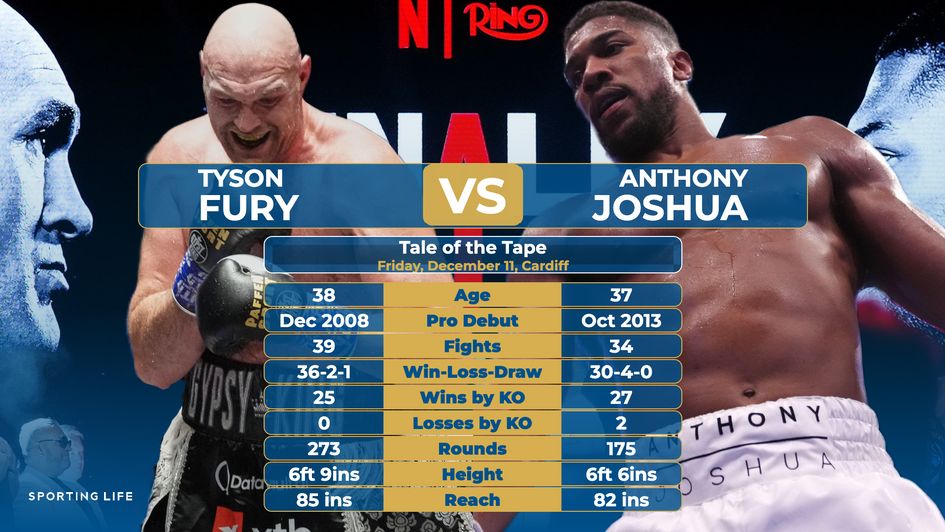
The wait for Tyson Fury vs Anthony Joshua is almost over but before the British heavyweight legends get inside the ring, we take a closer look at the tale of the tape and how their stats and careers compare.
From their contrasting routes to world titles to their knockout records and physical attributes, there are some fascinating differences between two of the biggest names in boxing.
Fury boasts advantages in height, reach and professional experience, while Joshua has a significantly higher knockout percentage. But which of those statistics could make the biggest difference when the British rivals finally meet?
Age: Similar age but career spans differ
- Tyson Fury: 38 years old | Anthony Joshua: 37 years old
Tyson Fury is just over a year older than Anthony Joshua at 38, but the two heavyweights began their professional careers almost five years apart.
Fury put the disappointment of missing out on fighting at the Beijing Olympics as an amateur by joining the professional ranks, where he marked his debut aged 20 with a first-round stoppage victory over Hungary's Bela Gyongyosi in Nottingham in December 2008.
Joshua's amateur career culminated in a headline-making Olympic super-heavyweight gold at London 2012 before making his paid debut aged 23 in October 2013 against Italy's Emanuele Leo at London's O2 Arena, winning with a first-round stoppage.
Despite Fury's considerable head start, it was Joshua who reached the summit of the sport more quickly.
Fury was 27 when he defeated Wladimir Klitschko on points in November 2015 to claim the WBA, IBF and WBO heavyweight titles in his 25th professional fight whereas Joshua was just 26 in April 2016 when he stopped Charles Martin in the second round of his 16th fight to become IBF heavyweight champion.
Both men are now approaching the latter stages of their careers, when reflexes, speed and recovery can become increasingly important.
However, with only 14 months separating them, age alone is unlikely to provide either fighter with a significant advantage.
Fights: Fury's fought more but is he more active?
- Tyson Fury: 39 fights | Anthony Joshua: 34 fights
Fury has contested five more professional fights than Joshua with 39, although that difference is relatively small considering he turned professional almost five years earlier.
Since making his debut in December 2008, Fury has averaged approximately 2.2 fights per year across a career spanning almost 18 years whereas Joshua has averaged around 2.6 fights per year since October 2013.
Those figures suggest Joshua has actually been the more active fighter relative to the length of his professional career.
However, we can't ignore that Fury spent more than two and a half years outside the ring following his victory over Klitschko in 2015, returning against Sefer Seferi in June 2018. His career has also featured further periods of inactivity and retirement announcements.
Joshua's career has generally followed a more consistent schedule, particularly during his rise through the heavyweight rankings and his first reign as world champion.
Overall, it's fair to say the quality of opposition, length of fights and experience in world championship contests are arguably more revealing than the number of appearances alone.
Fight records: Long unbeaten streaks ran out of steam
- Tyson Fury: 36-2-1 (25 KOs) | Anthony Joshua: 30-4-0 (27 KOs)
Both fighters built their reputations on lengthy unbeaten records before suffering defeats to some of the division's leading heavyweights.
Fury went unbeaten through his first 35 professional contests, recording 34 victories and one draw before Oleksandr Usyk inflicted the first defeat of his career in May 2024, and a second followed later that same year in their December rematch.
That sole draw of course came against Deontay Wilder in December 2018, when he famously climbed off the canvas 'Undertaker style' in the final round after appearing to have been knocked down cold.
Joshua won his first 22 professional contests before Andy Ruiz Jr stunned him with a seventh-round stoppage at Madison Square Garden in June 2019, although he avenged that defeat six months later via unanimous decision to regain his world titles.
Joshua subsequently suffered consecutive points defeats against Usyk in September 2021 and August 2022, while his fourth professional defeat came against Daniel Dubois at Wembley Stadium in September 2024, when he was knocked out in the fifth round.
Knockout power: Joshua doesn't hang around...even in defeat
- Tyson Fury 25 KO wins, 0 KO losses | Anthony Joshua 27 KOs wins, 2 KO losses
Despite suffering two knockout defeats compared to Fury's zero, Joshua has recorded more knockout victories than the Gypsy King in fewer fights, stopping 27 of his 30 victims inside the distance which represents a knockout-to-win percentage of 90%.
Fury's 25 stoppages come from 36 wins, which equates to a knockout-to-win percentage of 69.4%.
This reflects that Joshua has traditionally been a more explosive finisher, using his combination punching and powerful right hand to end contests before the final bell, while Fury has frequently relied on movement, distance management and tactical discipline to outbox opponents over longer periods.
That does not mean Fury lacks knockout power. His victories over Wilder in 2020 and 2021 demonstrated his ability to fight aggressively and wear down dangerous opponents.
As for knockout defeats, despite being sent to the canvas several times throughout his career, Fury has never lost a professional fight this way and that's a proud record he'll want to keep in tact.
Joshua, however, has suffered two defeats inside the distance, against Ruiz and Dubois, so some will argue his chin will be more vulnerable in Cardiff.
Rounds boxed: Tyson's been round and round in circles
- Tyson Fury: 273 rounds | Anthony Joshua: 175 rounds
One of the biggest differences in the tale of the tape concerns the amount of time each fighter has spent inside the ring.
Fury has boxed 273 professional rounds, compared with Joshua's 175 — a difference of 98 rounds.
That means Fury has completed approximately 56% more rounds across his professional career, averaging seven rounds per contest, compared with approximately 5.1 for Joshua.
The difference is partly explained by their respective knockout records, with Joshua ending all of his first 18 professional fights inside seven rounds and some plenty sooner.
His stunning 11th round stoppage of Wladimir Klitschko in his next fight at Wembley in April 2017 was the longest of his career and it wasn't until his 21st against Joseph Parker in March 2018 when he was finally taken to the judges scorecards.
Fury has been involved in more extended contests, including two of his three meetings with Deontay Wilder, his two defeats against Oleksandr Usyk and his famous 12-round victory over Klitschko.
But is having boxed more rounds an advantage? There are two ways of looking at this statistic.
On one hand, Fury has considerably more experience of managing fights over longer distances, adapting tactics and conserving energy in the championship rounds.
That could prove valuable if a meeting with Joshua develops into a tactical contest lasting beyond 10 rounds.
On the other hand, those additional rounds represent more time absorbing punches and enduring the physical demands of heavyweight boxing.
At 38, Fury's greater mileage could potentially count against him, particularly if Joshua is able to establish a fast pace.
Form guide: Rivals bouncing back after setbacks
Both fighters have experienced setbacks in recent years, most notably against Usyk, who defeated each man twice on points with boxing masterclasses to dominate the heavyweight division.
Fury returned from those 2024 setbacks this year with a unanimous decision victory over the durable Arslanbek Makhmudov in April before stopping Mariusz Wach in the seventh round of their contest in July.
Joshua rebuilt after his Usyk defeats with victories over Jermaine Franklin, Robert Helenius, Otto Wallin and former UFC star Francis Ngannou, only for Dubois to stop him in September 2024.
He subsequently returned to winning ways with stoppage victories over Jake Paul in December 2025 and Kristian Prenga in July 2026 - although neither triumph managed to silence anyone who thinks his best days are behind him.
Height: Does three inches really matter?
- Tyson Fury: 6ft 9ins | Anthony Joshua: 6ft 6ins
Both men are exceptionally tall heavyweights, but Fury enjoys a three-inch height advantage at 6ft 9ins and is among the tallest fighters to have held a major world heavyweight title.
Joshua is hardly small by heavyweight standards, but would nevertheless be the shorter man when he goes head-to-head with Fury.
Height can be an important factor in boxing because it allows a fighter to control distance, establish a jab and force opponents to punch upwards.
Fury has frequently used his size alongside surprisingly agile footwork to frustrate opponents and make himself a difficult target.
His victory over Klitschko demonstrated how effectively he can use movement and range to prevent an opponent from establishing a rhythm.
However, height is not necessarily an advantage in every exchange.
A shorter fighter who successfully closes the distance can attack the body, work inside and potentially exploit the taller boxer's greater difficulty in generating leverage at close range.
Joshua's challenge would be to get within punching distance without repeatedly walking onto Fury's jab.
The three-inch difference is significant, but Fury's ability to use his height effectively is likely to matter more than the measurement itself.
Reach: Does three inches really matter (part two)?
- Tyson Fury: 85 inches | Anthony Joshua: 82 inches
Fury also holds a three-inch advantage in reach, with an 85-inch measurement compared with Joshua's 82 inches.
Reach is the total length of a boxer's arms measured horizontally from the tip of one middle finger to the tip of the other, similar to a wingspan, and therefore also includes the width of the shoulders and chest.
That's why it's not to be mistaken with arm length, but still provides a useful indication of the distance from which a fighter may be able to land punches.
Fury's longer reach is notably longer than the average for a heavyweight - which is generally considered to be around 78-80 inches - so this should theoretically allow him to establish his jab from further away and make Joshua work harder to close the gap.
This could be particularly important during the early rounds, when both men are attempting to establish their preferred fighting distance.
If Fury can repeatedly land his jab while remaining outside Joshua's effective punching range, he could control the tempo and force his opponent to take greater risks.
Joshua, however, has the power to punish mistakes and has previously demonstrated his ability to stop taller or similarly sized opponents.
The key question is whether Joshua can move into range quickly enough to land meaningful combinations before Fury can retreat, clinch or change angles.
Fury's reach advantage is a genuine tactical asset, but not an insurmountable obstacle.
Boxing stance: Left feet mostly forward in Cardiff
- Tyson Fury: Orthodox / switch-hitter | Anthony Joshua: Orthodox
Both fighters are primarily orthodox boxers, meaning they generally stand with their left foot and left hand forward, keeping their stronger right hand behind them.
In an orthodox stance, the left hand is typically used for the jab, while the right hand provides the main straight power punch. When two orthodox fighters meet, their lead feet are positioned on the same side, creating a relatively conventional boxing matchup.
Unlike an orthodox-versus-southpaw contest, there is generally less emphasis on securing an outside lead-foot position to create angles for the rear hand. Instead, the battle often centres on the jab, distance management, head movement and the timing of right-hand counters.
Both fighters will be looking to establish their left jab while avoiding their opponent's straight right hand.
However, Fury possesses an additional tactical option as he's been known to regularly switch into a southpaw stance during fights, placing his right foot and right hand forward.
This can change the angles of attack, disrupt an opponent's timing and force adjustments in defensive positioning.
Fury used stance switching to good effect during his victory over Klitschko, helping to frustrate the long-reigning champion.
If Fury switches to southpaw, Joshua would suddenly face a different tactical challenge, particularly in the battle for lead-foot positioning and the angles available for straight punches.
That versatility could give Fury an additional weapon in a contest where both men are likely to be familiar with each other's conventional techniques.
Tyson Fury v Anthony Joshua: Who has the advantage?
This tale of the tape presents an intriguing contrast between two of Britain's most successful heavyweight boxers.
Fury holds the advantages in height, reach, professional fights and rounds boxed, while his ability to switch stances gives him an additional tactical dimension.
His record also highlights remarkable durability, having never been stopped despite facing some of the division's hardest punchers.
Joshua, meanwhile, boasts the superior knockout percentage and has recorded more stoppage victories despite contesting fewer fights.
That suggests he may represent the greater threat when opportunities arise to land powerful combinations.
If the contest becomes a long-range tactical battle, Fury's physical dimensions, movement and experience could prove decisive.
But if Joshua can close the distance and consistently land his most powerful punches, his knockout record suggests he has the tools to cause serious problems.
The statistics offer clues about how the fight might unfold, but as heavyweight boxing has repeatedly demonstrated, one punch can change everything.
Tyson Fury v Anthony Joshua: Big fight details
- When: Friday December 11, 2026. Main event starts approx 0200 GMT, Saturday December 12
- Where: Principality Stadium in Cardiff
- TV Channel: Netflix
- Records: Fury 36–2–1, 25 KOs. Joshua 22-1, 21 KOs
- Sky Bet odds: Fury 8/15, Joshua 8/5