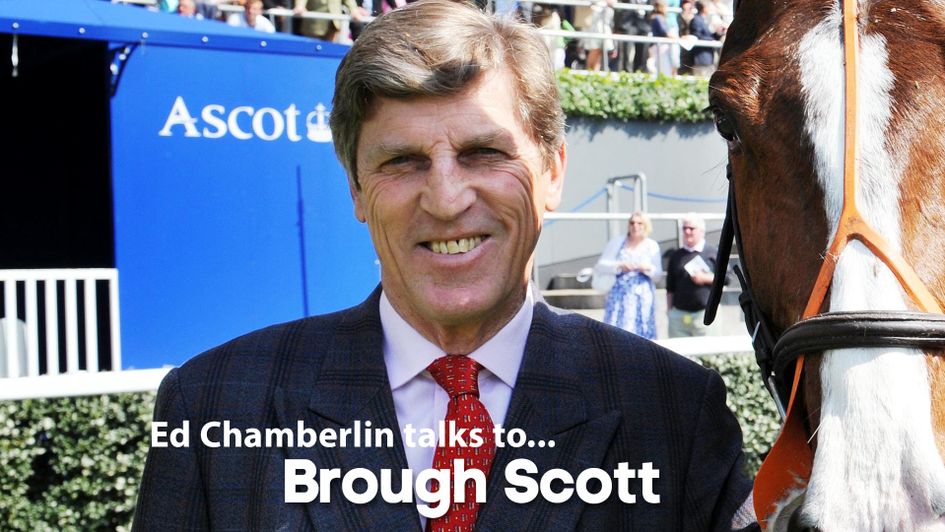
Our man talks at length to broadcaster, journalist and author Brough Scott about the challenges facing racing and much, much more.
The full interview is available as a podcast, read below for some of the Q&A highlights in text form.
Ed Chamberlin: How has lockdown been for you?
Brough Scott: It’s been inconvenient but not a hardship for me. I’m looking out at a nice garden with a couple of paddocks beyond. I’m very lucky. I’m 77 but pretty healthy and manage to go for a bike ride every day. I’m fine and it's me and my wife here but I miss my grandchildren very much but I have a book to write and plenty of things to catch up with.
I just feel for people in the wider communities, cities in particular. We’ve had 28,000 deaths from Covid-19 so far and over 24,000 have been in London. Can you imagine being there? On the tube and things? That must be very tough. I’ve been lucky along the way and I’m still lucky now but particularly in racing some of the older people I know, who aren’t in great shape, get trapped. And as they are in every walk of life that’s the worry.
EC: How tough is it going to be for the sport of racing coming out of the other side of this?
BS: I don’t think anyone really appreciates if the warnings are in any way right, how tough it’s going to be for the whole of society firstly. Racing depends on discretionary spend from the biggest investors which are owners and indeed after them punters. Both of them will feel the pinch in their pockets. Frankly even our hugely wealthy overseas investors will have question marks about their finances now. Even they have to be careful.
That’s why I think the stance racing takes in its attitude to it’s own and wider society is absolutely crucial. If it’s just seen as people indulging in rich men’s games then it doesn’t deserve any sympathy. On the other hand if it’s seen as a unit of British life which looks after it’s own, looks after animals, produces a very exciting activity that lots of people can get involved with at all sorts of different levels well then it has a very important place and a great chance of looking to the future and not the past.
The important thing is to look to the future. The fact is everyone now has to consign themselves to the past. Either you sit there and say everything was better in the old days and sit there moaning about it or you accept it’s going to be difficult but go forward and be positive. I’m a great believer in being an optimist. I was in South Africa just after Nelson Mandela was released and it was very tough. I was speaking to a chap who was running Scottsville Racecourse and I said to him ‘What’s the future like for you?’
He said. ‘Well in the situation I’m in where I can’t sell my house, the rand isn’t worth anything, I’ve got to be optimistic. I can’t afford to be pessimistic.’
And I don’t think racing can afford to be pessimistic now any more than society can. I think there are plenty of reasons to be optimistic too.
EC: Is it fair to say you’re clearly a great believer that public opinion is very important for our sport?
BS: Racing is part of British life but it’s there because it’s still in the sports pages, it’s there because it’s entertainment. I’m conscious that this is really an in-house broadcast and racing is a fantastic family but it tends to talk to itself a lot. If it is going to thrive it needs public opinion on its side and government support.
One thing I do know from being 97 years old is that the situation is completely different now. It doesn’t necessarily mean more gloomy but its different. I was at the Coronation Derby in 1953 and that autumn Winston Churchill, the Prime Minister, went to Doncaster for the St Leger because the Queen’s horse, Aureole, was favourite.
He went there deliberately to show her his vigorous support and underline how great it was. Nowadays the thought of a Prime Minister going to Doncaster to show ultimately how big a part of society he was is inconceivable. It seems to me most politicians now try to avoid going to the races.
Again back to the point its different and in danger of getting toxic. Cheltenham is a classic example of that. The idea that the Cheltenham racing authorities should have, midway through the Festival, gone against medical and government advice and cancelled is ludicrous.
If in hindsight you say there have been more infections in that area and it was already around so should it have taken place? Then probably not but you’re answering a different question and it wasn’t the reality at the time.
You might not approve seeing pictures from Cheltenham in the media and the likes of Piers Morgan saying it shouldn’t have taken place but that’s the attitude they’re going to take. Racing doesn’t need to be defensive but proactive and try to do its own job well. We shouldn’t look to apologise too much but need to look at how we’re perceived.
EC: Would you say the criticism Cheltenham received sums up the sport’s current popularity?
BS: It’s the reality and everyone should just calm down. 50 years ago was probably the last great peak of the modern era. A Wednesday Derby, Piggott, O’Brien and the new wonder horse Nijinsky who was not only unbeaten but unextended. It was much, much bigger than Frankel or Sea The Stars.
The two big sporting things events that summer were the World Cup which we thought we’d win in Mexico and went fairly close to doing so – and Nijinsky. He was a major story. When we had the wonderful time with Frankel, he never got anything like that. We only had three TV channels at the time of Nijinsky and you were talking about completely different types of numbers.
You can argue Piggott never won Sports Personality and the like but racing is an active minority and was a much, much bigger thing in British life then. It was virtually the only live sport on television, it was the biggest game in town. Go into any capital city in the world and what did they do? They built a racecourse. In Melbourne they built Flemington, America the likes of Belmont Park. If you now look along the lists of sports at the top of BBC Sport and racing is about 12th, it’s not number one and won’t be.
Someone came in a little while ago and said they were going to make racing as big as football. Well you're not. But you can still be vibrant, positive and most of all accessible. It’s greatest strapline was the ‘Sport of Kings’. That counts against it now as it’s not regarded as being a sport of the people.
But for me racing needs to realise where it is and not pretend it’s bigger than it is but also don't get sad and defensive and say it’s finished.
EC: You mentioned there the time when racing was the only sport on TV. Well there could be a time in the next few weeks’ where that’s again the case for a short spell. How big an opportunity is that?
BS: It’s absolutely massive and a wonderful opportunity which is exactly why racing needs to put to one side it’s perennial little internal squabbles which drive someone like me mad. It’s completely imbecilic to start saying ‘Sack Nick Rust’. You might have disagreements with some of the stances of the BHA but the way it came across was absolutely appalling. To the greater, wider world, racing is one thing. The fact it’s split into it’s various little units is an internal problem.
EC: To be fair to Ralph Beckett – he didn’t want that email to go public, with his views on Nick Rust and the rest. It was meant to be a private one?
BS: And that’s again internal squabbling coming to a head. I think it’s very unwise to say get rid now. What are you going to do? Who’s going to step in? How are you going to run it? There’s a process going on to recruit somebody and you’ve got a very capable chairman. The BHA is only one thing – and a lot of the things Mark Johnston was calling for were happening anyway. There’s an argument the BHA were being too cautious but at this stage everyone’s just got to try and put racing on the road and get racing ahead.
The last thing you want to do is give people a chance to say the sport is split and that’s what got me cross. I have a huge respect for all trainers but the most important thing racing needs to remind themselves is what unites them is infinitely more than divides them. I’ve spent a lot of time around the sport and its struck me how people are happy to squabble with each other rather than uniting against the basic tide which is sweeping away from them.
People say it’s all about punters or all about owners or all about trainers or all about the racecourses having more finance or we need a tote monopoly. People have to realise the racing landscape is three different things.
It's the ultimate athletic event, equine and human combined. It’s a betting game in the middle of that because that’s where most people access it from and the third deal is a social event.
EC: The new BHA CEO – how would you set about that role? Surely it’s an impossible job? How do you keep everyone happy?
BS: So far it’s proved impossible but it’s about racing being something that people from all parties can enjoy. The idea that the leading figures in government don’t want to come to the races because they think it’s toxic is something people need to think about very, very hard.
You’ve been to the racing lobby in parliament and they are very nice people but it’s still very limited. Somehow its when that gets stronger and people get more sympathetic then it will work but at the moment the structure doesn’t.
It can get along but when there’s pressure, when people are frustrated, you have to accept that the system doesn’t work. The worst thing about the CEO of the BHA is it isn’t what it sounds on the tin. The British Horseracing Authority don’t run the sport, they’re the regulatory authority. Government and people say why didn’t they do this or that? Well the racecourses are independent, trainers are virtually independent in many ways, its very difficult to try and organise them. The owners will tell you the biggest investors by miles and say we don’t want to do this or that and it’s very very difficult to handle.
More in the series
- Ed Chamberlin talks to... Pat Keogh
- Ed Chamberlin talks to... Ed Barrett
- Ed Chamberlin talks to... Cornelius Lysaght
- Ed Chamberlin talks to... Johnny Murtagh
- Ed Chamberlin talks to... William Haggas
- Ed Chamberlin talks to... William Derby
- Ed Chamberlin talks to... Dawn Goodfellow
- Ed Chamberlin talks to... Gordon Elliott
- Ed Chamberlin talks to... Lisa Hancock