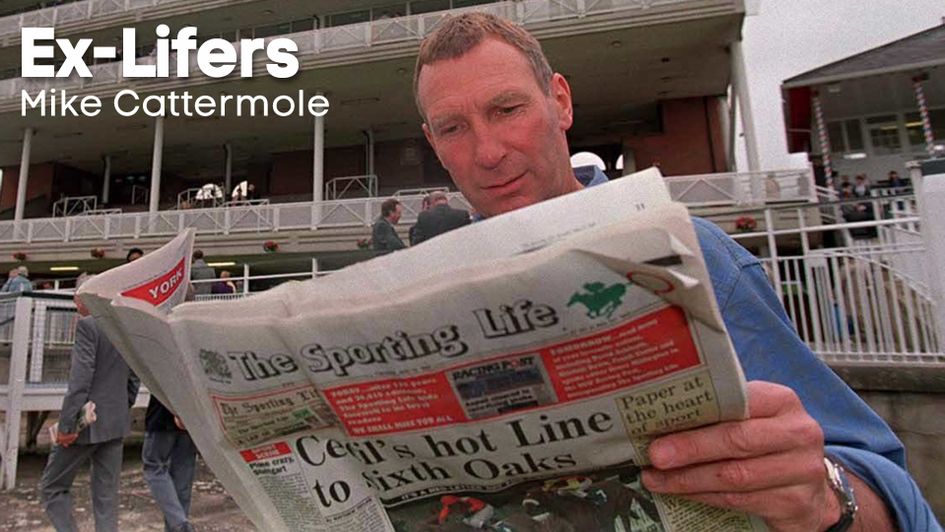
Mike Cattermole's series comes to a close with a fascinating edition with former Sporting Life newspaper editor Monty Court.
Monty Court was a much respected Fleet Street veteran when he was hand picked by then owner Robert Maxwell to lead The Sporting Life as editor against its new rival, the Racing Post.
Following five years on provincial newspapers, Court joined the Evening News, London, in 1953 as a reporter. A brief period on the News Chronicle was followed by nine years on the Daily Mail as reporter and finally News Editor. In 1965 came a switch to the Mirror Group as Investigations Editor and later News Editor of the Sunday Mirror. There, he got professionally involved with horse racing, the great love of his life, as racing editor and columnist.
Monty had declined earlier offers to edit the group’s Sporting Life until, in 1986, when the timing suited both parties. His five-year editorship not only went down very well with the staff, it was the most successful period in the Life’s 139-year history. He remained a columnist as long as the title lasted, with his weekly musings appearing as the "Court Circular".
Monty, now a sprightly 92, ends our mini-series of A Former Life.
When did you first become aware of The Sporting Life?
The Sporting Life was such an important part of my life for so long that it’s impossible to say when it first entered my consciousness.
What I do remember is that in my early days in Fleet Street, in the 1960s, when I was News Editor of The Daily Mail, it was a standing joke in the office that the most important paper on my desk every day was The Sporting Life.
But I suppose I first became aware of the massive part the paper played in the lives of the racing community a dozen years earlier when, as a reporter on The Evening Advertiser, Swindon, I started making friends and contacts in stables in the Lambourn area.
When and how did you join The Life?
Little did I know that almost 40 years after my Lambourn days, I would be writing a two-page typewritten memo to Robert Maxwell telling him how his legendary, but now sick and ailing paper could get off the sick bed to which it had been consigned by the outrageous behaviour of the print unions.
It wasn’t far off death's door and in no real state to fight off the challenge of the newly launched Racing Post, backed by Maktoum millions.
By that time I had acquired a fair bit of know-how after almost 40 years in Fleet Street as reporter, feature-writer, investigations editor and racing editor on half a dozen different titles. And George White had suggested to Maxwell that I could be the man to bring the paper back.
In truth I had been approached about the job some three years earlier by the old Mirror management, but the print unions were at the height of their evil powers and the editorial staff were beginning to lose heart. I certainly didn’t fancy being tossed into that kind of bloody turmoil by weak management.
What plans did you have for The Life?
What really saddened me about the state of The Life was that after years of desperate treatment it had appeared to have lost its will and lost its way. On the days when it did appear (and that was no guarantee) it certainly did not look like the authoritative voice of 'The Sport of Kings'. On a dull day the splash story on page one might often be the greyhound editor’s fancy for a £40 race at Harringay, or wherever.
It wasn’t punching its weight in any department. Page two was totally given over to what was called a marker sheet, so that betting shop managers could keep their own records. Page three was often devoted to a full-page advertisement for a stud. Where did the action start?
But all was not lost. With the unions finally tamed by Rupert Murdoch and Maxwell, the future looked brighter. It was a time for making plans: a proper news service, good big pictures that captured the excitement of the world’s greatest sport; campaigns for improvements on a variety of fronts – and top of my list, racing colours for every published race programme. That was my big dream. And in fairness to Maxwell, he bought into it.
Early memories....
The thing that struck me most on my first day in the office was the enthusiasm of everyone – and the spirit to get stuck in. Indeed I felt something of a heel when Noel Blunt, the Chief-Sub-Editor asked: ”What times the conference?” I replied: ”There will be no conference”, for I knew that what the paper needed wasn’t going to be solved by people sitting round a table. Indeed, I found over the years, the worst newspapers have the most conferences.
Another fond memory is of the excellent office manager, Carolyn Cluskey, drawing me a plan of the editorial floor showing who sat where. If I poked my head out of my office door and called someone’s name I was totally snookered if they’d changed places.
Funny/Happy moments?
Soon the office had a buzz about it. Everyone got behind the concept of a more newsy, positive paper.
Jeremy Chapman drew schemes for excellent pages – and the reporting team led by Mark Popham, Sue Montgomery, Jon Freeman produced good copy and readable, campaigns.
The outside staff led by Geoff Lester filed colourful copy from the courses, and the features department led by the hugely talented Alastair Down produced provocative features in pages which also carried contributions from Weekender staff like Simon Holt and Mike Cattermole. Within a week or two the paper was unrecognisable. And so were the sales figures, showing we were outselling the Racing Post by at least two-to-one; often much more.
Any doubts about us being on the right track were banished when my old friend, trainer Guy Harwood, called me: ”You bastard! I’ve been meaning to cancel that paper of yours for three years. Now I can’t”.
The biggest names were pleased to feature in our pages, with interviews with Princess Anne and campaigning features by The Duchess of Bedford and leading trainers like Tom Jones. But my feet were kept firmly on the ground with occasional fiery meetings with Maxwell to prevent some unworkable and inappropriate ideas getting into the paper.
The best thing about those days?
Possibly the most satisfying feature of The Life’s great fight back was that it was not achieved by mass firings and hirings. The staff who had suffered so much frustration in previous regimes, happily responded to the ideas of the old hack who’d been round the block a few times. All of which made the job of negotiating an across-the-card pay rise much easier.
The mood in the office was marvellous – and the only blood being spilt was on the floor of The Racing Post, where an editor and various executives either quit or were fired.
Then came the big moment, when after months of research and effort, we were ready to print the racing colours. It was the only time I can remember Maxwell bubbling with excitement as he looked over the page proofs I placed on his desk.
And when he asked who we would use for the TV commercials, I couldn’t resist the mischief of suggesting John Francome, who was the star figure in Brough Scott’s Channel Four Racing Team; for Brough was the architect behind the launch of the Racing Post, and who had sold the idea to Sheikh Mohammed.
But the moment that crowned all was the arrival of a post-card bearing just one laboriously penned word “Excellent”, from my old friend, the paralysed but still brilliant racehorse trainer Dick Hern.
What happened next…
In the best fairy stories, that should have been the end of the story. I had reached the end of my five-year agreement with Maxwell. The Life was outselling The Post and outscoring it on an almost daily basis. And I was ready to ride off into the sunset.
Sadly, it was the start of another episode. A bewildering series of extraordinary management decisions over the years led, ultimately, to the Racing Post being sold to the Mirror Group for £1 by Sheikh Mohammed.
I suppose, after the countless millions he had pumped into the paper he wouldn’t have been human if he hadn’t insisted that it should survive as the main racing paper.
But that’s life – and sadly it was the end of The Sporting Life after 139 turbulent years.