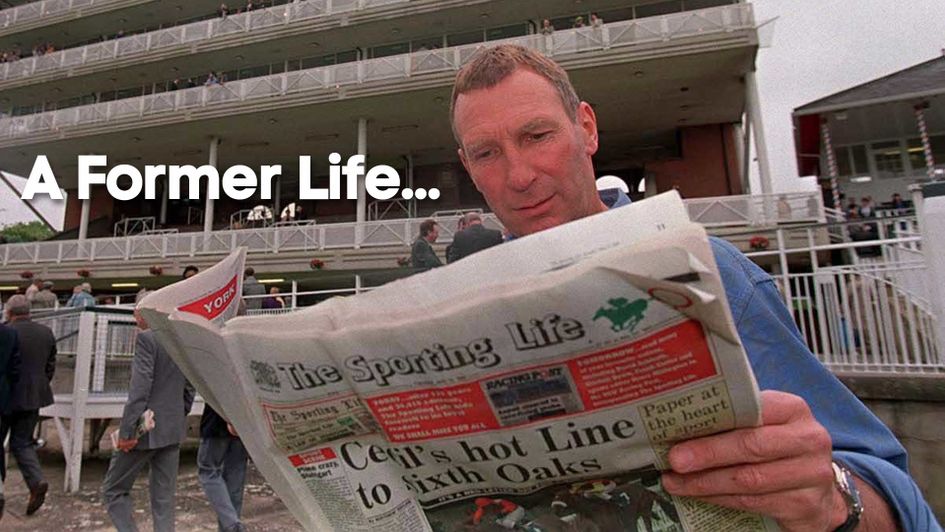
Mike Cattermole's series continues as he catches up with current columnist and top commentator Simon Holt about his time in the Sporting Life paper.
Simon Holt joined The Sporting Life family at the end of 1985, having begun his journalistic career at Superform.
After starting with The Weekender, he later joined the main daily paper, reporting, feature writing and even compiling a weekly column, all while developing a new and highly successful commentating career which took him all over the country.
Indeed both as a racecourse caller and then for many years as senior commentator at C4 Racing, few can boast as an illustrious big-race CV as 'the languid one'.
1. When did you first become aware of The Sporting Life?
I read The Sporting Life from a very young age, usually buying it on Saturdays to study the form and have a few (illegal) bets on the ITV Seven.
I would lay the paper out on a table in the lounge and hog the TV from the beginning to the end of the racing coverage much to the annoyance of my father who wasn't very interested in horse racing. Fortunately, I had a next-door neighbour who was a very keen punter, and he would put some bets on for me at the betting shop.
2. When did you join The Life and what was your first job?
I joined The Life, or the Sporting Life Weekender to be exact, on December 1, 1985.
I've always remembered the date as it was a dream come true to work there. With the Racing Post about to be launched, the number of jobs in racing journalism doubled so I was in the right place at the right time, and had some experience to draw upon having worked for Superform in my home town of Shoreham-by-Sea for a couple of years and then written form guides for racecards under the name of Racegoers Form Services.
The job on the Weekender involved just a three-day week from Sunday to Tuesday and, along with other newcomers Mike Cattermole, Tony Elves and Phill Lamphee, we would do a bit of everything, writing tipping pieces, sub-editing and taking it in turns to go out and interview trainers for the 'Straight From The Stable' feature.
The Life office was a bit of a culture shock as the levels of drinking and smoking were something I wasn't used to and, after three weeks, I was putting on weight and developing a beer belly. But I enjoyed the atmosphere of everyone being united by an enthusiasm for racing, and often it was terrific fun.
3. Did you have ambitions to stay there and climb the ladder?
I was 21 when joining The Life and had lots of drive and energy. Gradually, I was sent off to write features on racing personalities for the main paper itself, while still working on the Weekender, and in due course became an outside reporter (a job I loved) and wrote a weekly column. Yes, I was always keen to take on new challenges and, although I started as a commentator in 1988, journalism was my priority.
4. Any memories that stand out about experiences, personalities and/or stories of the time?
There were many different characters on the Life and I think Mike has already written about the chief sub Noel Blunt - blunt by name, blunt by nature - and his malapropisms such as "We'll cross that bridge when it arrives." Noel once wrote a headline: "(Name of Horse) To Scale The Heights in the Eider" and I often wondered when he passed away if he still thought the famous mountain was called the Eider.
Unfortunately, many of the journalists - particularly those who tipped under the pseudonym of 'Man On The Spot' - had quite unhealthy habits and I was often surprised to see them rolling back from the pub mid-afternoon to begin writing their copy.
We started out on typewriters but, when computers were introduced, the phrase "screen break" became a euphemism for seeking some liquid refreshment.
Shortly after joining the Weekender, Monty Court became Life Editor and he sent me off to Guy Harwood's yard during the 1986 Flat season which will be best remembered for Dancing Brave's exploits, his controversial defeat in the Derby and a magnificent victory in the Arc. At the end of the season, I joined Monty in another visit to Pulborough, interviewing all the members of staff who had been involved with the great horse after which the paper printed a full page tribute.
5. Any funny moments you can recall?
When working as an outside reporter, I could have some very busy days especially if I was also commentating at the meeting.
There were days when I performed three roles: commentating, producing 'close-up' comments on how each horse had performed and a report. The paper's senior reporter Geoff Lester also compiled the course roster and did his best to fit in with my commentating duties. It was very good of him.
Unlike the Racing Post, the Life allowed plenty of space for race-meeting reports and invariably one would be asked to produce "24 and 8", in other words a 24-paragraph main piece and an eight-para supplementary. Sometimes, with only six races on the card at the Midlands courses where I often worked, it was difficult to believe how the space could be filled. But there was always something to write about, getting bits of news from trainers and often some sort of drama to report.
In those days, we worked on very rudimentary word processors which could break down, and the close-up comments still had to be dictated to copy-takers over the phone which could be time consuming. Often, I found myself falling off the pace and would be the last to leave the racecourse. On two occasions, at Bangor and Worcester, I had been forgotten and was forced to find a way to escape in the dark.
To give you an idea of how long ago all this took place, it was a basic requirement to make a check call to the chief sub on the way home and this entailed finding a telephone box.
6. Any stories or tips that you are particularly proud of? Or not!
There was one incident I reported on at Wolverhampton when the winner of the seller was placed up for auction. In the corner, a roughly dressed old man carrying a plastic supermarket carrier bag started bidding, and the auctioneer Nick Lees kept asking him if he was being serious. Several racegoers began to laugh as the auction continued, and the man got the final bid much to Nick's obvious concern. But it turned out he had the money, all stuffed into his plastic bag.
7. What was the best thing about working for The Life?
I was proud to work for such a historic newspaper. There was a bit of kudos I thought in being involved right at the centre of the sport, meeting and speaking to all sorts of racing personalities. Over time, one was able to build up plenty of contacts which is so important for any journalist and it was particularly enjoyable to meet people I had long admired.
Responsible gambling
We are committed in our support of responsible gambling. Recommended bets are advised to over-18s and we strongly encourage readers to wager only what they can afford to lose.
Sky Bet's responsible gambling tools are detailed here and if you are concerned about your gambling, please call the National Gambling Helpline on 0808 8020 133, or visit begambleaware.org.
Further support and information can be found at GamCare and gamblingtherapy.org.