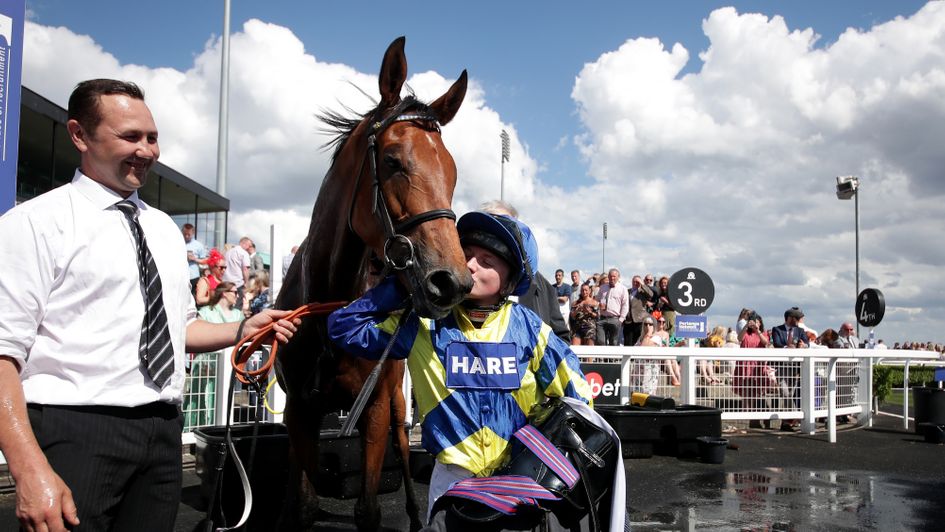
After Trueshan's remarkable effort to win the Northumberland Plate under 10-8, John Ingles looks at other notable handicap performances on the Flat.
‘That’ll blow a fuse in the computer!’
Technology has moved on a good deal since the 1970s when that quote was uttered – we’ll come to who said it and in what circumstances later – but, metaphorically at least, Trueshan’s extraordinary performance in winning the Northumberland Plate under 10-8 has to go down as another ‘fuse-blowing’ performance.
Running from a BHA mark of 120, the Alan King-trained six-year-old was conceding between 19 lb and 30 lb to his 19 rivals but justified favouritism under Hollie Doyle when getting up by half a length to beat Spirit Mixer who was in receipt of fully two stone, taking the 5 lb claim of the runner-up’s jockey into account.
That bettered Trueshan’s valiant effort in defeat in the same race twelve months earlier which was itself noteworthy enough when he’d carried 10-4 (minus Rhys Clutterbuck’s 5 lb claim) into sixth place from a BHA mark of 118, coming out the best horse at the weights.

Unlimited Replays
of all UK and Irish races with our Race Replays
Discover Sporting Life Plus Benefits

How was Trueshan able to defy the assessor?
It has taken a special set of circumstances for Trueshan to perform his heroics at Newcastle. He has won two Group 1 contests, the Goodwood Cup and Prix du Cadran, in between contesting the last couple of Northumberland Plates and, by rights, should have lined up for the last couple of Gold Cups at Royal Ascot but ground conditions – he has never run on going firmer than good on turf – have prevented him from doing so.
Now run on the artificial tapeta surface, there are no worries for Trueshan as far as underfoot conditions are concerned in the Northumberland Plate, unlike most Flat handicaps there is no ceiling to the weights, and a first prize of £81,000 made it an attractive consolation for having to miss Ascot again. That just left the small matter of having to give lumps of weight away all round, but all credit to Alan King and Trueshan’s owners for not letting that dissuade them from taking their chance.
Timeform’s digital base – which remains fully functioning despite Trueshan’s performance – goes back to 1994 and shows that he has defied much the highest BHA/Turf Club rating in a Flat handicap in that time. Out of the many thousands of horses that have run in handicaps on the Flat in Britain and Ireland in that period, only 26 had previously won from marks of 110 or higher.
Where does this performance stand?
The previous highest BHA rating from which a horse had been successful on the Flat was 115. That was the John Ryan-trained Ocean Tempest who won a handicap at Chester from that mark in 2014, having won the Lincoln earlier that year. Allotted 10-1 at Chester, apprentice Joe Doyle took 5 lb off his back.
The horse with the highest BHA mark before Trueshan to win a staying handicap this century was Rainbow High in the 2001 Chester Cup. Trained by Barry Hills, Rainbow High was a race regular, running in four Chester Cups. First successful from a BHA mark of 103 in 1999, he defied a 10 lb higher mark two years later when carrying 9-13 to victory and was a valiant second from the same mark and under the same weight in 2002. Those last two runs were the best performances of his career, earning him a Timeform rating of 121.
It has often been sprinters rather than stayers who have put up some of the best performances in handicaps. Rohaan won his second Wokingham at Royal Ascot recently under top weight of 9-12 from a BHA mark of 109. However, although he’d carried less weight (9-8) as a three-year-old the year before, he was running off a higher BHA mark of 112 on that occasion.
The last horse to run in a handicap on the Flat from a similar mark to the one Trueshan has had in the last couple of Northumberland Plates was the Amanda Perrett-trained Tillerman. He ran from a BHA mark of 119, carrying 9-11, when mid-division in one of Ascot’s valuable seven-furlong handicaps, the Tote International Stakes in 2002. However, in his two previous attempts in the same race, Tillerman recorded the best performance of the year in a handicap when running to 121 both times. He won the International in 2000 from a mark of 103 and then finished a close and unlucky third from 110 a year later.
Timeform’s Racehorses acknowledged the year’s best performance in a handicap on its Timeform Champions page from 1994 until the final edition of the annual in 2019. Trueshan’s provisional Timeform rating of 131 from the Northumberland Plate trumps the highest rating from that particular period which was achieved by the Mick Easterby-trained sprinter Hoof It who ran to 128 when winning the Stewards’ Cup in 2011.
A win under top weight in the Sky Bet Dash at York the week before earned Hoof It a 6 lb penalty for Goodwood where he was effectively running from a BHA mark of 111. But Hoof It made a mockery of his burden of 10-0, coasting home by two and a half lengths and setting a new weight-carrying record for the race. He confirmed himself a high-class sprinter later that season when beaten just a nose and a head into third behind Dream Ahead and Bated Breath in the Sprint Cup at Haydock.

As far as performances in a staying handicap are concerned, you probably have to go back to the 1950s to find efforts on a par with Trueshan’s. Gladness and Primera, both rated 131, won consecutive editions of the Ebor under the late Lester Piggott in 1958 and 1959. The Vincent O’Brien-trained mare Gladness had already won the Gold Cup and Goodwood Cup when running away with the Ebor under a then-record weight of 9-7 by six lengths, conceding 29 lb to runner-up Woodside Terrace.
‘This was a most impressive performance indeed’, said Racehorses, ‘and deserves to rank with the greatest handicap achievements in racing history.’ A year later it was Primera’s turn to impress: ‘If any horse can be said to outclass a handicap field like that which turned out for the Ebor, then surely Primera merits that distinction, since he carried 9-0, and won without really being off the bit.’ He finished a close-up fifth in the Arc on his next start.
Who else has shone under welter burdens?
The weight-carrying record set by Gladness in the Ebor was eventually broken by Sea Pigeon who carried 10-0 to victory in 1979 under regular his regular partner over hurdles Jonjo O’Neill. It was desperately close, though, with O’Neill dropping his hands in the final strides and having only a short-head to spare over Donegal Prince who was in receipt of 40 lb, including his rider’s allowance. While a better horse over hurdles, Sea Pigeon was nonetheless rated 123 at his best on the Flat, though by the time he won the Ebor the big Flat handicaps had competition from pattern races which tended to attract the best horses.
Another top staying handicapper from the 1970s was John Cherry (rated 125). Later a dual winner of the Queen Alexandra Stakes (which had been plan B for Trueshan this year if the rain had come in time at Ascot), John Cherry carried top weight to victory in effortless fashion – under Piggott again – in both the Chester Cup and Cesarewitch of 1976, winning the latter by five lengths under a race record weight of 9-13.
So what about the horse whose handicap performance was reckoned to have ‘blown a fuse in the computer’? That remark came from the trainer of Roman Warrior, Nigel Angus, after his strapping sprinter won the Canada Dry Shield Handicap at Ayr for the second successive year in July 1975. A 6 lb penalty for winning Newcastle’s Gosforth Park Cup the previous month took Roman Warrior’s burden at Ayr to 10-6. But conceding upwards of 16 lb to his nine rivals, Roman Warrior won easily by three lengths giving 23 lb to runner-up Blue Star who was rated 116 in that year’s Racehorses and went on to win the Great St Wilfrid at Ripon.
According to Timeform’s handicappers, that was an even better performance than Roman Warrior’s subsequent victory in that year’s Ayr Gold Cup where he carried a record weight to victory of 10-0, holding on by a short head from the Stewards Cup winner Import with the pair split by the width of the track. Roman Warrior, whose other claim to fame is that he remains the last Scottish-trained winner of the Ayr Gold Cup, went on to dead-heat with the high-class three-year-old filly Swingtime in the Diadem Stakes at Ascot later in the season.
Describing him as ‘a horse to break the handicapper’s heart’ and ‘a colossus of a horse with a heart to match’, Timeform awarded Roman Warrior a rating of 132 in Racehorses of 1975. Having carried still more weight to victory at Newcastle on Saturday, Trueshan’s performance almost certainly rates as the best seen in a Flat handicap in Britain since.
More from Sporting Life
- Racecards
- Fast results
- Full results and free video replays
- Horse racing news
- Horse racing tips
- Horse racing features
- Download our free iOS and Android app
- Football and other sports tips
- Podcasts and video content
Safer gambling
We are committed in our support of safer gambling. Recommended bets are advised to over-18s and we strongly encourage readers to wager only what they can afford to lose.
If you are concerned about your gambling, please call the National Gambling Helpline / GamCare on 0808 8020 133.
Further support and information can be found at begambleaware.org and gamblingtherapy.org.