Where do you start with a race that throws up as many compelling questions as the 2022 Randox Grand National?
Who in the world writes Sam Waley-Cohen’s scripts?
Are Aintree trends worth a dime after victory for a seven-year-old novice who only came out of bumpers just over a year ago?
How long did it take 71-year-old Ted Walsh to think 'that might be my last chance of another National' after watching the gallant Any Second Now come up just short behind Noble Yeats?
How the hell did Matt ‘The Brock’ Brocklebank tip the 50/1 winner when we all knew another son of Yeats – namely Longhouse Poet – was the one to be on?
What must UK trainers do to get back in the National game after Ireland dominated again with the first three home and seven of the first nine?
Will the whip debate ever subside after the winning rider incurred a nine-day ban (on the final ride of his career) while Mark Walsh followed the rules on the runner-up?
Is it time to make further alterations to the National after two of the 40 horses who set out at just after 5.15 on Saturday failed to make it home?
Or is it time to rally round the modern National flag in the face of renewed scrutiny and criticism of the world’s most famous steeplechase?

Unlimited Replays
of all UK and Irish races with our Race Replays
Discover Sporting Life Plus Benefits

Mixed messaging a recipe for problems
We are very sad to report that having sustained a traumatic head injury in yesterdays Grand National, Eclair Surf lost his fight this morning. (1/2) pic.twitter.com/wCAeN35Dr4
— Emma Lavelle (@ELavelleracing) April 10, 2022
It’s important to separate heat from light in the aftermath of turbulent days such as Saturday but some don’t have the luxury of a few days to assess the overall picture.
Step forward the Aintree communications team and various respected media bods.
Under-fire public figures have been known to whisper about being home free if they can get through two stormy news cycles without sustaining serious damage.
Aintree’s comms team were operating in a much narrower window as they updated viewers and listeners on Saturday evening and you don’t need to be the world’s greatest cynic to wonder about the wording of a preliminary update which began with “all horses are back in the stables” and continued with a reference to “no fatalities.”
The same cynic might suggest that update masked the fact that two horses were already in major strife; he or she might also wonder why the ITV bulletin seemed to contain more up-to-date detail than the one on RTV; but the bottom line is that Discorama and Eclair Surf had to be euthanised after Saturday’s race.
And two fatalities in a National, as when Gold Cup hero Synchronised and popular northern stayer According To Pete died in 2012, means that calls for change are sure to follow.
Change back on the menu
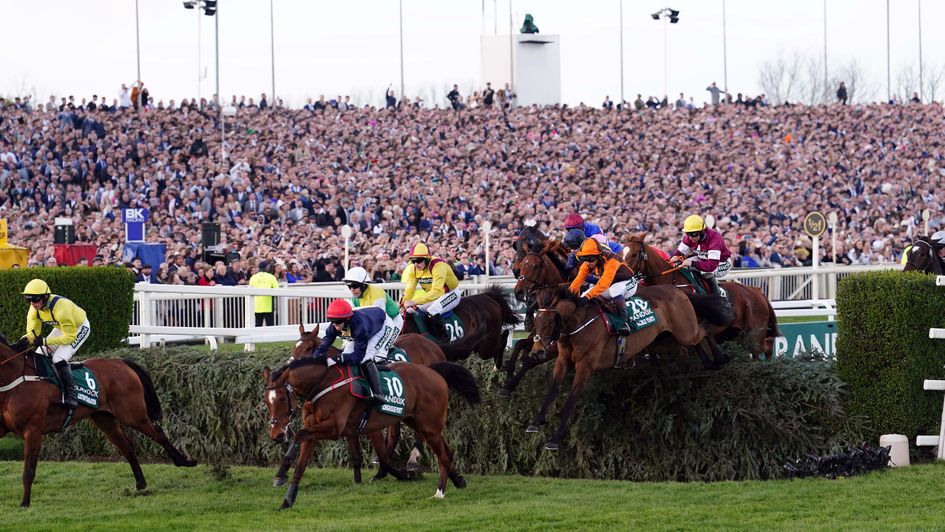
My memory is hazy but I recall being interviewed by Sky’s Nick Powell on that bleak day and saying something akin to “how do you go home and explain to your family that the National is a fair test nowadays?"
Aintree clearly shared those concerns – as they made radical changes to the National fences soon after – but further change is now desirable according to several seasoned observers.
Dave Yates of the Mirror, a friend and colleague through four decades, told the Nick Luck Daily that the speed of the race could be reduced by “looking at the size of the fences and making them a little bit bigger."
Newsboy’s admission that such a move would be “a difficult one to package in terms of the non-racing public” will take some beating in the Understatement of the Year Handicap.
And, although this year’s race was run at a severe gallop, detailed research by ATR’s Simon Rowlands reveals that the pace to halfway in modern Nationals tends to be only fractionally faster than when the fences were infinitely taller and stiffer.
The RP’s Lee Mottershead warned against kneejerk reactions but suggested “there may be some justification in examining whether the 40-runner field size is excessive,” while Rob Wright of The Times wondered what level of risk the public will accept before arguing that “a cut to a maximum of 30 would retain the spectacle while reducing the chaos."
The one sure thing about this year’s National debate is that the conversation will move on to the Classics and Punchestown well before two news cycles are complete. Look at your papers and websites - it already has.
But Wright touched on a crucial point in referring to the level of risk that the wider public are comfortable with.
That level clearly varies considerably from person to person – and I’m not sure I will like all my allies in typing this – but at this point I stand right behind maintaining the Grand National in its current form.
And the reason for this is because I’m leaning hard on what has happened during the ten years since 2012 as opposed to ten minutes of frenetic drama in Liverpool 9 on Saturday.
Decade of data should drive what comes next
Yes, there is something crude and uncomfortable about going comparison shopping on equine deaths but that key metric is what will determine the future of the National.
And that metric – along with several others – provides a telling counterpoint to the call for further changes.
It’s a matter of record that eleven horses died in the National between 2002 and 2012, while four died in the period from then until 2022.
The fact that two of those four came on Saturday was always going to prompt a prisoner-of-the-moment reaction but we now have a decade of data to show that National runners are almost half as likely to fall and twice as likely to be pulled up than in the pre-2012 era. Those trends are significant. Very significant.
Only three horses fell on Saturday compared to eleven in 2012. The nine who unseated did more damage to the pride of their riders than to themselves and, with six casualty-free years in the last ten, the first decade of the so-called Synthetic National has been safer than any other since detailed records started being kept more than half a century ago.
BHA director of health and welfare James Given will doubtless weigh all this data and much more as he continues an “ever-evolving commitment” to safety but he and the rest of us need to take the long view as the National enters its second synthetic decade.
Maye that will involve a reduction in field size, though I’m far from convinced that a 30-runner National would have helped Discorama and Eclair Surf save for the fact that the latter wouldn’t have made the cut to run in the race.

That aside, the stark question for hardened devotees and once-a-year fans alike is as follows: Are you prepared to give your continued support to a uniquely demanding race in which a fatality is currently just a shade of odds against each year?
Saturday’s ITV viewing figures suggest the post-pandemic National isn’t resonating with a fair chunk of the wider public, though it will take much more than a drop from 8.8m to 7.5m to persuade some starry-eyed scribes there is anything to fret about.
But, as previously stated, this is strictly an individual matter.
Society is polarised like never before on a range of crucial matters – and I don’t expect everyone who reads this piece to agree with it - but the facts don’t support a case for radical change to a race that can never be fully vaccinated against danger.
Like many an ageing star, the National opted for a significant facelift to remain relevant and popular with the viewing public back in 2012. Its seductive charms may be less obvious to some nowadays but there isn’t enough evidence to suggest further surgery is essential.
Not yet, at any rate.
More from Sporting Life
- Racecards
- Fast results
- Full results and free video replays
- Horse racing news
- Horse racing tips
- Horse racing features
- Download our free iOS and Android app
- Football and other sports tips
- Podcasts and video content
Safer gambling
We are committed in our support of safer gambling. Recommended bets are advised to over-18s and we strongly encourage readers to wager only what they can afford to lose.
If you are concerned about your gambling, please call the National Gambling Helpline / GamCare on 0808 8020 133.
Further support and information can be found at begambleaware.org and gamblingtherapy.org.