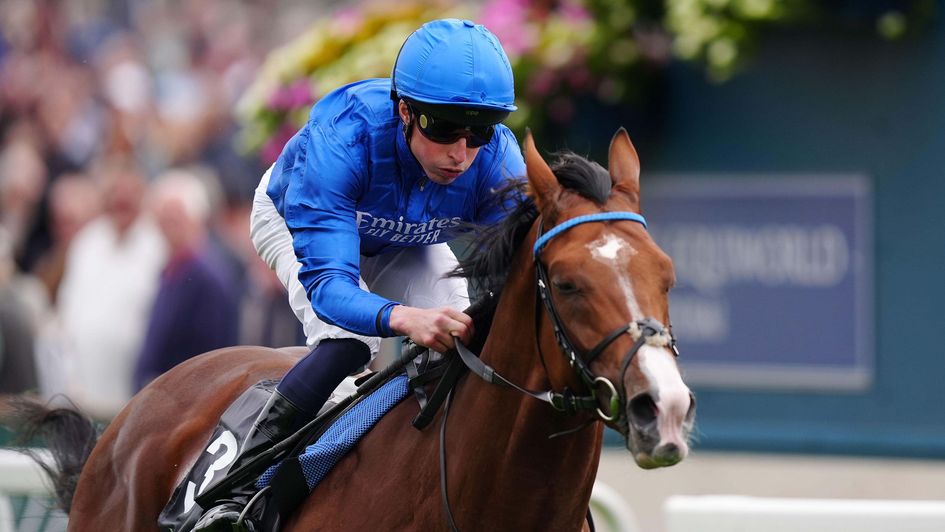
With Ombudsman bidding to repeat last year's Juddmonte International victory next week, John Ingles looks at the race's three dual winners.
Next Wednesday at York, Ombudsman will bid to win a fifth Juddmonte International for the Gosden stable. John Gosden won it for the first time as the sole licence holder with Roaring Lion in 2018, since when, in partnership with son Thady, York’s richest race of the season has gone back to Clarehaven thanks to Mishriff in 2021, Mostahadaf in 2023 and Ombudsman himself last year.
A second win for the now five-year-old Ombudsman would put him in select company as only three horses so far – the last thirty years ago – have managed to win two editions of the race which started out as the Benson & Hedges Gold Cup in 1972.
It wasn’t long after that that the race had its first dual winner, with the top-class French mare Dahlia winning under Lester Piggott in 1974 and 1975. Trained by Maurice Zilber, Dahlia was already well known to English racegoers by the time she first ran at York as a four-year-old. In fact, in an era when European horses weren’t campaigned as globally as they are now, Dahlia was unusually widely travelled.
Her six wins from ten starts as a three-year-old included the Irish Oaks, the King George VI and Queen Elizabeth Stakes and the Washington International, North America’s most important international turf race in the era before the Breeders’ Cup. By the time she went to York the following year, she had already won that season’s Grand Prix de Saint-Cloud and repeated her win at Ascot, becoming the first horse of either sex to win the King George twice.
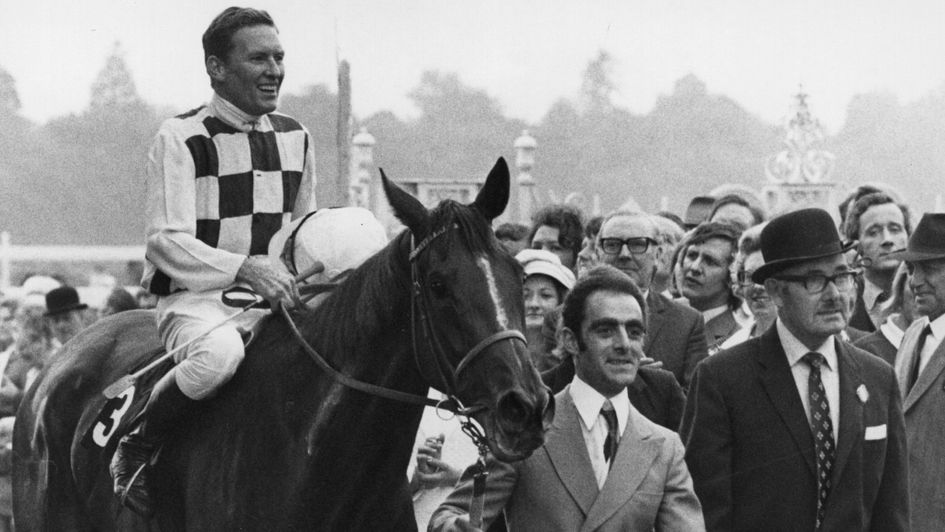
While her trainer said after her first York win that he regarded her essentially as a mile and a half performer, that didn’t stop Dahlia from proving much too good for her rivals in the Benson & Hedges Gold Cup. Once in the clear, she ran out a decisive winner by two and a half lengths from the Derby runner-up Imperial Prince who turned the tables on the Epsom winner Snow Knight in third, though that was three places better than Snow Knight had finished behind Dahlia in the King George. Beating the first two from Epsom was no mean feat of course, though Timeform regarded the 1974 Derby as ‘one of the worst in living memory’.
As the likes of Enable and Kalpana show, there’s nothing too unusual nowadays about a top middle-distance filly being kept in training well after the age of three, though again Dahlia was ahead of her time in that respect. When she returned to York as a five-year-old, she had two more big races in North America on her CV from late the previous year, the Man o’ War Stakes and Canadian International, but she didn’t show the same form during in an eleven-race campaign in 1975, her only success that year being her repeat victory in the Benson & Hedges Gold Cup.
She ran in the King George again beforehand, bidding for a third win, but that turned out to be the epic renewal fought out by Grundy and Bustino who pulled five lengths clear of Dahlia back in third. Although a far superior Derby winner than Snow Knight the year before, Grundy didn’t give his running at all at York, evidently not recovered from his battle at Ascot, and finished a well-held fourth in what proved to be his final race. For Dahlia, therefore, her second Benson & Hedges Gold Cup was something of a gift, and she made all for a comfortable win over the King George fifth Card King. At the time, Dahlia had record earnings for a European-trained horse, and while she raced on at six, there was no bid for a third win at York as she was sent to be trained in California that year.
It was to be nearly twenty years before Dahlia’s feat at York would be matched, with consecutive dual winners coming along in the 1990s. The first of those was Ezzoud, trained by Sir Michael Stoute for Maktoum Al Maktoum, marking the start of the Maktoum family’s success in the Juddmonte International which continues right up to the present day with Ombudsman.
If the betting had got it right, it would have been Sheikh Mohammed receiving the trophy after the 1993 Juddmonte International as he was the owner of the 7/4 favourite Sabrehill, first past the post in his only two outings for Henry Cecil. However, the Juddmonte International had a reputation for shock results, starting with Brigadier Gerard meeting with his only career defeat at the hands of Roberto in the inaugural edition, and at 28/1, Ezzoud provided another upset.
Ezzoud had finished second to Rodrigo de Triano – winner of the Juddmonte International later that year – in the previous season’s Irish 2000 Guineas but had a mixed record, reappearing at four with a win in the Earl of Sefton Stakes, but finishing down the field in the then Group 2 Prince of Wales’s Stakes at Royal Ascot before his run at York. When Sabrehill surged clear two furlongs out, Ezzoud already looked beaten in mid-division, but he produced a remarkable finish, cutting down Sabrehill in the closing stages to win going away by a length and a half.
Already fitted with headgear at three, Ezzoud was certainly no easy ride, but he was skilfully handled by Walter Swinburn who won a second Group 1 on him in the following season’s Eclipse when he had that year’s Derby winner, the odds-on Erhaab back in third. There was nothing much Swinburn could do about Ezzoud jinking and unseating him soon after the start of the King George next time, but Ezzoud was on his best behaviour again when defending his Juddmonte International title.
Cecil trained the favourite again, this time King’s Theatre who had chased home the riderless Ezzoud when winning the King George. However, he was only third in a race that turned into a crawl and where Swinburn’s judgement of pace proved key. Deciding to commit some way from home – ‘I thought, “Go on and let’s see if you’ll battle”’ his jockey reported afterwards – Ezzoud did just that, getting the better of Muhtarram by a neck at the end of a final-furlong tussle.
The runner-up was trained by John Gosden who would therefore have a lengthy wait until Roaring Lion won him his first Juddmonte International. Another one that could be said to have got away was Muhtarram’s stablemate Halling, winner of that year’s Cambridgeshire in Sheikh Mohammed’s colours in what proved to be his final start for Gosden. As an early recruit to the Sheikh’s new elite stable of older horses, Halling would go on to win the next two editions of the Juddmonte for Godolphin and Saeed bin Suroor instead after a winter in Dubai.
The much-improved Halling provided Swinburn with a third consecutive win in the Juddmonte International in 1995. It was Halling’s eighth win in a row, and he was sent off the 9/4 favourite following his first Group 1 win in the Eclipse when he had made all for a neck win over Singspiel, the Juddmonte International winner two years later. He had much more to spare at York, sprinting clear after leading on the bridle and winning easing down by three and a half lengths from the St James’s Palace Stakes winner Bahri.
‘I cannot recall a more willing partner than Halling’, his rider said afterwards. ‘I felt after the Eclipse that he’d have won by four lengths that day if I hadn’t dropped my whip.’ Halling went on to suffer heavy defeats on dirt in the Breeders’ Cup Classic and Dubai World Cup, but he put up some top-class performances back on turf the following season, winning the Prix d’Ispahan and a second Eclipse before attempting to double up in the Juddmonte International.
Frankie Dettori, who had ridden him to victory in the Cambridgeshire, was back on board at York where Halling produced just about the best effort of his career. He was an equally emphatic winner as he had been the year before but under different tactics, Dettori setting out to make all the running and stretching clear to beat the Sussex Stakes winner First Island by three lengths. For the second year running, he put up the best performance seen in Britain over a mile and a quarter.
The reason for there being no dual winners in the thirty years since Halling is that very few Juddmonte International winners have been back to defend their crown. But the three who did were all placed; Nayef was third to Falbrav in 2003, Notnowcato filled the same position behind Authorized in 2007 and Mishriff came up against Baaeed in 2022.
Halling’s two wins were the first of six so far for Godolphin. Sakhee and Sulamani were successful for Saeed bin Suroor and Dettori in the following decade and Ghaiyyath won it for Charlie Appleby and Ombudsman’s jockey William Buick in 2020. Now it’s Ombudsman’s chance to join Halling on that select list of dual winners.
Related Sky Bet York Ebor Festival content
- David Ord: Is the Juddmonte International really a match?
- Ben Linfoot: Best thing about York? The need for speed
- Nic Doggett: The York test facing Gimcrack hopeful Arapaho Gold
- Karl Burke: My York team
- Charlie Johnston: My York team
More from Sporting Life
- Free bets
- Racecards
- Fast results
- Full results and free video replays
- Horse racing news
- Horse racing tips
- Horse racing features
- Download our free iOS and Android app
- Football and other sports tips
- Podcasts and video content
Safer gambling
We are committed in our support of safer gambling. Recommended bets are advised to over-18s and we strongly encourage readers to wager only what they can afford to lose.
If you are concerned about your gambling, please call the National Gambling Helpline / GamCare on 0808 8020 133.
Further support and information can be found at begambleaware.org and gamblingtherapy.org.