
Timeform’s Michael Williamson examines the data to identify at which age horses peak.
Nothing seems to quite spark the debate at a Cheltenham Festival preview night like a trends-based argument as to why a horse can’t win – and no doubt plenty will be out to get the five-year-old Goshen in the Champion Hurdle. But what is a ‘good’ age?
A key point to consider is that horses usually have a season running against fellow novices. This means that while they may look like good prospects they are often only being tested against a select group of horses. It is usually only when horses graduate into open company that their true ability can be assessed.
This is especially true for juvenile hurdlers, as those who stick to graded races usually only meet horses of the same age – Goshen looked spectacular last year but was competing against a small subset of the hurdling population.
However, before a marker pen goes through his name on your shortlist, we’ll look at the wider horse population for all runners in the past five years in Britain and Ireland:
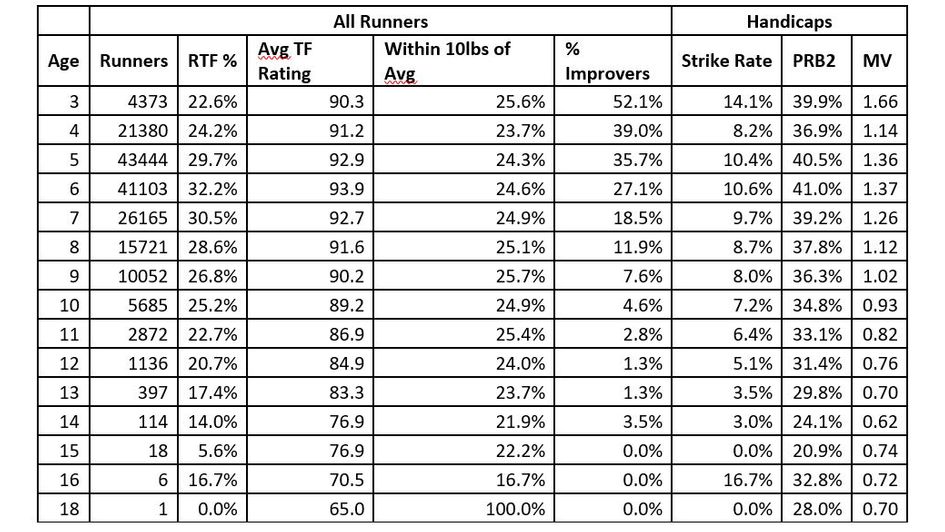
The average rating and Timeform Run To Form percentage of hurdlers that run to at least a Timeform rating of 60 (done to prevent heavy skewing by those horses that failed to complete) suggests that, in general, five-year-olds aren’t too far away from reaching their peak over timber.
The data suggests that most hurdlers that had at least ten runs peak in their second season of racing – whether that be at five, six or seven.
Youth is certainly a valuable asset in handicaps. The handicap data (Strike Rates and Percent Rivals Beaten²) suggests life gets progressively tougher for older horses as they often come up against opponents that are not yet in the grasp of the handicapper. Percent Rivals Beaten², as discussed in a previous article, was devised by James Willoughby to reflect the horse’s finishing position as well as factoring field size.
There is interestingly a blip for four-year hurdlers in handicaps. This is potentially as a result of four-year-old form being rated too highly, while the significant drop in weight-for-age allowance – which seemingly allows three-year-olds to thrive when going handicapping early – could also be a factor.
The final column (MV) represents the Market Value of those horses, which is calculated from their starting price and the field size. This shows that the market often aligns with the success of the younger horses.
One thing to bear in mind, though, in the hurdling ranks at least, is that there are many potentially top-class performers that never get chance to show how good they are. In recent years Shishkin, Altior, Min, Douvan and Vautour have all been sent chasing, so potentially the average ratings of older horses could be higher.
So, how does the chase data look? An 11-year-old Native River galloping a seven-year-old A Plus Tard into submission would surely be the story of the Festival, but how realistic is it?
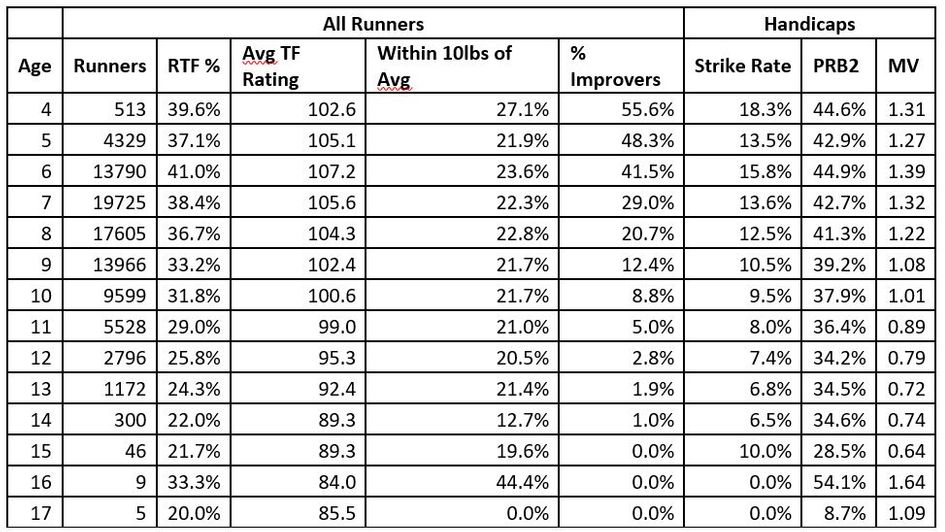
Not only are the average ratings of older chasers much lower, but the chances of them improving their form becomes less and less likely.
Native River matching his 2018 Gold Cup effort at Sandown in January was an incredible achievement from horse, trainer and jockey but can he do even better at Cheltenham? He might need to as horses like A Plus Tard have not shown their full hand yet.
It is worth noting that when limiting the analysis to top-class horses only, the peak for both hurdlers and chasers rises around half a year.
So, what is a good age? More often than not it is better to focus on hurdlers aged five to seven, and chasers aged six to eight.
In handicaps, it would seem wise to focus most attention on the younger, less exposed horses. The older handicapper might be vulnerable to their younger counterparts.