
Timeform’s head of product and technology, Michael Williamson, analyses the impact that a horse’s absence has on performance.
Trials Day was lost to the weather, the Dublin Racing Festival is in the rear-view mirror and opportunities for trainers looking to get a run into their horses before the Festival are starting to appear thin on the ground.
To evaluate the risk that trainers may be taking by fitting in a prep run close to the Festival, it is best to look at how the general horse population fares after certain gaps between races.
For those new to the sport or seeking to learn more, a traditional race card can be a daunting prospect. In the case of ‘days since last run’ the seemingly random number next to the horses’ name often leads many to question ‘is that good?’
Dealing with runners over hurdles and fences in Britain and Ireland since 2015, sticking to the same discipline and similar trip, general inferences can be made as to when the number of days off can be largely ignored or when it is a cause for concern.
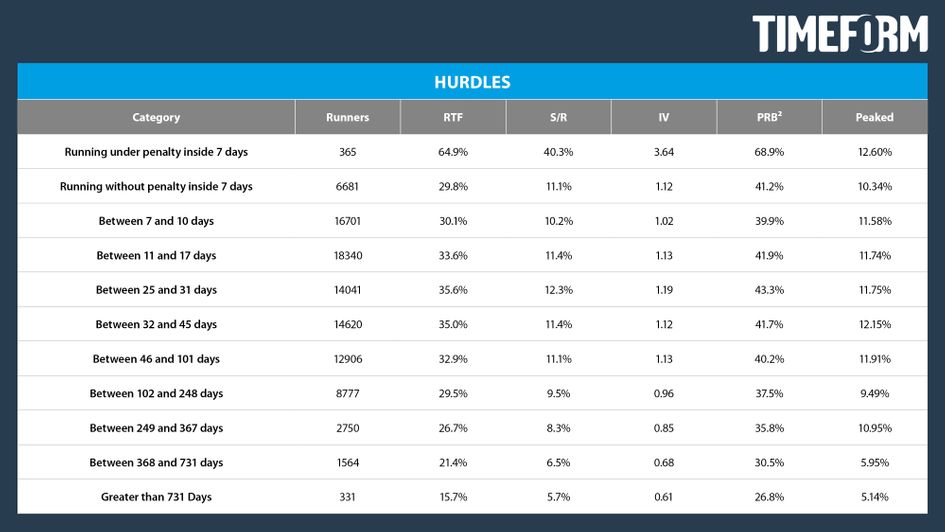
Hurdles:
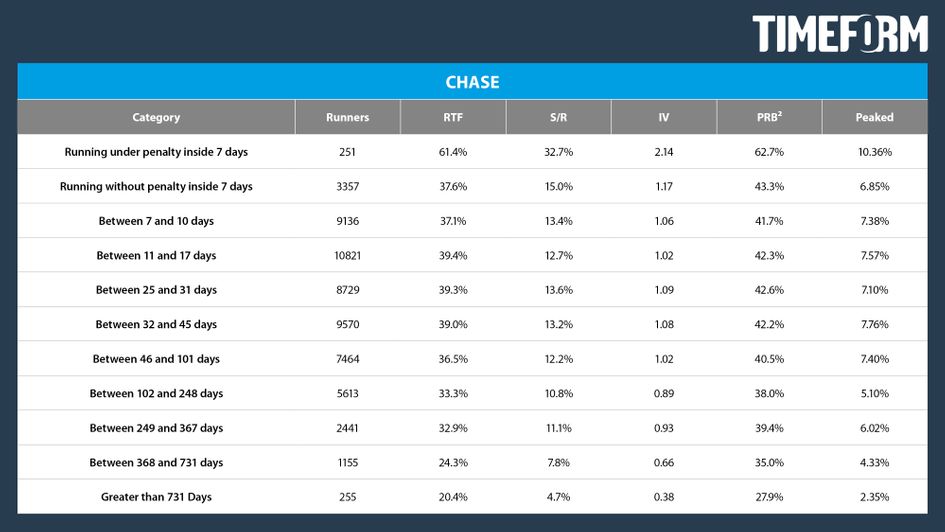
Chases:
The first set of horses to remove from wider analysis are those who are turned out with a fixed penalty for having recently won a race. As well as being in form and potentially plotted to run up a sequence, many of these take advantage of favorable conditions.
Ignoring horses running under a penalty, the tables show there isn’t a huge difference in performance among those reappearing within 45 days.
Metrics we have used to assess performance include Timeform Run to Form, Impact Values (which compare winners to random chance) and Percent Rivals Beaten², which was devised by James Willoughby to reflect the horse’s finishing position as well as factoring field size.
Across all race types, there is then a noticeable drop off in performance when the gap is between 46 and 101 days. This increases in significance as the gap grows, introducing horses making seasonal reappearances and horses that have had physical issues.

The segment between 46-101 days is a key area as these are horses that are unlikely to have had any significant setbacks but are waiting for opportunities to race. Breaking this band down further, there is a small but steady decline on a week-by-week basis.
When marginal gains can mean everything at the top table, would trainers be better served looking to get a run into their horses?
It’s worth noting that the risk presented isn’t fully considered by this study due to the selection bias of only looking at horses that made it back onto the track, but otherwise the numbers suggest that trainers should be looking to get a prep run into their representatives.
The final point to consider is that many horses aren’t just being asked to run to form at the Festival, they are being primed to peak. When looking at the percentage of horses that improve on their previous best by at least 5 lb over hurdles and fences it is a similar story – peak performances become less frequent the longer a horse has off.
The reason why racing appeals to so many is due to its nuances and the sheer number of variables, with every horse and race a puzzle to be unlocked. Some horses may go better fresh, others strengthen and grow for their break while a selection thrive on racing. But for those seeking a more general view, hopefully the days off number next to the horses’ names is now a little less mysterious.