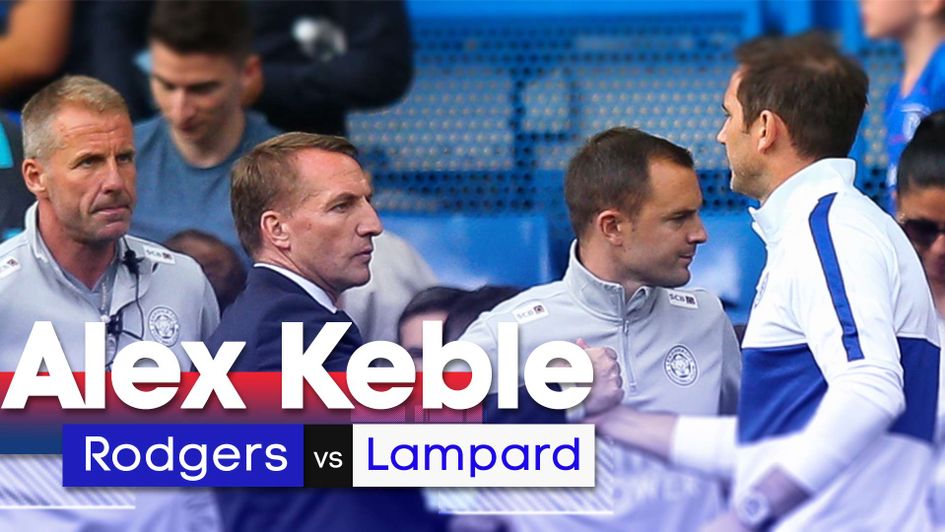
Alex Keble compares the coaching capabilities of Brendan Rodgers and Frank Lampard ahead Chelsea's visit to Leicester.
When Brendan Rodgers first entered the public consciousness as Swansea City manager he was seen as an ambitious and talented young coach who, though favouring a possession style, displayed the vulnerable trait of latching dogmatically to his tactical approach.
There are notable similarities to the way Frank Lampard’s single season at Derby County was perceived and so, as the current Chelsea manager goes through a sticky patch while Rodgers soars, it is worth asking: is Lampard being found out, or – like the man in the opposite dugout on Saturday - will he grow and mature into a top-level coach?
Rodgers certainly wasn’t an instant success. A brief spell at Watford was average at best, with bursts of form and long winless runs leaving the club mid-table by the time he left in the summer of 2009. Things were even worse in six months at Reading and Rodgers left by mutual consent in December. His first year as a manager, then, was less successful than Lampard’s.
But the crucial difference between the two men is their coaching history prior to landing top jobs. Rodgers spent many years learning the coaching side of the game following a career-ending injury aged 20, shadowing managers in Spain before spending several years as a coach at Chelsea. Lampard, by contrast, went straight into a managerial role at Derby following a brief period as a pundit.
This does not automatically mean Lampard won’t emulate Rodgers in a steady incline, but it is noteworthy because the difference is somewhat reflected in their tactical differences. In simplistic terms both have similar styles: they like to mix possession with a high press, they look to play predominantly through the middle of the pitch, and they both tend to switch between 4-3-3 and 4-2-3-1.
But what is often missed about Rodgers is his adaptability - even at the beginning of his career, long before the dramatic stylistic shift between his Swansea and Liverpool teams. The Swans looked to play vertical passes between the lines of midfield, but they also focused heavily on crosses into a traditional striker. They indulged in short passing, but Rodgers emphasised speed and variety; Swansea played with a directness that aimed to prevent the dull sideways passing that tiki-taka can become.
Flexibility in formations
Before that, he was even more flexible in formation and tactics, and indeed his subsequent tactical variety displayed at Liverpool, Celtic, and Leicester suggest we simply formed a lasting opinion of Rodgers while at Swansea – a club already moulded by Roberto Martinez in a fashion Rodgers was instructed to continue.
Lampard does not wish to suffocate with possession either, and in fact expects his creative players to roam freely in the number ten space to receive quick vertical passes. However, where Rodgers showed constant flexibility (most likely as a consequence of his years of coaching experience) Lampard’s first forays into management are more rigid.
Under Lampard, Derby and Chelsea play in almost identical ways. At both, the attack is free form, focusing on wingers cutting well inside to overwhelm the centre, and the midfield is built with the same focus on box-to-box Lampard-esque players seeking space. At both clubs the centre-backs were tasked with carrying the ball forward to play midfield-splitting passes – and at both clubs the same flaws arose from this aggressive team shape.
Chelsea have continually been exposed in the attack-to-defence transitions this season, a direct consequence of fanning out across the width of the pitch. Unlike other high-press managers like Jurgen Klopp or Pep Guardiola, Lampard does not give much attention to ensuring the team’s shape is perpetually vigilant to what would happen if they lose possession. Gabriel Martinelli’s solo goal in their last league outing is a perfect example, although pretty much every Chelsea game this season has seen the same pattern develop.
Lampard is learning on the job, of course, and imperfections are certainly to be expected for the time being. Then again, it is striking that while Rodgers was always praised for his tactical attention to detail – for deliberately altering the tempo mid-match, for breaking the game into 15-minute segments – Lampard is rarely spoken of in this manner. The freedom his players appear to show in their decision-making suggestions it is with good reason.
Lurching erratically from fast-paced attacking football when confidence is high to dry, hesitant passing lines when morale has dipped, Chelsea’s players are showing what happens when tactical identity is defined by individual decisions rather than an organised team shape. True creativity requires a free mind; when confidence wanes, players stop moving and passing with the same energy. Rodgers teams were never accused of this.
Still early days for Lampard
Then again these are very early days for Lampard, and it is worth noting tentative signs of managerial growth were on display in the Chelsea manager’s best result in management so far - a 2-0 victory against Jose Mourinho’s Tottenham Hotspur in December.
There was so much to love about that performance: the surprise switch to a 3-4-2-1 that bamboozled Mourinho; hitting the wing-backs early with long diagonals that isolated Spurs’ problem full-backs; using a back five to go man-to-man with Jose’s five-pronged attack; Mason Mount and Willian, as inside forwards, overloading Eric Dier.
Pundits drew on Antonio Conte’s influence in the use of a 3-4-2-1, but in reality it was Mourinho rubbing off on Lampard. The detailed game-plan, targeting of opposition weakness, shifting tempo, and willingness to play direct would have made his old boss proud. It was also, and not coincidentally, the most Lampard had taken after a young Rodgers. The Leicester manager was hired by Mourinho at Chelsea in 2004 and is cited as a significant influence.
Perhaps Rodgers would have appeared similarly one-dimensional and prone to bouts of poor form had he been thrust into such a high-profile job so early in his career. Building a tactical philosophy – or rather, letting go of the philosophy and appreciating the importance of variation and subtlety – is easier to do at mid-table Championship clubs. Certainly it is far too early to suggest with authority that Lampard cannot grow into someone as cultured and tactically respected as Rodgers.
Saturday’s lunchtime kick-off, like the trip to Spurs, is a good opportunity to further assess Lampard’s credentials. He may well continue to learn and adapt. To do so will require humility and hard graft, the kind that ordinarily comes more naturally to those whose playing careers are cut short and must fight their way to the top of the coaching ladder – as opposed to those living the charmed life of a Premier League superstar.
The latter is, of course, an unfairly simplistic picture of Frank Lampard. He is clearly smart, passionate, and hard-working. But coaching experience? By the time Rodgers became a Premier League manager he already had 16 years under his belt.
JANUARY TRANSFER WINDOW
With Deadline Day fast approaching, stick with Sporting Life for all the latest transfer news, with our live daily blog here and done deals for the month available here.We will be providing live coverage on Friday ahead of the 2300 GMT deadline, keeping you across all the completed transfers across the Premier League, Sky Bet EFL and Europe.
Follow Sporting Life on social media - find us on Facebook here or tweet @SportingLifeFC
Related football links
- Transfer Window: Latest updates
- January Window: Done deals
- Laura Woods column: Here's to you, Allan
- Spurs transfers: Still to be done?
- What do Man City need?
- What impact will Augustin make at Leeds?
- Bruno Fernandes: What United will gain
- Super 6: Enter NOW!
- Fantasy Football: Pick your team now!
- Football results