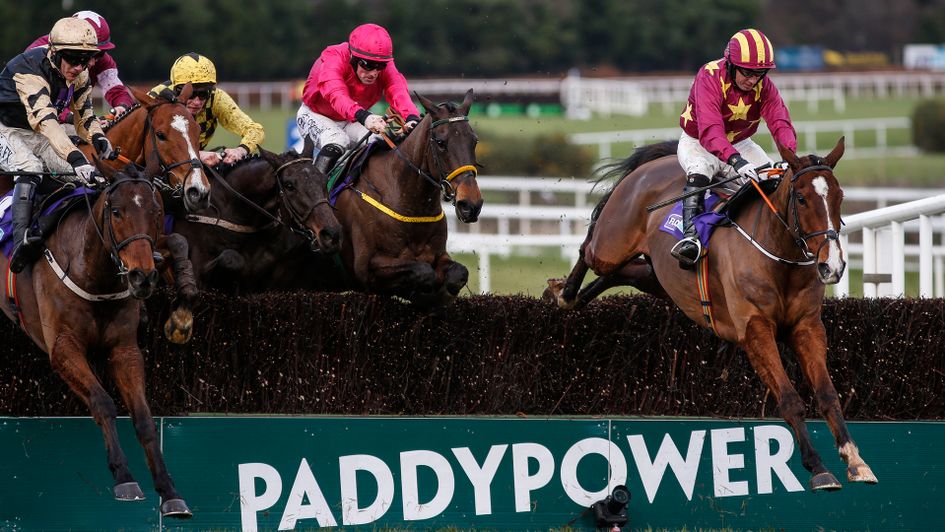
How do we work out where the toughest fences are?
Which are the trickiest closing fences to jump in Britain or Ireland? The third-last at Fakenham? The fourth-last at Galway? Two out at Market Rasen? Or perhaps the last at Ascot?
Encouraged to delve deeper into this fascinating topic by the drama that unfolded (free replay below) in the recent match at Cheltenham that saw Gin On Lime come home alone after both she and sole opponent My Drogo had made a mess of the second-last, so reigniting discussion about a fence that has had its fair share of issues over the years, I have queried the Timeform database in a bid to find the answer.

Unlimited Replays
of all UK and Irish races with our Race Replays
Discover Sporting Life Plus Benefits

The definition of ‘closing’ as I have used it here is any of the final four fences. This is partly out of simplicity (the last four fences are the same whether the race is over two miles or four miles, unless something like low sun intervenes) but also reflects the point at which a good number of races properly start to take shape.
In order to try and reflect more recent track conditions and not those in the distant past (the Grand National fences have changed notably in recent years, for example) the dataset I used was all races run over fences (but not cross-country races) from January 1, 2017 to November 15, 2021.
This gave a dataset of around 68,500 performances which were then split into falls and unseats by course and course configurations where those alternatives exist (Cheltenham Old Course and New Course, for example).
In the interests of fairness and accuracy, not every fall or unseat was counted: those falls or unseats which the Timeform reporter felt were no fault of the horse concerned (such as when cannoned into by another runner or slipping on landing after jumping the fence perfectly well) were omitted. Falls and unseats at fences that were not jumped in the usual sequence have been recategorised as the one the fence would have been had the need for resequencing (badly damaged fence or low sun, for example) not been necessary.
Factors that influence falls
Before we delve into the data more deeply, some background context first. The number of falls and unseats (I’ll call them falls from now on to avoid becoming too repetitive) at any track depends upon many factors, among which ground conditions, field size and programme make-up are just some.
Sandown, where the Grade 1 Tingle Creek took place on Saturday, is often put forward as a course where jumping is at a premium but there are relatively few fallers because the track stages a high number of handicap chases aimed at experienced and largely sound jumpers, while putting on very few novice chases.
Wincanton stages very few two-mile chases and lots of three-mile races, for example, while some tracks in Ireland, such as Naas and Tipperary, are much more focused on beginners’ chases than other courses (which arguably makes Naas an even easier track to jump around than the figures suggest). Before I address the trickiest closing fences, here are some background numbers for context.
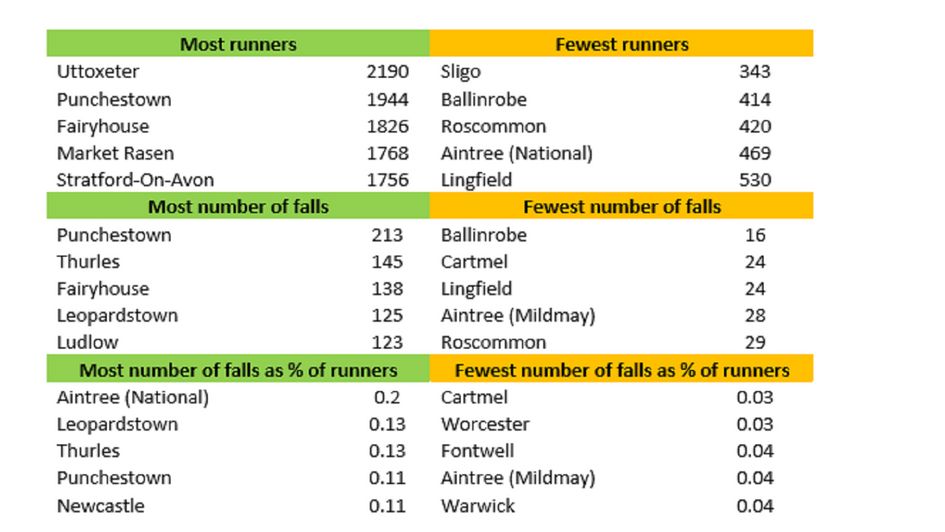
Uttoxeter has played host to most chase runners (2190) over the period under review, but has had only 94 fallers at all fences, which puts it just outside the easiest top five tracks to jump around when falls are calculated as a percentage of the overall number of runners (Cartmel comes out easiest in this category at 0.03%).
Punchestown has had the largest number of fallers – 213 – but other than Uttoxeter has also had more runners than any other course. Ballinrobe has had only 16 fallers, but only Sligo has had fewer runners. The National Course at Aintree is still the trickiest course to jump round – early in the race at least – but, as I’ll show later, its final four fences catch hardly any horses out.
Four-out at Ludlow is a tricky fence
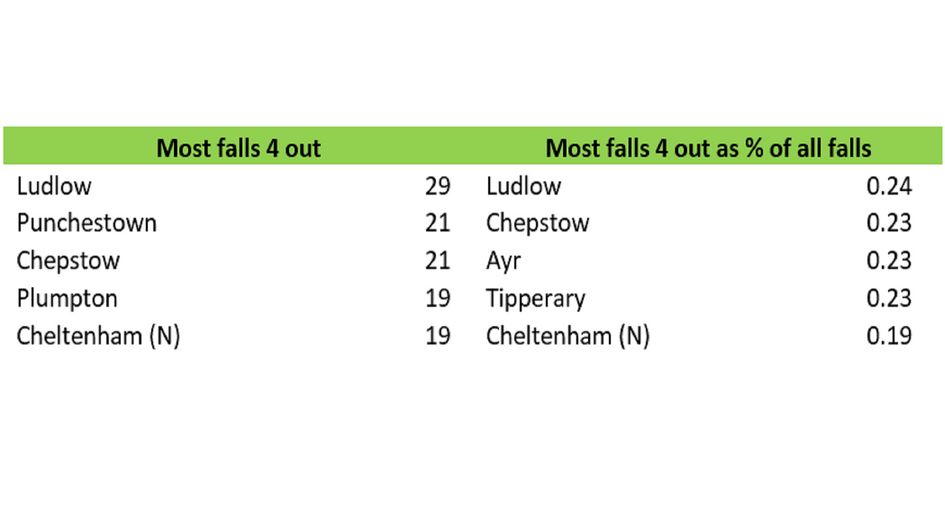
Anyone who witnessed the dramatic exits of both Pic d’Orhy and Remastered at the fourth-last at last weekend’s Ladbrokes Trophy fixture might have expected Newbury to have figured prominently on this list, but the fence has been responsible for only around 6% of the falls there in the period under review, some way below the general average 9% falls we can expert at the fourth from home.
Heading the list instead, and it’s no surprise to anyone to who tunes into Racing TV regularly, is Ludlow which not only has registered the most falls but also has the highest number of falls at four out as a percentage of overall falls (there has been another at the fixture held since this dataset was compiled).
The Shropshire track has made a well-publicised effort in recent years to attract better horses by increasing prize money substantially, and that has possibly contributed to the rising incidence of errors with more races there being run at a faster pace.
More likely, however, is that the fence is a perfect storm of coming too quickly into the home straight after taking a very sharp bend. Given there is no option to reposition it, you have to wonder if the track would be better off removing the fence completely, leaving just three in the straight spaced further apart while retaining the water jump.
Chepstow, Ayr and the New Course at Cheltenham also feature in the ‘difficult four out’ category, while Sandown, Gowran Park, Catterick and Sedgefield come out best in the ‘easiest four out’ section.
Why Market Rasen's third-last is difficult
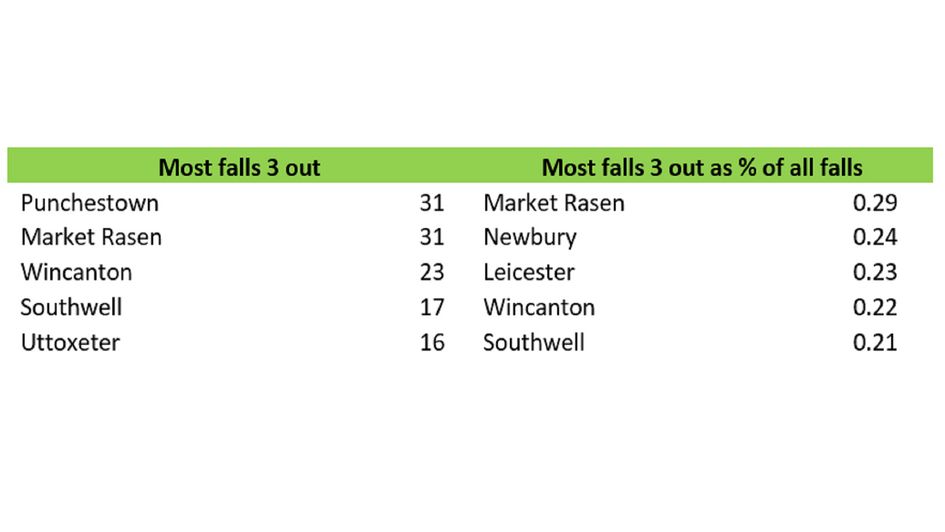
Market Rasen and Punchestown are clear in number of falls at three-out but it is the Lincolnshire venue that is out on its own when falls three out as a percentage of total falls are calculated. The main contributory factor to this being such a tricky fence would seem to be that what precedes it - a pronounced drop coming out of the back straight that Google Earth suggests is something approaching a 3% gradient.
With that in mind, it’s no surprise that the first fence in the straight catches so many out, and if the fence has one saving grace it is that it isn’t positioned any nearer the home bend otherwise the casualty rate would surely be worse.
Three out at Newbury and Leicester are the second fences in the home straight and are both open ditches, but the third-last at Wincanton and Southwell (the racecourse was forced to close in 2020 after a number of fatalities) are both the first in the straight and – you guessed it – come quickly off the final bend.
The ‘easiest third lasts’ are on the National Course at Aintree, Chepstow (in stark contrast to four out) and Newton Abbot, the last-named hardly surprising as it was once the water jump.
What to make of the second-last at Cheltenham?
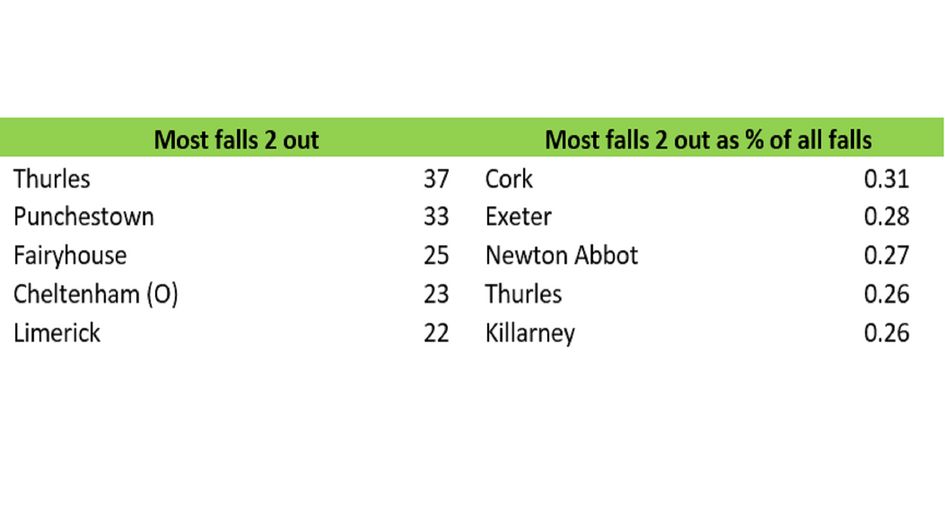
The second-last on the Old Course at Cheltenham, which was moved in 2010, 2016 and again in 2019 in a bid to reduce the number of fallers, has gained an unwanted reputation over the years and is a tricky obstacle, but isn’t quite as troublesome as some second-last fences elsewhere.
The first move was on account of horses coming down who had actually jumped the fence perfectly well but lost their legs on the ground that dropped away after the fence, while the changes in 2016 and 2019 have moved it increasingly further away from the home turn. Al Boum Photo, Gumball and Coole Cody are among the high-profile casualties at this fence in the last couple of years and, from the data clearly seen at other tracks, the proximity to the bend off the back of a 12-metre drop (or near 2.5% gradient) mean the problems at this fence are not going to go away any time soon.
Thurles, which tops the list for most falls at two-out, and is also among the top five tracks in terms of percentage of overall falls, had for many years faced the same issue as Cheltenham.
Until very recently, the second-last came immediately off a near-4% downhill gradient into the straight and must have been a live contender for the most feared fence in racing, but thankfully the executive there responded to the problem and moved the fence close to the third-last, meaning there is now only one fence in the home straight (it’s too early to see what changes that has made to faller rates at the final fence, and analysis of the trickiest final fence shows that having just one fence in the straight isn’t necessarily an improvement on having two).
Cork, Exeter and Newton Abbot are easy jumping tests overall, but the positioning of their second-last clearly causes issues, with the one at Newton Abbot again very close to the home bend. Two out is a largely insignificant fence on the National Course at Aintree, Ascot and Haydock.
Focus on the final fence
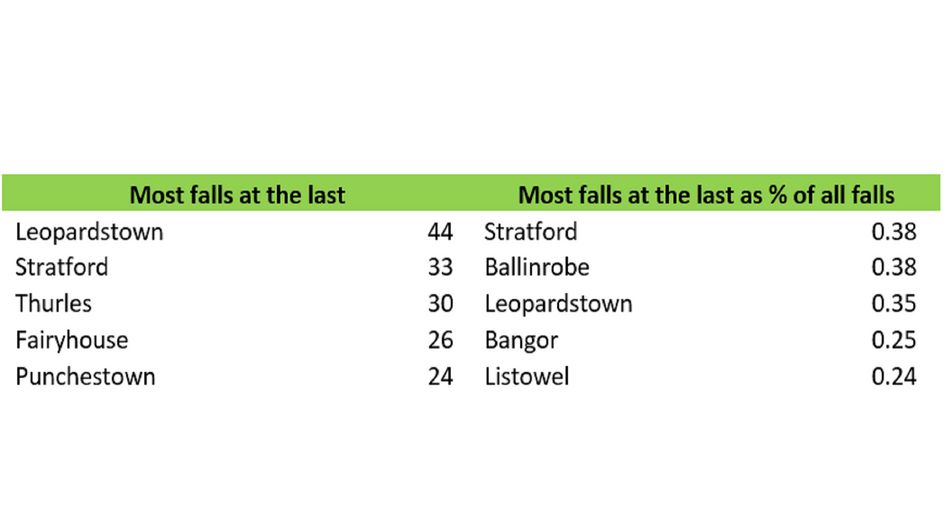
Leopardstown is out on its own as the course with the most falls at the last in the period under review, and the course also figures right up there near the top when falls at the last are considered as a percentage of overall falls. The course is a far stiffer test of stamina than it appears from television pictures with a 14-metre climb from the lowest point in the back straight to the winning line according to Google Earth with the most punishing part of that climb coming after the entrance to the home straight.
Tiredness surely plays a part but, more significantly it would seem, the fence is also the only one in the straight before the winning post as the runners sweep off the bend. Stratford isn’t known as a demanding test of stamina or a difficult jumping track overall, but, like Leopardstown, has only one fence in the straight before the winning post and that comes off a much sharper angle as well.
The same reasoning almost certainly explains Ballinrobe’s position in the list. The course isn’t known as a stiff jumping test either – it has one of the lowest proportion of falls to runners anywhere when taking all the fences into consideration, but the last fence is particularly tricky and, once again, is the only one in the straight before the winning line and comes shortly after a right-hand kink.
In contrast, the easiest final fences are those on the National Course (once again) at Aintree and at Fontwell... unlike at Leopardstown, Stratford or Ballinrobe, if the horse you’ve backed is in a clear lead approaching those fences you can breathe easily.
More from Sporting Life
- Racecards
- Fast results
- Full results and free video replays
- Horse racing news
- Horse racing tips
- Horse racing features
- Download our free iOS and Android app
- Football and other sports tips
- Podcasts and video content
Safer gambling
We are committed in our support of safer gambling. Recommended bets are advised to over-18s and we strongly encourage readers to wager only what they can afford to lose.
If you are concerned about your gambling, please call the National Gambling Helpline / GamCare on 0808 8020 133.
Further support and information can be found at begambleaware.org and gamblingtherapy.org.