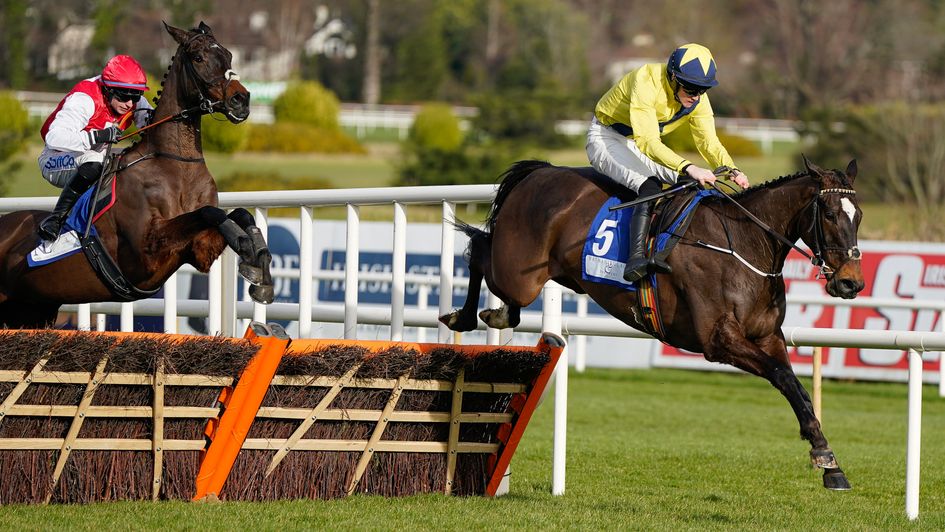
Cassie Tully examines the differences between Irish and British jumps stallions and their French counterparts who continue to dominate the big meetings.
French-breds boss Dublin Racing Festival
Embers have finally settled after fireworks from one of the most exquisite weekends in Irish and British racing.
And while daydreams are now fleeting between glittering track action from the Dublin Racing Festival and upcoming Cheltenham clashes, the corresponding breeding results snap us immediately back to a much harsher landscape of reality.
Eight Grade 1 races took place at Leopardstown. Each of the eight winners were by eight different sires, they had eight different grand-sires and also eight different broodmare sires. Astounding. Refreshing.
The perturbing statistic however is that all eight Grade 1 winners were French-bred.
Already dominating the Grade 1 table so far this season, the French-breds have now won 25 of the 36 top-flight contests on offer (Ireland bred seven and Britain bred four of the remaining 11), but the trend was displayed to an overwhelming extreme last weekend.
Success with a French suffix on these waters is no news flash by any means, and past accomplishments have further encouraged and intensified their procurement from across the Channel (even those who are unproven, for example Mighty Potter).

What's the state of play?
So, what exactly is going on? Unlike Flat racing, the cross-border competition does not much include involvement of the French trainers at our festivals and likewise, we rarely compete over there. How so are a nation that do not compete on race days with us, beating us at what we historically thought we always did better – breeding the athletes?
Is it a numbers game? Do they breed more horses than we do? The answer is a strong ‘no’ to those questions. Ireland on average produces 4,000 National Hunt foals each year and Britain produce 1,000 (we then produce a further 5,000 and 3,500 flat foals in each jurisdiction respectively). Meanwhile, France averages a total of 6,500 Thoroughbred and AQPS foals per year combining both Jumps and Flat racing.
If not strength in numbers, what makes them so special and what do we have to do to compete?
One of the most commonly held conceptions regarding the source of the French superiority and precocity has been to do with their upbringing. Horses bred in France face obstacles at a much earlier age than over here and complete in races over hurdles as early as three-years-old.
But tackling obstacles one season earlier than our point-to-pointers simply cannot single-handedly increase overall ability on that scale and explain the blatant severity of these results.
Perhaps there is an element of the French focusing on toughness, soundness and durability over fashion and the sales ring when choosing a stallion. This may well be part of the case however, if just measuring the aforementioned characteristics by number of runs, the average number of runs the top 15 French sires had as racehorses is 13, while the average number of runs the top 15 Irish sires had as racehorses is 16. Next.

What sets Britain and Ireland back?
There are actually two other major differences in the landscape of National Hunt breeding in France compared to Britain and Ireland.
The first of those differences is their sheer diversity of bloodlines available at stud (think back to eight G1 winners, eight different sires, eight grand-sires and eight broodmare sires in one annihilating weekend). And the second is their propensity to keep young jumping horses entire and then stand them as stallions. Let’s delve.
The top 15 most expensive National Hunt stallions standing in France are represented by 13 different sires and 10 completely unique sire lines.
By comparison, of the top 23 National Hunt sires in Ireland (those standing at €4,000 and above), 20 are immediate descendants of either Sadler’s Wells, Monsun or Cape Cross. Leaving just three stallions to offer different varieties of genes and only one of those three (Poet’s Word) is under the age of 18.
It is a similar scenario in Britain where only two of the top ten are not by Sadler’s Wells, Monsun or Cape Cross and sons.
There is nothing wrong with these lines, three of the greatest National Hunt stallions of past - King’s Theatre, Old Vic, and Kayf Tara - are all by Sadler’s Wells. But the lack of diversity is not a picture that is painting success nor one that has developed overnight. And it is important to remember that 50% of the offspring from those stallions are our future broodmares. Who are they going to be able to visit?
Certain lines are dominant and successful for a reason. Inbreeding however, bar a handful of wild outliers, is proven not to be so; and heavy reliance on singular sets of genes leaves little other option while also diminishing the gene pool of variety to nothing.
Adding in four more of our past stalwarts – Flemensfirth, Shantou, Beneficial, and Presenting. Two are sons of Alleged, one is by Top Ville and one is by Mtoto. Three unique sire lines that flourished and prospered alongside Sadler’s Wells. Those lines are now extinct.
Not one son of Flemensfirth, Shantou, Beneficial or Presenting is standing at stud in Britain, Ireland or France. Nor Kayf Tara or Old Vic for that matter. Outrageous. Lamentable.
How does France do it?
This leads us nicely onto our second major difference in the French landscape – keeping some of their young jumping horses entire.
Of the top 15 National Hunt stallions standing in France, 10 of them ran over obstacles. How many of ours did? Blue Bresil. And we imported him from France. (Walk In The Park did attempt a Hurdles race on his final start but that was not exactly his track highlight).
The last time there was an entire Grade 1 winner over hurdles or fences in the UK or Ireland was the hugely exciting but ill-fated Sir Erec (although he was not going to aid the lineage situation having Sadler’s Wells on both his sire and dam’s side).
Before that was a horse called Nickname. He was a Grade 1 winner over hurdles in France before changing ownership and moving to Martin Brassil’s yard in Ireland and going on to win the Grade 1 Dial-A-Bet Chase at Leopardstown in 2006. After 31 lifetime starts Nickname went to stud in France and covered just three crops before his untimely death. But the 190 foals he left behind happened to include the likes of Frodon, Cyrname and Yala Enki, as well as the dam of Bravemansgame.
Another example would be going all the way back to the 1995 Champion Hurdle winner Alderbrook. He stood at stud in Ireland until 2007 and sired the hugely tough Grade 1 winner Ollie Magern that ran 59 times.
Not only does keeping some jumping horses entire leave the potential for them to pass on their genes should they be worthy of doing so, but there is also the element of sending one’s mare to a horse proven in the disciple that one is breeding for.
No, it is not necessary, most of our leading National Hunt sires were successful top-class racehorses on the flat. But the purpose of this investigation is to see what France are doing differently and ultimately better than us and the majority (10 out of 15) of France’s leading sires were successful over hurdles or fences and the majority (9 out of 15) are also completely free from Sadler’s Wells, Monsun and Cape Cross blood, while also being of completely unique descent from each other.

The generalisations of us breeding for the sales ring rather than the racetrack can echo true compared to France. And their horses may well be primed for jumping earlier by starting earlier. But the harsh reality is that we have slowly been digging our own grave by not keeping bloodlines alive.
Ireland’s top two National Hunt Stallions at present – Walk In The Park and Blue Bresil – although both tough and talented, never won a stakes race either on the flat or over jumps. Would they have been supported if retired to stud here initially? Luckily for us, the French did.
Variety is the spice of life and let us not forget that Northern Dancer, the sire of Sadler's Wells and forebearer to the majority of horses we have racing in jumps today, won the Kentucky Derby. Tough genes breed tough genes regardless of surface or obstacles.
Vive la France.
More from Sporting Life
- Racecards
- Fast results
- Full results and free video replays
- Horse racing news
- Horse racing tips
- Horse racing features
- Download our free iOS and Android app
- Football and other sports tips
- Podcasts and video content
Safer gambling
We are committed in our support of safer gambling. Recommended bets are advised to over-18s and we strongly encourage readers to wager only what they can afford to lose.
If you are concerned about your gambling, please call the National Gambling Helpline / GamCare on 0808 8020 133.
Further support and information can be found at begambleaware.org and gamblingtherapy.org