
Our timefigure expert Graeme North battles going descriptions and official distances to analyse the big action from England and Ireland last week.
Regular readers of this column will know I devoted the first paragraph of last week’s article to the currently unsatisfactory inaccuracy of official going reports and concluded that the issue is increasingly getting out of control.
I don’t want to bang on interminably about the malaise - it was also covered disapprovingly in his Sectional Blog column on At The Races by my former colleague Simon Rowlands - but less than a week after Haydock consistently underreported the true state of the ground at its three-day Betfair Cup meeting, Doncaster’s Clerk of the Course overreacted to sudden rainfall much as Goodwood’s clerk did back at their big meeting at the start of August when he changed the official ground from ‘Good, Good to Firm in places’ to ‘Heavy’ in the space of one race, a decision he later admitted was too hasty.
At the time the Portland Handicap took place at 2.25pm last Saturday, the official ground at Doncaster was ‘Good, Good To Soft in places’; come 3.00pm it had changed to ‘Soft’ which it remained until the end of the day despite no discernible change in underfoot conditions since the beginning of the afternoon.
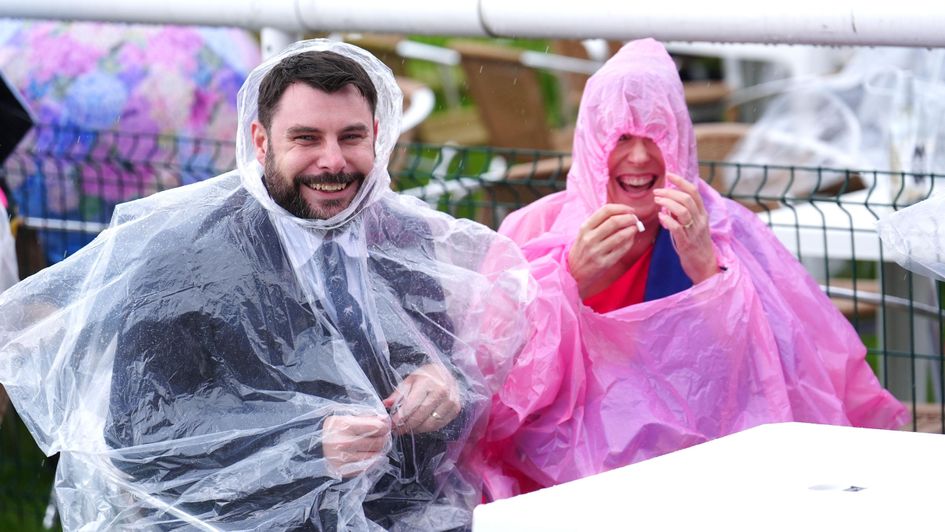
If there’s anything I’ve learned since being tasked with overseeing the Flat timefigures at Timeform two things stand out; firstly, as indicated above, it’s that rainfall during a meeting has far less impact on surface speed than is generally imagined, unless the meeting starts off on soft ground and field sizes are large; and secondly, wind speeds on the ground at racecourse level seldom replicate those reported from nearby wind stations where measurements are taken high up in the air.
One Clerk of the Course reached out earlier this year to Timeform to better understand the relationship between race times and ground – all credit to her – and it would be nice to think others aren’t so stubborn as to not want to better understand that relationship too.
If unreliable official going reports were all I get to deal with on a daily basis then returning timefigures wouldn’t be overly taxing – after all, I can assess the state of the ground from the times and allocate different pounds per lengths or lengths per second to race results than might be inferred from official descriptions and proceed from there.
A much bigger plague, however, is incorrect race distances or additional yardage, something I’ve written about before this year too, and it’s disappointing to see Ireland’s major Flat racecourse the Curragh, which hosted day two of Irish Champions weekend, persist with some race distances that are clearly incorrect.
Arizona Blaze won the Bar One Flying Five Stakes on Sunday in an official time of 59.03 seconds which is itself on the quick side for a track whose final three furlongs purports to be uphill and is referred to in several online guides as ‘stiff’.
Leaving aside for a later day whether their five furlongs really is five furlongs, gathering time evidence from well-run races on similar tracks in Britain won by horses whose winning performances have been rated 100 or higher by Timeform suggest to me that a winning time of 59.03 seconds over five furlongs ought to correspond somewhere around 72.40 seconds over six furlongs and 75.75 seconds over six furlongs and 63 yards.
Yet the winning times for the races over those two distances at the Curragh on Sunday were 75.34 seconds and 80.81 seconds respectively, suggesting the distances of both races were significantly longer than reported by approximately 55 yards and 90 yards respectively. The amount of misinformation - which will go uncorrected, of course, as after all it’s not seen by the authorities as important - stuffing the official form books of Britain and Ireland right now is astonishing.

Those two scenarios added to the overwhelming feeling the week just gone is Flat racing’s peak silly season.
In just four days of racing last week between Thursday and Sunday, there were no less than 24 Group races of some kind in Britain, Ireland and France (where deceptive official ground reports show no sign of abating either) besides another four Listed races.
With so much to get through I’ll keep this week’s round-up brief and start at Doncaster where Timeform called the ground ‘Good’ even when the official report was persisting with ‘Soft’.
‘St Leger week is the best time to judge Doncaster, as the St Leger field passes the Red House and swings into the broad straight and makes for home, there is a great thrill in the air. Many St Legers are won and lost in that testing final furlong’.
Those in attendance in the rain on Saturday might not agree with that opening few words, reproduced here from B. W. R. Curling’s work ‘British Racecourses’, but they couldn’t have disagreed with the closing sentiments as Scandinavia stayed on stoutly to deny Rahiebb, who was ridden from much further back, by a neck with third-placed Stay True unable to sustain the effort which had taken him upsides and possibly in front of Scandinavia with a furlong to run.
Scandinavia’s winning timefigure at the end of a sound gallop was a career-high 115 while Raheibb’s was 114 and Stay True’s was 113 with the last-named arguably deserving a small upgrade after making his ground so quickly.
The saddest sight of the contest was dual Derby winner Lambourn labouring home in fourth after attempting to become the first Leger winner since Scorpion in 2005 to make all the running, leaving the impression that he isn’t the first Derby winner in recent times to have been flattered by being allowed to secure a wide-margin lead at Epsom.
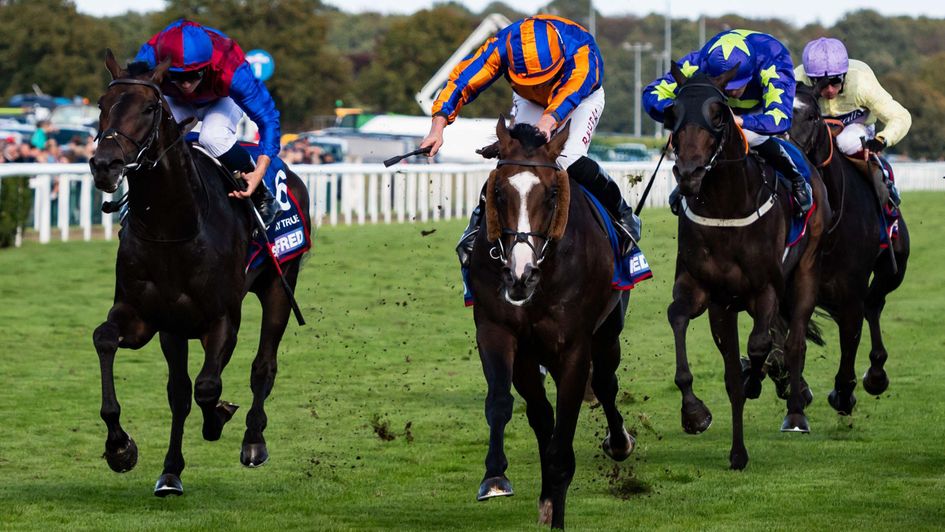
Saturday’s other pattern races, the Champagne Stakes and the Park Stakes, both also sponsored by Betfred, were won by Puerto Rico and Marvelman respectively in relatively modest timefigures, the former posting a 97 and the latter 103.
I was impressed by the enthusiastic manner in which Puerto Rico disposed of his rivals but that he was winning his first race at the sixth attempt tempers future enthusiasm somewhat; if there was a horse above all others on the day to go into your notebooks for the short term it’s surely Rosario (103 timefigure, career best) who finished a clear first on the stands' side and third overall in the Portland on a part of the track times on Friday suggested was riding a fair bit slower than the middle or far side.
He’s gone up 2lb for this yet still remains 1lb lower than when winning at Goodwood in May since when he’s not had the rub of the green on plenty of occasions.
The feature races on the opening day of the four-day meeting (one day too long in my opinion, like most Festivals) were the May Hill Stakes and the Park Hill Stakes.
The May Hill attracted a good-looking bunch so I’m told but they all looked much of a muchness for most of the mile trip and the winner Aylin, who’d finished third in the Prestige at Goodwood the previous month behind subsequent Moyglare Stud winner Precise, was not the only one at it a long way out in a race where her winning timefigure was just 87.
The Park Hill, the fillies ‘St Leger’, attracted an unspectacular field given its Group 2 status and was won by Santorini Star who was following up her Ebor meeting handicap win off a mark of 97. She battled on well here in a race that wasn’t quite as well run as that one had been (timefigure 97, had been 107 at York) and deserves plenty of credit for keeping all her rivals at bay despite the drop in trip.
Neither the Flying Childers nor the Doncaster Cup on the Friday caught the eye on the clock. The former was won from the front by Revival Power in 93 after several of her rivals dithered at the start unsure of where the race would take shape, fourth-placed Havana Hurricane perhaps the guiltiest of that jittery cohort.
Sweet William proved far too good in the Doncaster Cup but that he could win by so far (nearly four lengths) in a well strung-out field says much about the stamina limitations or current ability of most of his opponents.
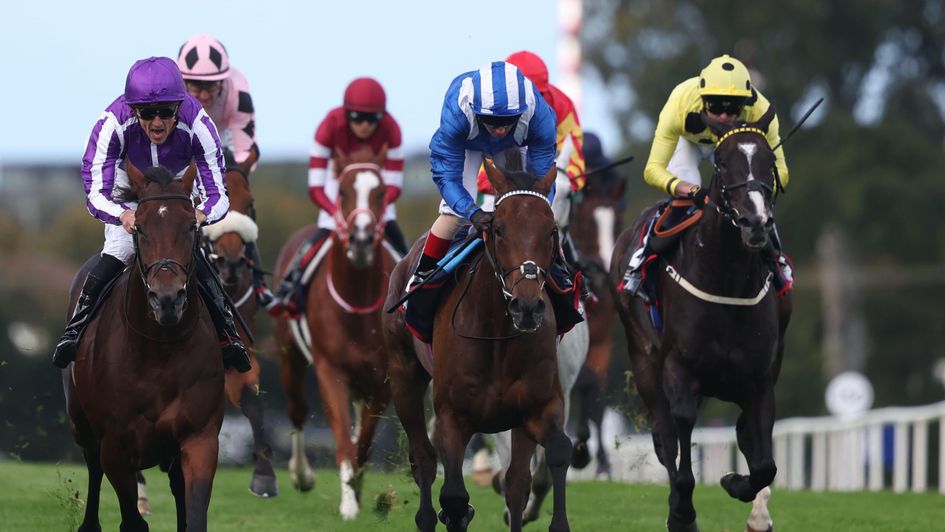
Across at Leopardstown, Delacroix laid down claims to being the best mile-and-a-quarter horse in Ireland with a clear-cut win in the Irish Champion Stakes.
The contest wasn’t a vintage renewal despite five of the eight runners having a pre-race Timeform rating of 121 or higher but the strong-travelling Anmaat nearly always gives his running at this level and distance yet had no answer as Delacroix seized the initiative on straightening up and proved too hard to catch at the end of a well-run race that saw his winning timefigure come in at 122, his best yet.
His rider Christophe Soumillon had a very good day in contrast to his experience for the stable on French Arc trials day at Longchamp six days earlier, landing the listed Ingabelle Stakes on Diamond Necklace and the Champions Juvenile Stakes on Benvenuto Cellini.
Neither bare timefigure was much to shout home about but close to end-of-race upgrades arguably elevate Diamond Necklace’s 87 timefigure to 102, making her clearly the best of those in the race as visual analysis suggested and a plausible 1000 Guineas candidate, while Benvenuto Cellini showed a very good turn of foot to win readily, so much so that a figure of 109 after incorporating sectional upgrades from two furlongs out is a much better indication of his merit than his 79 timefigure.
The other Group 1 race on the card, the Matron Stakes, went to Fallen Angel who was going one better than in 2024 and didn’t have to improve upon her recent Deauville success in the Prix Rothschild to see off the possibly less-than-willing Exactly at the conclusion of a well-run race (timefigure 112).
Fallen Angel’s trainer Karl Burke had a double with Convergent (63) in the steadily run Group 3 Group Stakes where nothing got involved from off the pace. while Alakazi in the Group 2 Solonoway (103, 13lb below his Timeform performance rating) was another always-close-up winner on the day.
Difficulties with exact race distances aside, neither of the two Group 1 juvenile contests on Sunday at the Curragh, the Moyglare Stud Stakes and the National Stakes, were run at an end-to-end gallop though the pace for the National at least ensured little hiding place.
The Moyglare had been won by Fallen Angel two years ago and Karl Burke sent across his unbeaten Prix Morny winner Venetian Sun, but she found herself short of room in a very messy race and could finish only third behind Precise (66) in a 59 timefigure after runner-up Beautify travelled best but seemed not to get home.
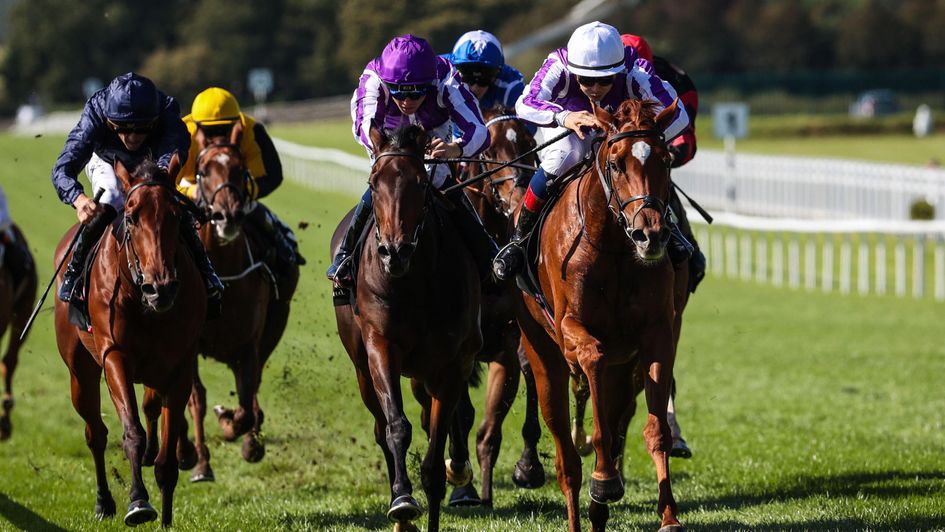
The form of the Morny, which looked the best two-year-old race of the year at the time, was also represented in the National by Gstaad but neither he nor his stable-companion Italy proved up to seeing off the progressive Zavateri whose winning timefigure (108) was a small but sufficient improvement on what he’d registered in both the July Stakes and the Vintage Stakes.
Nighteyes caught the eye from well off the pace in the Flying Five won by Arizona Blaze (113 timefigure) and would interest me for the Prix de l’Abbaye if she is given a supplementary entry, while Al Riffa (100 timefigure) had too much speed at the end of the Irish St Leger for the hitherto unbeaten Amiloc and Al Qareem.
The Blandford Stakes saw a turnaround in recent form with winner Barnavara (95) making the most of an uncontested lead to clear away in the straight with the horse who beat her last time and who I fancied would be well suited by the longer trip Red Letter only third.
More from Sporting Life
- Free bets
- Racecards
- Fast results
- Full results and free video replays
- Horse racing news
- Horse racing tips
- Horse racing features
- Download our free iOS and Android app
- Football and other sports tips
- Podcasts and video content
Safer gambling
We are committed in our support of safer gambling. Recommended bets are advised to over-18s and we strongly encourage readers to wager only what they can afford to lose.
If you are concerned about your gambling, please call the National Gambling Helpline / GamCare on 0808 8020 133.
Further support and information can be found at begambleaware.org and gamblingtherapy.org.