Timeform analyst Graeme North explains the concept of ‘jumpability’ – an assessment of how well horses jump.
What is ‘jumpability’?
The National Hunt season provides the tantalising prospect of last term’s top chasing prospects Shishkin and Energumene moving out of novice company.
How will their jumping stand up against the best of the established chasers around do we think? Can we even measure how well they jump?
Well, yes, we can and have been doing internally at Timeform for some years. We call the metric ‘jumpability’. For those readers unfamiliar with the concept, ‘jumpability’ is an attempt to assign a ‘jumping’ rating to a chaser that measures jumping ability, much as a form rating reflects merit, and is calculated by utilising data that exists within the Timeform database.
For many years now, Timeform has recorded for every performance (where one is deserved) ‘in-play symbols’ – effectively a short-hand notation that indicates noteworthy positive or negative aspects of a horse’s performance, two of which are x (or X) and j (or J). Long-time readers will be familiar with the x as it sometimes appears alongside a rating (or by itself) in the Timeform racecard, denoting a poor jumper (or, if xx, a very bad jumper). Contrastingly, a j (which isn’t a racecard symbol) signifies that the horse jumped well or, if awarded a J, outstandingly well.
From that starting point, ‘jumpability’ ratings are then prompted by allotting a 0 or ‘jump neutral’ value to the horse if it has neither an x or j in-play symbol for a particular race and didn’t fall or unseat; a negative value if it attracted an x or a bigger negative value if it warranted an X, and a positive value for either j or J.
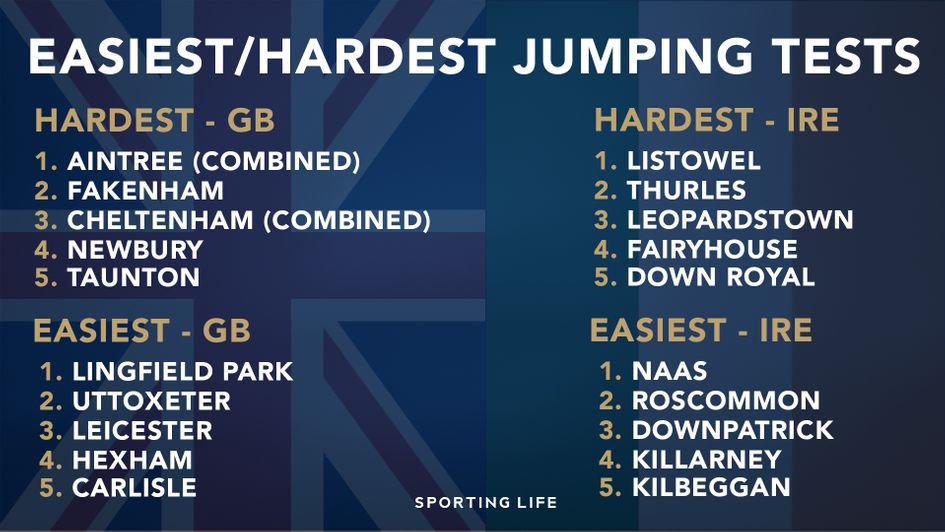
Falls and unseats are negated by a j or J and x’s and falls/unseats are not counted twice within the same race. Those values are then set against all the tracks at which the horse has run, as some courses have easy fences (Lingfield, for example) while others have stiff fences (Cheltenham).
To complete the calculation, those figures are then tweaked further after accounting for field size, race distance, race type (‘novice’ or ‘beginners’ races as opposed to handicaps, for example) and underfoot conditions (because longer distance races in the mud are more likely to prompt jumping errors than small-field affairs over short distances on good ground).
The resulting jumpability rating is recalculated after every run. Horses that have had fewer than eight races are treated as jump neutral for each ‘missing’ race so as not to wrongly label a horse either a superb or terrible jumper based on insufficient runs. And that’s it!
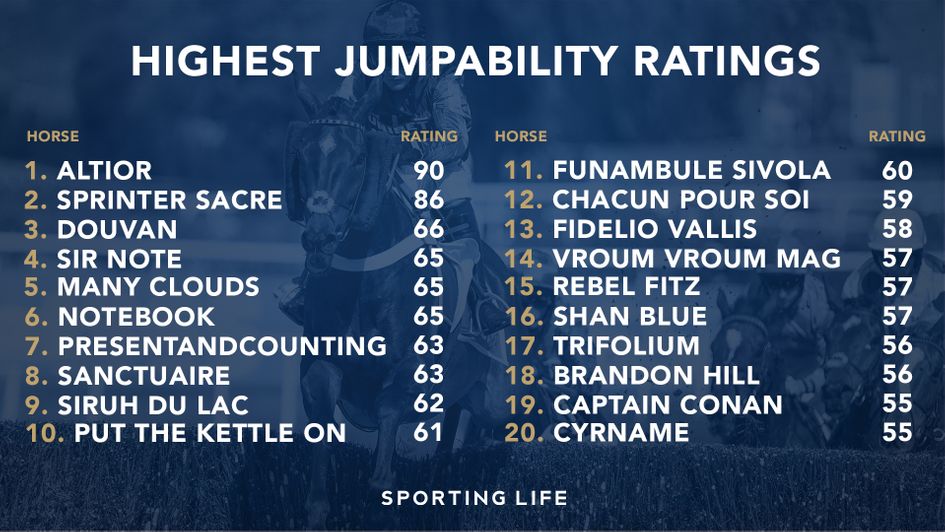
Tables highlighting the easiest and hardest jumping tests in Britain and Ireland as well as the leading jumpability ratings since 2010 are shown below.
Who are the leading jumpers?
The first thing to notice is that not unexpectedly the best jumpers over the last 10 seasons include some very familiar names whose longevity at the top of their tree is in part due to their jumping prowess.
One-time stable companions Altior and Sprinter Sacre dominate the list (the ratings are set on a scale with 100 being outstanding, 0 being neither good nor bad and -100 appalling), while the leading Irish-trained runner is the memorable Douvan.
The best-since-2010 top 20 list highlights a couple of last season’s novices. Funambule Sivola was one of the most improved of his ilk last season, winning his first handicap off a BHA mark of 112 and his last off 143 after which he ran a career best against Shishkin in a good time at Aintree. Still only six, he has got scope for more improvement and certainly won’t be held back by his jumping.
Shan Blue may have fallen on his return at Wetherby but that was a rare lapse from a chaser whose jumping has largely been superb.

How do Shishkin and Energumene compare?
So, what of last season’s other leading novices?
Well, Shishkin didn’t quite make the top ten novices last season (twelfth) but, for all he has made the odd error in his races, he put in an exemplary round of jumping on his debut at Kempton and also earned a small j for his effort in the Arkle.
His main rival in last year’s novice division Energumene falls outside the top 20 with a jumpability score of 31, but that shouldn’t put anyone off. He was awarded a J when winning the Irish Arkle at Leopardstown and showed he was over the issue that kept him away from Cheltenham with a near-flawless display in the Grade 1 Ryanair Novice Chase at the Punchestown Festival.
Energumene’s jumping stood up well in three very strongly-run races last season, all races in which he earned timefigures well into the 160s, and, for me at least on that count, looks the most interesting novice venturing out into open company.
More from Sporting Life
Safer gambling
We are committed in our support of safer gambling. Recommended bets are advised to over-18s and we strongly encourage readers to wager only what they can afford to lose.
If you are concerned about your gambling, please call the National Gambling Helpline / GamCare on 0808 8020 133.
Further support and information can be found at begambleaware.org and gamblingtherapy.org.