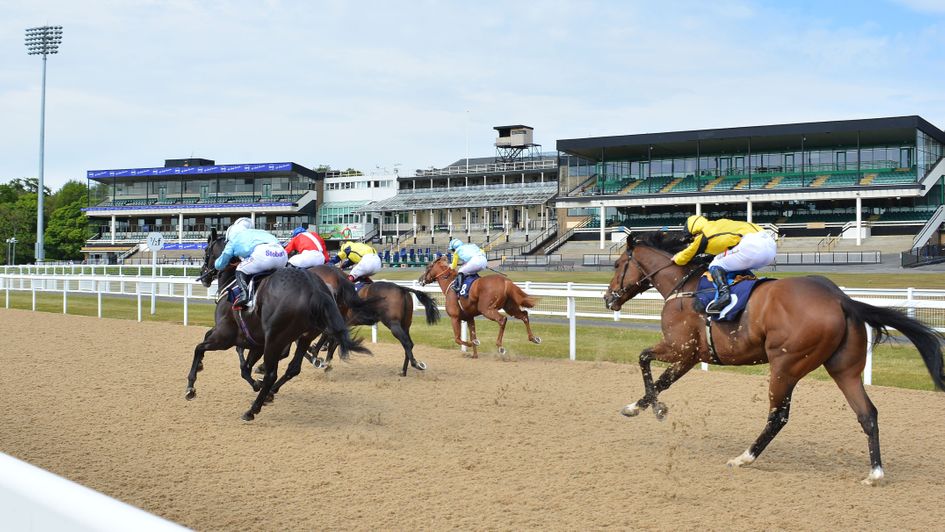
Where would we be without all-weather racing? Once more Britain has been hit by a series of snow storms and abnormal temperatures which have played havoc with the National Hunt schedule.
There have been over 30 jumps meetings in Britain alone abandoned since the turn of the year and the weather forecast continues to look bleak. Hopefully temperatures rise and allow Newbury’s Betfair Hurdle meeting to go ahead on Saturday, but the late addition of another all-weather Flat meeting at Chelmsford on Saturday tempers enthusiasm.
Some love and some loathe all-weather racing, but I lay firmly in the former camp, and there is plenty of analysis that goes into it through the winter months at Timeform. One tool used by our reporters are Early Position Figures (EPF).
They range from 1 to 5 and aim to explain where a horse is positioned during the race, with EPF 1 indicating a front-runner and EPF 5 denoting a horse who is held up at the rear of the field.
One of the best supported all-weather tracks in the country is Chelmsford, largely down to its fairly close proximity to Newmarket, but also due to the prize money which is on offer, usually higher than similar tracks in the country.
Just over a mile a circumference, the track has a polytrack surface and is essentially galloping with broad, sweeping turns. Crucially, since the track reopened (formally known as Great Leighs) in 2015, we have discovered that horses racing prominently have been seen to better advantage.
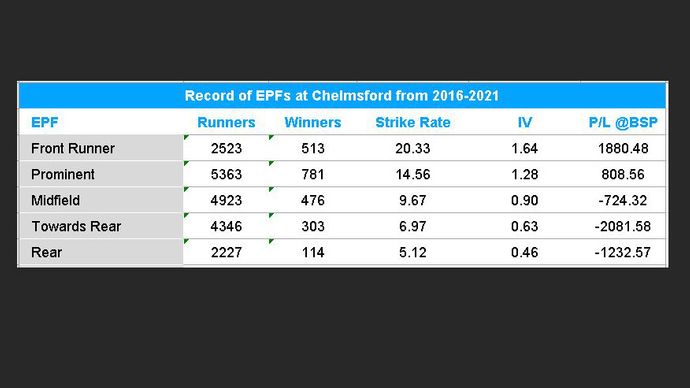
*Impact Value (IV) is a statistical technique which calculates winners compared to random chance. Anything above 1 is good.
The table above displays the findings over the last five years, fully confirming that horses who record an EPF of 1 (front-runner) or 2 (prominent) at the track are seen to much better effect, leading in all three key areas (winners, strike rate and impact value), while also producing a very healthy profit at Betfair starting price.
The emphasis of being at the front or prominent at Chelmsford can differ depending on how the track is riding. The surface can often be harrowed deeper in the winter, which places more emphasis on stamina and tends to suit horses ridden more prominently. This also tends to produce more kickback, which can be an issue for horses ridden more patiently. Horses who turn into the straight prominently are usually hard to peg back, despite the straight being two furlongs long, and horses who tend to come down the middle are often seen to better advantage than those who stay towards the inside rail.
Is it better to be held up at Newcastle?
In contrast, Newcastle is a track where horses who are ridden more patiently can be seen to good effect. The decision to tear up the turf track and replace it with tapeta in 2013 caused uproar as many leading figures in horse racing were dead set against the idea. However, it is hard not to see the decision as anything other than a roaring success in hindsight, such is the calibre of horse Newcastle is able to attract nowadays. Many of Newmarket’s top trainers are often well represented, particularly John Gosden, who can boast a 33% strike rate over the last five years and has become a big advocate.
Enable memorably made a winning debut at the track in 2016, while stablemate and three-time Ascot Gold Cup winner Stradivarius broke his maiden at the track in the same year. Palace Pier also won a handicap at Newcastle on his way to winning the St James’s Palace at Royal Ascot last season.
Top stables are keen to support the track as it is considered as one of the fairest in the country, the long, wide-open straight giving horses plenty of time to organise themselves, while the emphasis on stamina leaves no hiding places. The last four furlongs are all uphill, meaning an ability to see out the trip is essential, and those who press on too early can prove vulnerable in the later stages. This allows hold-up horses to be seen to much better effect.
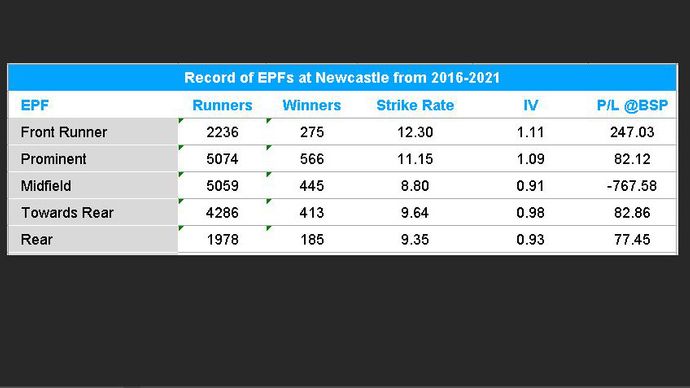
The stats comply with the notion that Newcastle is a very fair track, while also proving that it lends itself well to horses who are ridden more patiently. In fact, hold-up horses have a considerably better record at Newcastle than at any other all-weather track in the country. Along with Chelmsford, Wolverhampton and Southwell are two other courses where patient tactics are generally not seen to best effect.
Early Position Figures are also used by Timeform to analyse how jockeys riding style can differ, and how they fare on horses who are ridden in contrasting styles.
Who are the jockeys to follow when on the speed?
This year’s All-Weather Jockeys Championship is currently being fought out between Richard Kingscote, Hollie Doyle, David Probert, Tom Marquand and Luke Morris. It is Kingscote who currently leads the way, now four winners clear of Doyle at the time of writing, and, the fact he has had less rides than all of the jockeys mentioned shows how well he is performing at present.
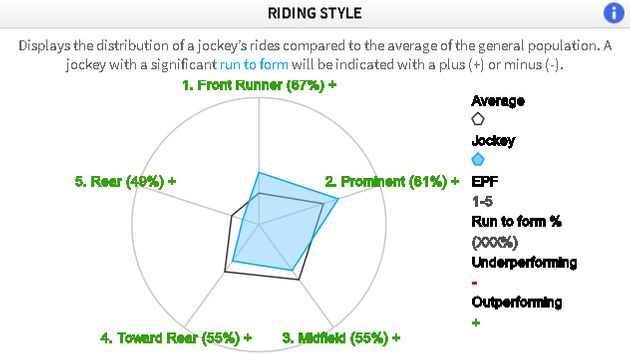
That view is fully backed up by the graph above. Since the turn of the year, Kingscote’s Run-To-Form percentage (RTF%) is above average in every EPF area, demonstrating how much of a well-rounded, in-form jockey he is at present. He has proven most effective from the front, but that isn’t a surprise given he has recorded most of his wins at Lingfield and Wolverhampton since the All-Weather Jockeys Championship started.
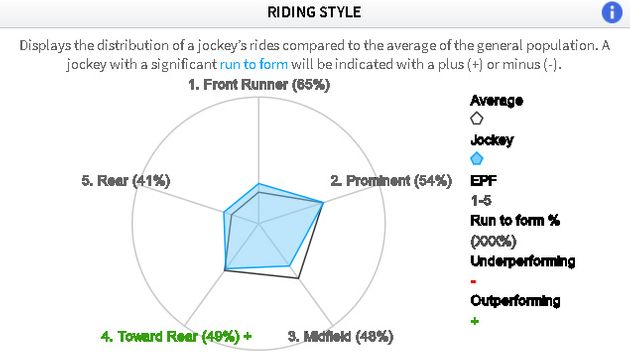
As you would expect, Hollie Doyle’s stats aren’t far behind Kingscote, but she is only reaching an above-average RTF% when riding horses positioned towards the rear. The graph also proves that she is also riding at a very high level at present and it is no surprise she isn’t far behind.
The all-weather jockeys title culminates on All-Weather Finals Day at Lingfield on Good Friday, and it promises to be an interesting battle between all riders concerned. Whilst jockeyship is clearly paramount, it will also come down to the calibre of mounts each rider gets. The likes of Hollie Doyle and Tom Marquand are sure to be in high demand, but for my money Richard Kingscote will be hard to peg back in current form.