John Ingles looks at the origins of Sun Goddess whose earnings are now ten times what she had cost as a yearling.
By any standards, Sun Goddess has had a remarkable season for a two-year-old filly campaigned at the top level, especially one from the modern era. Her win in the Breeders’ Cup Juvenile Fillies Turf came on her ninth start of a campaign which had begun just under six months earlier. She won seven of those races, including three more at the top level in Europe – the Phoenix, Moyglare and Cheveley Park – prior to her Keeneland victory which took her total earnings well into seven figures.
Of course, Sun Goddess is trained by the most successful trainer in Breeders’ Cup history, but it would be wrong to assume that she’s just another blue-blood to roll off the Coolmore production line for Aidan O’Brien to work his magic on. As we’ll see, Sun Goddess is not a typical Ballydoyle filly in terms of pedigree, and an appreciation of her breeding only makes her achievements in 2026 shine all the brighter.
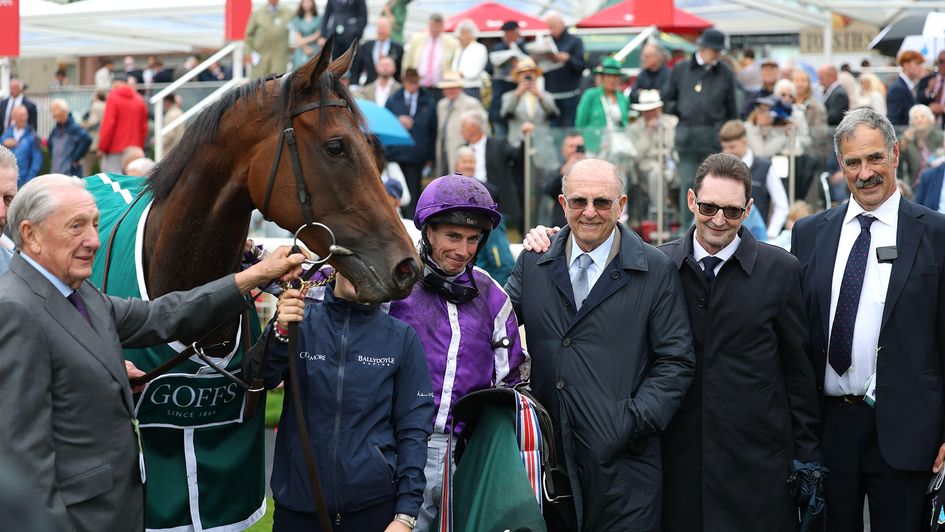
Her sire Sioux Nation was standing for €17,500 the year Sun Goddess was conceived, though his fee was only €10,000 the year before that. His stock has kept rising since, though, and it seems a good bet that his fee will hit a new high again next year from the €37,500 he was standing for at Coolmore’s Castlehyde Stud this spring. But while being a sire on the up, Sioux Nation hadn’t sired a Group 1 winner in Europe from any of his first five crops until Sun Goddess came along in his sixth. His only other Group 1 winner to date is the Australian filly Socks Nation, winner of the 2024 Queensland Oaks.
Sun Goddess wasn’t the only notable two-year-old from her sire’s current juvenile crop as Sioux Nation was also responsible for the Flying Childers winner Final Objective and the Ed Bethell-trained Prix d’Aumale winner Rogue Nation. At 120, Sun Goddess also becomes her sire’s best horse on Timeform ratings, none of Sioux Nation’s previous runners proving better than smart on the Timeform scale.
Sioux Nation was smart himself, though a Timeform rating of 115 put him some way down the pecking order of the Ballydoyle two-year-olds of 2017 behind U S Navy Flag, Saxon Warrior, the filly Clemmie, Fleet Review and Mendelssohn. His best efforts at two came when winning the Norfolk Stakes and Phoenix Stakes, but he found life tougher against the best sprinters at three, winning the Group 3 Lacken Stakes early on and running his best races afterwards when fifth in the July Cup and third in the Flying Five.

As well as being by a less fashionable sire – and as a result - Sun Goddess was picked up by Coolmore for just £120,000 as a yearling which amounts to little more than spare change for an operation that regularly spends millions on bloodstock. While she was the most expensive Sioux Nation to be sold at the Goffs UK Premier Yearling Sale (which qualified her for the sales race at the Ebor meeting), she was only the joint-twelfth most expensive lot at Doncaster overall. There were plenty of other hands she could have ended up in, therefore, which begs the question of whether she would have achieved anything like as much with another yard.
Sioux Nation is a son of Scat Daddy, a sire line which had further success on ‘Future Stars Friday’ at the Breeders’ Cup. Besides Sioux Nation, two more of his sons were responsible for winners, with No Nay Never’s daughter Libertango (one of only two horses to have beaten Sun Goddess) winning the Juvenile Turf Sprint and Justify’s son Haffner winning the Juvenile Turf.
Sioux Nation’s pedigree is interesting because it has threads going back to Aidan O’Brien’s early days as a Flat trainer. He’s a grandson of Johannesburg who was not only his trainer’s very first Breeders’ Cup winner – in the Juvenile on the dirt at Belmont in 2001 – but had also been the last two-year-old before Sun Goddess to win four Group/Grade 1 wins at that age, he too one of his trainer’s many Phoenix Stakes winners before going on to win the Prix Morny and Middle Park Stakes.
O’Brien also trained Sioux Nation’s smart grandam Catch The Blues, one of his first good Flat horses at a time when he was still training jumpers. Owned by Helen Keaveney, whose colours have been carried with distinction more recently by the Grand National runner-up Vanillier, Catch The Blues won the Group 3 Ballyogan Stakes and was twice placed in the Cork And Orrery Stakes (forerunner of the Queen Elizabeth II Jubilee), going close to providing O’Brien with his first Royal Ascot winner when runner-up in 1996.
There’s a Ballydoyle connection on the dam’s side of the pedigree of Sun Goddess too as she’s out of a daughter of Starspangledbanner, winner of the Golden Jubilee and July Cup for Ballydoyle after being imported from Australia in 2010.

Etoile Bleu, the dam of Sun Goddess, never ran and her first foal, Meritocratic, a son of Churchill, could hardly have a more different racing record to his year-younger half-sister. Meritocratic has failed to win in ten starts on the Flat, picking up a Timeform ‘squiggle’ for unreliability along the way, while he was pulled up on his hurdles debut at Hereford at the start of Breeders’ Cup week.
Going back further on her dam’s side, Sun Goddess has royal blood, or at least Royal Studs blood. In fact, the next four mares on the bottom line of her pedigree all won races for the late Queen and each of them earned black type. Her grandam Holly Blue won the Fern Hill Handicap which used to have listed status and was run at the Ascot Heath meeting before becoming the Sandringham Handicap as part of the Royal meeting. The next dam, Nettle, trained by Dick Hern, won a listed race at Newbury at two and was the first foal of Sans Blague, winner of the Galtres Stakes at York for the same stable. Best of the lot, though, was Sans Blague’s dam, Joking Apart, trained by Ian Balding. Earning a Timeform rating of 120, she was third in the 1975 1000 Guineas and won the Strensall Stakes at York later in the year.
While this family couldn’t boast a Group 1 winner at the time Sun Goddess was purchased, two have now come along at once. Three-year-old Thesecretadversary, who went one better than Sun Goddess at Royal Ascot by winning the Jersey Stakes, went on to win the Prix Jean Prat. He’s a great grandson of Holly Blue, the grandam of Sun Goddess.
There’s one other horse in the pedigree of Sun Goddess who deserves a mention because he not only appears twice but was also trained at Ballydoyle, though in the Vincent O’Brien era. That’s the 1987 King’s Stand Stakes winner Bluebird, a $1.1m yearling purchase who raced for Robert Sangster. He’s the sire of both Catch The Blues and Holly Blue. Who knows how relevant, if at all, that is, or any of the other aspects of her breeding that have been discussed here, in explaining why Sun Goddess is the filly that she is. What is more certain is that it’s likely to be a while before her exploits at two are rivalled, and whatever she achieves at three, she has to go down as one of the shrewdest yearling purchases her owners have ever made.
More from Sporting Life
- Free bets
- Racecards
- Fast results
- Full results & free video replays
- Horse racing news
- Horse racing tips
- Horse racing features
- Download our free iOS & Android app
- Football & other sports tips
- Podcasts & video content
Safer gambling
We are committed in our support of safer gambling. Recommended bets are advised to over-18s and we strongly encourage readers to wager only what they can afford to lose.
If you are concerned about your gambling, please call the National Gambling Helpline / GamCare on 0808 8020 133.
Further support and information can be found at begambleaware.org and gamblingtherapy.org.