Following the first sub two-hour marathon in London at the weekend, John Ingles looks at racing's relationship with record times.
‘People said that Sir Roger Bannister’s [sub four-minute] mile was the greatest sporting moment of the twentieth century. Is this the greatest sporting moment of the twenty-first century? I don’t know, but it was just brilliant.’ London Marathon race director Hugh Brasher was speaking last weekend after Kenyan athlete Sabastian Sawe had become the first man to break the two-hour barrier for the marathon distance in an official race, setting a record of 1:59:30.
At the beginning of the century, the marathon world record stood at 2:05:42. But since Ethiopia’s Haile Gebrselassie set record times in consecutive Berlin Marathons in 2007 and 2008, a succession of Kenyan runners had gradually brought the record closer to the mythical two-hour mark, with Kelvin Kiptum setting the previous record of 2:00:35 in the 2023 Chicago Marathon which Sawe broke in London last week. Runner-up Yomif Kejelcha from Ethiopia also completed in under two hours. Sawe’s coach believes he’s capable of lowering the record further on a faster course such as Berlin or Chicago. In racing terms, he is unexposed at the trip, having run just four marathons, this being his second victory at London.
Brasher has a close connection with the other great sporting moment he referred to as his father Chris, co-founder of the London Marathon, was one of the pace-setters in Bannister’s history-making race in Oxford in 1954. Bannister’s mile record didn’t last long however, and, between them, the British trio of Sebastian Coe, Steve Ovett and Steve Cram were among those who helped bring the time down still further later in the century.
Cram, commentating on the Marathon for the BBC, was another to compare Sawe’s achievement to Bannister’s sub four-minute mile. But unlike for the marathon, the record for the mile hasn’t budged at all this century, with the time set in 1999 of 3:43.19 by Morocco’s Hicham El Guerrouj still standing. However, could that too fall on British soil later this year? British record-holder Josh Kerr has stated his intention to bid for the record at the London Diamond League meeting in July, saying ‘It was a non-negotiable to do it in the UK. I think that’s massively special. It’s time to bring the mile world record home.’
What do record times tell us about horse races?
Record times readily identify the best human athletes, but the relationship between race times and racehorses is much less straightforward for a variety of reasons, so there’s no real equine equivalent of a Bannister or a Sawe. The varying profile of racecourses, especially in Britain, make comparison of raw times across different tracks meaningless – hence the need for Timeform’s timefigures - and that’s even before taking the variables of different types of going into account.
In any case, if time records do happen to be broken, that’s almost always just a by-product of factors such as underfoot conditions and race pace on the day, not a goal in itself – jockeys are only intent on beating each other, not the clock.
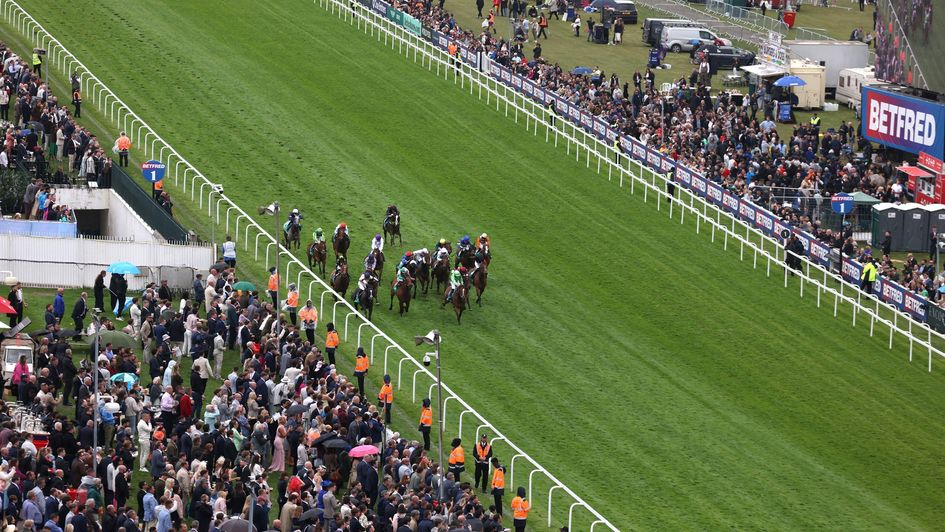
These days especially, on safety and welfare grounds, conditions conducive to producing fast times are positively avoided by tracks if at all possible. If not, trainers will vote with their feet as was clearly demonstrated at Sandown on Jump Finale day last Saturday when, on going Timeform returned as ‘good to firm’, there were a total of twenty non-runners, the majority taken out because of ‘unsuitable ground’. The days are gone at Sandown when top-of-the-ground specialist Tingle Creek would fly round breaking the two-mile chase record or when Mr Frisk won the Whitbread Gold Cup on firm ground straight after breaking the record for the fastest Grand National under similar conditions.
Record times indicate firm ground, and firm ground can heighten the risk of injury, not just over jumps. On a hot day, Sottsass smashed the track record at Chantilly when winning the Prix du Jockey Club in 2019, though rather than seeing it as an achievement, the reaction from the assistant of winning trainer Jean-Claude Rouget was ‘we don’t like hearing records have been broken.’ The stable’s unease about the firmness of the going perhaps proved to be justified as while Sottsass himself was fine afterwards, neither of the placed horses was seen out again that season.
Searching for a sprint star
But my York racecard from Dante day in 1988 reminds me that there was an initiative that year ‘aimed at finding a horse to break the world five-furlong record.’ Sponsored by Skol Lager, the ‘Skol Sprint Classic’ consisted of a series of six qualifiers leading to a valuable final at Goodwood. Here’s how the series was promoted in the racecard:
‘Traditionally, horses have competed against each other and not the clock, but with the introduction of Skol’s new race series, things are about to change. As the Final represents the richest race of its kind in Europe, this all aged five furlong sprint handicap will attract the interest of top trainers and should result in a high-quality field.
‘Amazingly enough, the 53.60 seconds record for the fastest horse over five furlongs has stood for 28 years; it was set by Indigenous at Epsom on 2nd June 1960, but the fact that it was hand timed has always raised the question of its reliability. However, a race was framed in 1983, again at Epsom, in an attempt at the record, and Spark Chief came within split seconds with a time of 53.70 seconds.’
So, did the series find a new five-furlong record holder? No, but by not having any of the races at Epsom – no coincidence that that’s where the previous fastest times had been set - it was almost certainly doomed to failure in that respect from the outset. Besides York, the other qualifiers were held at Kempton, Newmarket, Haydock, Ayr and Newbury whose five-furlong courses are nothing like as quick as Epsom’s downhill track.
Not even Battaash, rated 136 by Timeform and the best British-trained sprinter of recent times, who beat Dayjur’s 1990 York time when winning the 2019 Nunthorpe Stakes on firm ground in a time of 55.90 would have been able to get close to the all-time five-furlong record away from Epsom. Only two of the Skol Sprint Classic qualifiers were won in sub sixty-second times, the races at Kempton and Ayr, which were both won by Abathatc. The Goodwood final, worth over £38,000 to the winner, was won by Ski Captain (rated 83 by Timeform that season) in a time of 59.11, a bit quicker than the on-screen time on the BBC coverage, on ground that was officially firm. Battaash holds the course record there too, winning the 2020 King George Stakes in 55.62.
While the publicity for the Sprint Classic series mentioned Indigenous and Spark Chief, they omitted Raffingora who, in 1970, set a record, again at Epsom, for what was then the fastest ever electronically recorded time for five furlongs. Performing just before the pattern system was introduced, Raffingora earned his top-class Timeform rating of 130 mainly through carrying weights of 10-0 or more in handicaps. He won more races than any other horse in both 1969 (eight) and 1970 (nine), so no wonder Racehorses hailed the big, strong grey as ‘one of the most popular horses ever to race in this country’ and deserving ‘a place among the immortals of the Turf’.
Ridden by Lester Piggott, Raffingora’s Epsom win came in the Cherkley Handicap at the Derby meeting, nowadays the Epsom Dash, in which he got up late from a seemingly hopeless position for a short-head verdict. ‘The electrically recorded time for Raffingora was 53.89 seconds, over a fifth of a second outside the world record time for five furlongs accredited to Indigenous when he carried 9-5 to victory in the Tadworth Handicap at the Derby meeting in 1960’ reported Racehorses, before going on to explain:
‘The 53.60 seconds returned for Indigneous was hand timed. As a general rule, one can expect an electrically recorded time to be around half a second longer than a time taken by hand. Our two representatives clocked Raffingora at 53.38 seconds and 53.35 seconds. Back in 1960, we timed Indigenous at 53.59 seconds, so we can certainly say that Raffingora put up the fastest time for five furlongs that we have ever taken.’
Other horses have come along since to better Raffingora’s official time in the Dash, however. The aptly named three-year-old Double Quick’s time in 1995 was 53.86, while 50/1 winner Stone of Folca was faster still in 2012 when winning in 53.69, a fraction under Spark Chief’s time.
It wasn’t just the marathon record which was broken last Sunday. On the same day in Hong Kong, the track record for Sha Tin’s six furlongs, or its metric equivalent 1200m, also fell. There might be some debate about which horse can lay claim to have run the fastest time historically, but there’s not much doubt about the identity of the fastest horse in the world at present. In winning the Chairman’s Sprint Prize in 1.07.10, Ka Ying Rising recorded his third track record in his last three starts while extending his winning streak to twenty races.

Ka Ying Rising first broke the Sha Tin six-furlong record in November 2024 when running 1.07.43, beating the previous record of 1.07.50 that had been set by Sacred Kingdom in the same race 17 years earlier. Last Sunday was the third time since then that Ka Ying Rising has shaved a bit more time off the record, while in February he had also set a new best time for the seven furlongs at Sha Tin.
Ka Ying Rising almost always has the luxury of coasting home in his races but breaks records even so, which begs the question, could he go faster still? His jockey Zac Purton had said before his latest victory that he wasn’t setting out to break another record, even though that’s what happened.
For Ka Ying Rising, the one minute-seven second barrier looks his equivalent of the four-minute mile or the two-hour marathon. Purton says he gets ‘a hundred messages a week’ telling him to go for a still quicker time, though as he also points out ‘people think you can go out and chase it, but it doesn’t work out that way.’ One day, though, it just might.
More from Sporting Life
Safer gambling
We are committed in our support of safer gambling. Recommended bets are advised to over-18s and we strongly encourage readers to wager only what they can afford to lose.
If you are concerned about your gambling, please call the National Gambling Helpline / GamCare on 0808 8020 133.
Further support and information can be found at begambleaware.org and gamblingtherapy.org.