Simon Holt shines a light on Saturday's King George and wonders where the race would be if geldings had been barred from taking part.
In 1999, Saturday’s King George VI and Queen Elizabeth Stakes formed part of a new ‘World Racing Championship Series‘ which featured races across nine countries and four continents.
The ‘global presenter’ was Chris Lincoln, a hugely experienced American sportscaster, who had a winning smile and a lyrical way with words.
To say that the heavily built Lincoln filled the screen would be an understatement and, in what proved to be a very troubled production at Ascot, he was soon 'filling' for his life.
The show began well enough with a pre-recorded opening charting the progression of newborn foals to adult maturity, but then the wheels came off as technical issues prevented the running of several VTs (video tapes) which the big man had written links to.
For what must have seemed like half a lifetime, with the director close to meltdown and at one point crying out: "This is nonsense!", Lincoln kept talking and talking without really saying anything.
It was a masterful performance, one that the now retired commentator Derek Thompson - no mean filler himself - would have admired.
With the race drawing near after the commercial break, things began to run more smoothly and it was a straightforward call for yours truly as the distinctive grey Daylami stormed clear under Frankie Dettori.

Beaten into fourth behind Swain in 1998, Daylami was an entire horse who got better and better as he became whiter. He was a great example of how keeping good horses in training can pay dividends, and his career reached a fitting crescendo when he won the Breeders Cup Turf at Gulfstream Park.
Unfortunately, and worryingly, it's going to be a small field on Saturday and one which would be considerably weaker if geldings were banned from taking part.
In the absence of Calandagan and Rebel's Romance, the race would have been 'Aidan O'Brien versus Kalpana' and, it should be noted that last year's winner Goliath was also minus wedding tackle.
The subject of geldings running in major Group Ones divides opinion.
France still resists allowing them into the Arc on the basis that the country's top race should produce a winner who can then go on to be a top stallion or broodmare.
On the other hand, shouldn't a test of the best be won by the best irrespective of procreation?
The argument for denying geldings their chance in favour of future breeding prospects grows weaker by the year.
Group One winners over a mile and a half in the King George and Arc - and, of course, in the Derby too - are no longer that fashionable in sales rings where buyers favour speed and precocity.
For example, the progeny of a 'one hit wonder' like Mehmas, who retired after just one racing season in 2016, fly off the shelves and have become much more commercial than many a Derby or King George winner.
The last Derby winner to become a top-class sire was Sea The Stars (2009) whereas Golden Horn, the best winner at Epsom of the last ten years, is the sire of the current Champion Hurdle winner, Golden Ace.
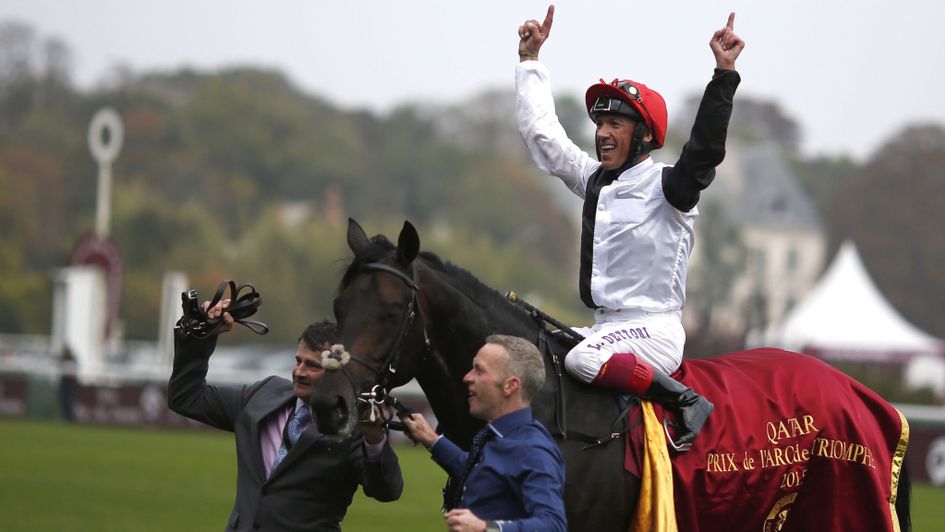
The starkest illustration of what the market thinks of Derby winners is that the best of Golden Horn's progeny include this year's Gold Cup winner Trawlerman and the good stayer Gregory.
But, given his sublime ability as a racehorse, it would be surprising if he couldn't breed faster horses from sharper-bred partners.Given the chance.
The irony is that, for all this headlong rush for speed, Britain can barely boast a decent sprinter - the Jubilee at Royal Ascot was dominated by the French and Japanese-trained Lazzat and Satono Reve respectively - while, thanks to breeding outfits like Coolmore, Juddmonte and Darley, we still do mile-plus horses very well. So much so, that British and Irish bloodstock is much sought after (geldings very much included) by overseas racing destinations.
Lazzat aside, France can also struggle to produce good sprinters and the best horses across 'La Manche' tend also to be better at longer distances.
In terms of the Arc, the race has been won by as many fillies as colts in recent years (Treve, Found, Enable, Alpinista, Bluestocking) but, as an illustration of where the breeding industry sits at the moment, the Prix du Jockey Club (French Derby) has become a successful producer of stallions - the likes of Shamardal, Le Havre, Lope De Vega, New Bay, Almanzor and, most recently, Study Of Man - since its distance was reduced to just over a mile and a quarter.

Despite this, it seems very unlikely that either the King George or the Derby will go down the same road and nor should it happen. That would be a terrible shame.
Instead, the sport should continue to incentivise the breeding and ownership of middle-distance racehorses or else face the dire situation in Australia, a great racing country which can barely produce a staying horse good enough to compete in its most historic race.
Changes to the conditions of next year's Windsor Castle Stakes, for example, are on the right track but have proved controversial and probably go a bit too far.
In confining the race to horses whose sire won over seven furlongs as a two-year-old or a mile-plus as a three-year-old, the BHA's Flat Pattern Committee has excluded a great number of stallions from possible representation.
So few qualify that there is talk that you might need something by Flemensfirth or Walk In The Park to win it.
Or, in the future (if such initiatives work), a Golden Horn?
More from Sporting Life
- Free bets
- Racecards
- Fast results
- Full results and free video replays
- Horse racing news
- Horse racing tips
- Horse racing features
- Download our free iOS and Android app
- Football and other sports tips
- Podcasts and video content
Safer gambling
We are committed in our support of safer gambling. Recommended bets are advised to over-18s and we strongly encourage readers to wager only what they can afford to lose.
If you are concerned about your gambling, please call the National Gambling Helpline / GamCare on 0808 8020 133.
Further support and information can be found at begambleaware.org and gamblingtherapy.org.