With Juddmonte's Field Of Gold hot favourite for Wednesday's Sussex Stakes, John Ingles looks at the five colts to have won the race in the same colours.
Where it all began
In a period spanning around thirty years, Khalid Abdullah won the Sussex Stakes six times with five different colts. It made him one of the most successful owners in the race’s history, with only the Coolmore partners in their various combinations having won the Goodwood Group 1 more often.
Abdullah died in 2021, but his Juddmonte bloodstock empire lives on through his family, and on Wednesday the famous green, pink and white colours will be carried by top-class three-year-old Field Of Gold who will be bidding for a third consecutive win at the top level.
Abdullah’s first Sussex Stakes winner was the four-year-old Rousillon (Timeform annual rating 133) trained not far from Goodwood at Pulborough by Guy Harwood. Rousillon had a good record at his local track as he won his maiden there as a two-year-old and the Waterford Crystal (now Celebration) Mile at three. But along with plenty of ability, Rousillon also had more than his share of temperament, at least as a three-year-old, when he ended up with the ‘Timeform squiggle’. ‘It became increasingly clear’, said his essay in Racehorses that season, that he hadn’t the enthusiasm to go with his abundant ability and his sharp turn of foot’.
He first contested the Sussex Stakes as a three-year-old, finishing second past the post, half a length behind the St James’s Palace and July Cup winner Chief Singer. But it was a rough race with the two colts going for the same gap on the rails over two furlongs out resulting in Chief Singer being badly hampered when Rousillon veered across him. Rousillon was disqualified from second and placed last while his jockey Greville Starkey was found guilty of reckless riding and handed a 14-day ban. That ended just in time for the Waterford Crystal Mile, but even there the odds-on Rousillon only scrambled home with Starkey appearing reluctant to resort to the whip.
‘Too weak a finisher and too difficult a ride to be backed with much confidence’ was Timeform’s verdict on Rousillon at the end of his three-year-old season, so his top-class form as a four-year-old was quite a transformation. Key to that was Rousillon being supplied with a pacemaker, stablemate Cataldi who had won the Lincoln at the start of that season. Rousillon put up a smooth performance to win the Queen Anne Stakes on his reappearance at Royal Ascot after Cataldi had ensured a good gallop and was suited by the fierce pace set by his stablemate in the Sussex Stakes when swooping on the 2000 Guineas runner-up Bairn under a furlong out and going on to win convincingly by two and a half lengths.

Home-bred star shines
It was only three years later that Harwood won the Sussex again for Abdullah with an even better miler, the three-year-old Warning (136), ridden by Pat Eddery. Unlike the American auction purchase Rousillon, Warning was an early success for Abdullah’s own breeding programme as he was by Known Fact, awarded the 2000 Guineas, out of Oaks runner-up Slightly Dangerous, both of whom had carried Abdullah’s colours.
Warning had won all four of his starts at two, including the Richmond Stakes at Goodwood but ended up missing the 2000 Guineas after an odds-on defeat in the Craven Stakes. But after winning a listed contest at Lingfield, Warning started the 11/10 favourite for a Sussex Stakes which lacked a bit of quality compared with the Prix Jacques le Marois which he would contest next when beaten by top-class French filly Miesque.
Warning won a shade comfortably at Goodwood, quickening to lead around a furlong out and passing the post a length and a half ahead of five-year-old Then Again who had been a close third in the Queen Anne. His best effort, though, came later in the season when he won the Queen Elizabeth II Stakes by five lengths – ‘the best performance seen all season on a European racecourse’ said Timeform.
Warning won the Queen Anne himself when kept in training the following season, but having finished second in the Eclipse in the meantime, he was a beaten favourite when bidding to win the Sussex again. That sixth place behind three-year-old Zilzal proved the final start of his career.
Enjoying the View at Goodwood
Eddery was also on board Abdullah’s next Sussex Stakes winner, Distant View (126) in 1994, trained by Henry Cecil who had already trained three Sussex Stakes winners in the 1970s. Distant View might have the lowest rating of Abdullah’s Sussex Stakes winners, but that’s more a reflection of the quality of the rest of the group rather than any shortcomings on Distant View’s part.
Distant View was notable for not having raced as a two-year-old, due to a cannon-bone injury, and won the Sussex on just his fifth start, three and a half months after making his debut at the Craven meeting. Despite being beaten first time up, he still took his chance in the 2000 Guineas, finishing an excellent fifth in a huge field behind Mister Baileys, and after the formality of landing a maiden at Kempton, went to Goodwood after being beaten a head by the 2000 Guineas runner-up Grand Lodge in the St James’s Palace.
The field Distant View faced in his Sussex Stakes was a stronger one than Warning had beaten, with six individual Group 1 winners who had won eleven such races between them, including the previous year’s first two Bigstone and Sayyedati. Sent off the 4/1 second favourite behind Mister Baileys who set a pace on the firm ground which resulted in the track record being broken, Distant View looked to be struggling to hold his place for much of the contest. But he finished the race strongly once Eddery pulled him out wide to make his run and got the better of the year-older Queen Anne winner Barathea by half a length.
Grand Lodge, Sayyedati and Mister Baileys were the next three home. Distant View was below form in his two remaining starts at three, including in the Breeders’ Cup Mile won by Barathea, and a tendon injury scuppered plans for him to race again at four.
The greatest of all time
Cecil won another Sussex Stakes three years later with Ali-Royal but for Abdullah his next Sussex winner was a long time coming. But it’s fair to say the wait was worth it because the peerless Frankel (147) counted two Sussex Stakes victories in his unbeaten 14-race career. Few will need reminding of Frankel’s exploits, but suffice to say that his reputation as being something well out of the ordinary was already established by the time he contested his first Sussex Stakes in 2011.
Only three took him on, but one of those was the top-class older miler Canford Cliffs, the previous year’s winner who had just won his fifth consecutive Group 1 in the Queen Anne. Frankel was sent off the 8/13 favourite and Canford Cliffs 7/4 in the so-called ‘Duel on the Downs’ but, forced to make his own running under a perfectly judged ride from Tom Queally, Frankel looked to have Canford Cliffs in trouble even before he produced an instant turn of foot to streak clear inside the final two furlongs. Frankel’s winning margin over Canford Cliffs, who hung markedly left in the closing stages, was five lengths and it was the second time, after his memorable display in the 2000 Guineas, that he had recorded a Timeform rating over 140.
A year later, Frankel faced another three rivals, though one of those was his own elder half-brother Bullet Train on pacemaking duties. Sent off at 1/20 after his latest eleven-length romp in the Queen Anne Stakes, Frankel strolled home by six lengths this time, from his only worthy opponent Farhh. Frankel remains the only horse to win the Sussex twice since it was first opened to four-year-olds in the 1960s. He had no more left to prove at a mile and completed his exceptional career with wins in the Juddmonte International and Champion Stakes.
A new King is born
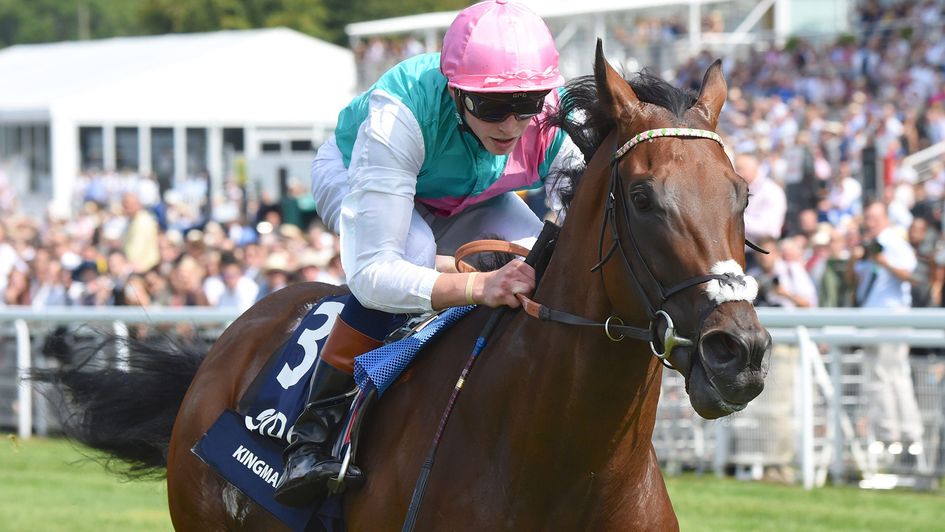
Kingman (134) might not have been in Frankel’s league, but he was another top-notch miler in his own right and provided Abdullah with the final Sussex Stakes winner of his lifetime just two years after Frankel’s second victory. While he couldn’t emulate Frankel by winning the 2000 Guineas, Kingman’s half-length defeat to outsider Night of Thunder proved to be the only time he was beaten in an eight-race career for John Gosden. Kingman avenged that defeat in the St James’s Palace Stakes, after winning the Irish 2000 Guineas, and like Frankel in both his Sussex Stakes, faced just three rivals at Goodwood as the odds-on favourite.
As in the original ‘Duel on the Downs’ three years earlier, the Hannon stable fielded the previous season’s winner Toronado, he too having won the Queen Anne beforehand, as the main rival to the Abdullah-owned favourite. A tactical race turned into a two-furlong dash, and while all four runners were covered by less than three lengths at the line, Kingman’s quality shone through as he unleashed a devastating burst to come from last to first inside the final furlong, with the bare margin of his length victory over Toronado not doing justice to his superiority. ‘I got first first run on Kingman off a slow pace and he has still beaten me!’ said Toronado’s jockey Richard Hughes incredulously afterwards. Kingman had more to spare in his only other start in the Prix Jacques le Marois, though that too wasn’t a truly-run race.
Abdullah’s last two Sussex Stakes winners have become excellent Juddmonte stallions and Kingman is now the sire of Field Of Gold who has trodden an identical path to his sire for John Gosden and son Thady in recent starts. After finishing second in the 2000 Guineas, Field of Gold has been a convincing winner of the Irish 2000 Guineas and St James’s Palace Stakes, apparently having inherited his sire’s potent turn of foot.
He’s now a short price to complete the same Group 1 hat-trick as Kingman on Wednesday, forty years after Khalid Abdullah first won the Sussex Stakes with Rousillon.
More from Sporting Life
- Free bets
- Racecards
- Fast results
- Full results and free video replays
- Horse racing news
- Horse racing tips
- Horse racing features
- Download our free iOS and Android app
- Football and other sports tips
- Podcasts and video content
Safer gambling
We are committed in our support of safer gambling. Recommended bets are advised to over-18s and we strongly encourage readers to wager only what they can afford to lose.
If you are concerned about your gambling, please call the National Gambling Helpline / GamCare on 0808 8020 133.
Further support and information can be found at begambleaware.org and gamblingtherapy.org.