
As we head into the busy Flat racing summer, Adam Houghton reveals the extent to which three-year-olds are typically advantaged in all-aged handicaps.
Backing three-year-olds against older horses in all-aged handicaps is a betting strategy that many punters swear by, and they’ll certainly have plenty to get stuck into in the coming weeks as those clashes start to become a more regular occurrence.
That approach doesn’t pay dividends in every instance, of course, but there are certain circumstances and certain types of races in which the three-year-olds will be of particular interest, a view informed by evidence gathered over a long period of time.
Specifically, it’s in all-aged handicaps run over at least nine and a half furlongs that the three-year-olds have really held sway. And, essentially, the further you go up in trip, the bigger the advantage that age group seems to have.
Using six years of data, from the start of 2017 to the end of 2022, it’s possible to determine the extent to which both those points are true. 2017 is a fitting starting point considering the adjustments that were made to the weight-for-age scale at that time to try and level the playing field and give the older horses more of a chance. Despite those changes, a bias still exists.
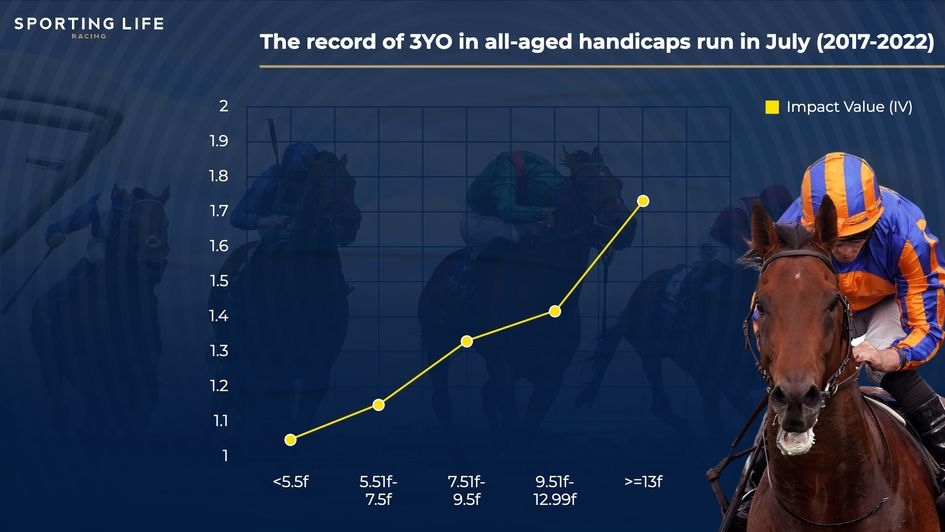
- Impact Values help to compare the number of three-year-old winners in all-aged handicaps to those expected to occur by chance. An IV below 1.00 means they performed below expectation, while an IV above 1.00 means they performed above expectation.
Using the month of July as an example in the graphic above, it is apparent that three-year-olds have performed more and more above expectation the further they go up in distance.
Opportunities over staying trips (>=13f) are not there for three-year-olds against their elders in the first part of the season - they don’t tackle older horses in that category until June onwards - but they make an immediate impact when given the chance and continue to fare well throughout the summer with an IV of 1.78 in August and 1.70 in September.
So, how do we explain the advantage three-year-olds seem to have in all-aged handicaps at this time of year, particularly over longer trips?
The first contributing factor is the aforementioned weight-for-age scale which still leaves older horses at a disadvantage despite the changes made in 2017.
This is an allowance worked out on a sliding scale which considers a horse’s age, the race distance and the time of year. It is designed to account for differing levels of maturity among each age group by giving a weight allowance to the younger runners, which decreases as the season progresses and they are deemed to be approaching physical maturity.
Though not a handicap, Saturday’s Coral-Eclipse at Sandown is an example of a race in which Timeform disagrees with the current weight-for-age scale. The three-year-old Paddington receives 10 lb from the older male horses in opposition, but Timeform believes it should only be 8 lb and that the Classic generation is at an advantage under these circumstances.
Similarly, any three-year-olds running in an all-aged handicap at that sort of trip (a mile and a quarter) at this time of year would be favoured due to the inherent shortcomings of the weight-for-age scale.
Another point to consider is that, as a rule, the three-year-olds have had fewer races than their older counterparts, which means the handicapper has less evidence on which to base their judgement of a horse’s ability.
More importantly, the three-year-olds also get more opportunities to tackle longer trips as the season progresses, a point we made about there being no all-aged handicaps at >=13f until June.
This is often one of the main angles ‘in’ to a race. When you see stoutly-bred horses who have been handicapped on form shown at shorter distances, they are immediately of more interest than most when upped to a trip in keeping with their pedigree. Their potential for improvement is far more obvious than those who have been contesting similar events for a while.
It’s also worth bearing in mind the strength of the three-year-old only handicaps run in the first part of the season. They tend to be highly competitive affairs, containing plenty of unexposed types, and are often a rich source of future winners, so a switch from those events to all-aged events can help show a seemingly averagely weighted three-year-old in a more favourable light.
Speaking of competitive handicaps, the data also tells us that three-year-olds have performed most above expectation in all-aged handicaps at the top end.
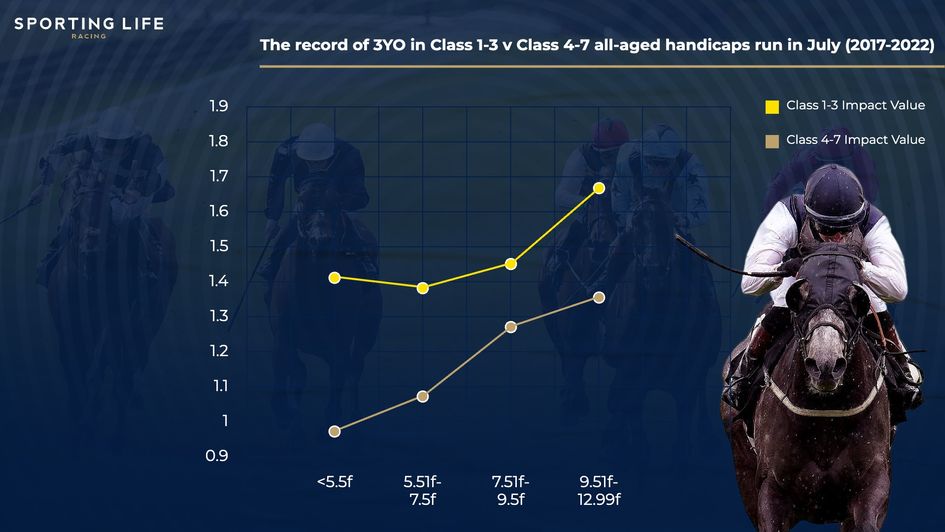
Again, using the data for the month of July from 2017 to 2022, the graphic above highlights how, at all distances, three-year-olds have typically fared better in all-aged handicaps at Class 1-3 level compared to in similar events at Class 4-7 level.
Incidentally, the >=13f category has been missed out because there weren’t enough Class 1-3 races run at that sort of trip to make a meaningful comparison.
There is no escaping the overall trend, though, and when factoring in all-aged handicaps run at all distances and at all times of the year, three-year-olds have an IV of 1.41 at Class 1-3 level, compared to an IV of 1.18 at Class 4-7 level.
Why three-year-olds have performed so much better at Class 1-3 level is perhaps tougher to explain, though the type of opposition they're coming up against must be taken into consideration. It's often exposed rivals who are handicapped up to their best, while the fact much of the proven talent is sold abroad these days must also have an effect, depleting the ranks when it comes to the older horses and rendering these races less competitive.
By contrast, the pool of horses running at a lower level tends to stay fairly consistent and the three-year-olds find themselves coming up against older rivals who are finally coming down the handicap.
Either way, it's food for thought in the coming weeks when improving three-year-olds will be well worth keeping on the right side against their older rivals, particularly over middle-distances and beyond.

Three-year-old handicappers to follow on Saturday
Sceptic (14:25 Sandown)
Sceptic showed improved form to pick up a second career success at Goodwood a couple of weeks ago, quickly asserting after being produced to lead over a furlong out. He is 6 lb higher in the weights on Saturday but may yet have more to offer after just five starts, all of which have come against his own group. He takes on older horses for the first time at Sandown.
Golden Maverick (16:07 Leicester)
Last seen filling the runner-up spot at Newmarket, Golden Maverick will also be coming up against older horses for the first time at Leicester. Still totally unexposed at around a mile and a quarter, he should be capable of winning a race like this from a BHA mark of 67, already having proved himself a very progressive sort for the Ian Williams yard in 2023.
Chartwell House (16:25 Haydock)
Chartwell House has made good progress in three-year-old only handicaps and his latest effort over this course and distance was a significant career best, making all to win by four lengths in impressive fashion. The runner-up won her next start at Newmarket and Chartwell House remains one to be interested in now stepping out of his own age group from a 9 lb higher mark.
More from Sporting Life
Safer gambling
We are committed in our support of safer gambling. Recommended bets are advised to over-18s and we strongly encourage readers to wager only what they can afford to lose.
If you are concerned about your gambling, please call the National Gambling Helpline / GamCare on 0808 8020 133.
Further support and information can be found at begambleaware.org and gamblingtherapy.org