It’s a week when the headwinds have been evident once again.
BHA chief executive Brant Dunshea called on government ministers to halt the introduction of affordability checks after a reform of the levy system was ruled out on Wednesday.
The social licence came under the spotlight following the news that greyhound racing has been banned in Wales and Scotland.
But work on landing the crucial welfare messages is on ongoing. The HorsePWR campaign continues to showcase the standards that underpin the sport and other projects are striving to make a difference too.
Take Equi-ed, as the name suggests an equine education provider, for example.
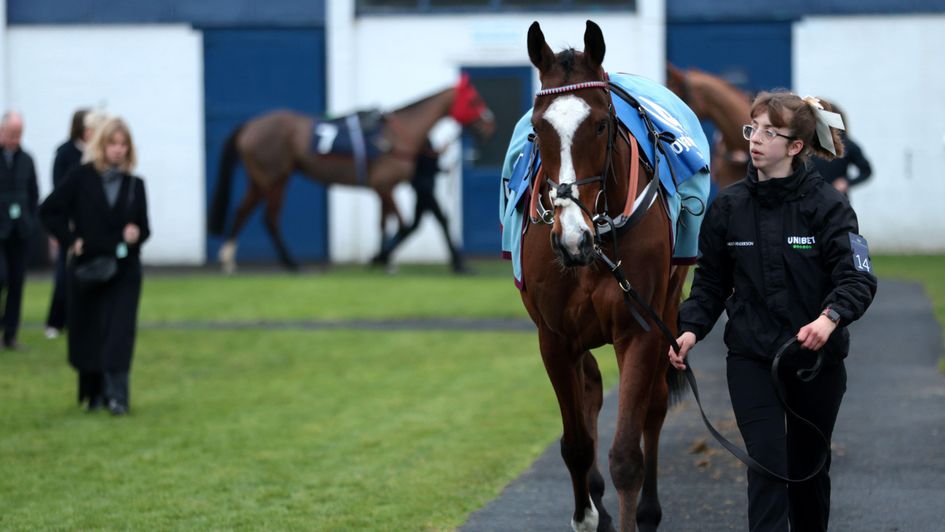
The Jockey Club have partnered with the organisation and funded 100 places for stable staff to receive the training programme. I saw it first-hand at Oliver Greenall and Josh Guerriero’s yard this week.
Leading the course was Therese Murphy, owner and founder of Equi-ed, who explained what their aim is.
“We ran a pilot programme in Cheltenham last year with The Jockey Club to see how stable staff training would be received. And this is different to the training that has been previously provided in that we have a very different approach,” she said.
“It’s very practical to what happens in real life in the yard, and we focus on things like physiology and anatomy, so they understand why things are happening rather than being told this horse has X, this horse has Y. We explain why it happens.
“And then there’s a massive focus on the prevention too, small things that stable staff can do to prevent injury from happening at all, such as raceday exercises. And by that I don’t mean exercise they do with the horse, but daily raceday checks that that can let them know if there is something brewing or about to happen.”
And it’s that element of preventing injuries that drives the work.
“Our attitude to it was, with racing under the microscope as it is, as an industry we do need to say we can do things better. And when I looked at what was available in this area I thought we absolutely could do it better,” Murphy adds.
“That’s where it came from and it was massively successful at Cheltenham last year and The Jockey Club committed to extra training places for staff over here. We’ve made a quite a lot of trips to the UK this year, trained lots of staff, the feedback has been very positive.
“We wrote a specific course for The Jockey Club and it’s an accredited course so it’s nice for the staff to have recognition of the training as well. It’s A-Level 3 qualification so they can build on it if they want to. It’s been very successful. My take on it is if we want to improve our training standards, improve on welfare standards and defend our industry, we must start with the people who are in it.
“These guys are with the horses every day. It’s not about telling them what they’re doing wrong, but little things that maybe they’re not doing at all at the minute. They were maybe unaware that there are little things you can do to prevent injuries, there are little signs before lameness, and we go through all of that.
“We actually bring bones to the training for the detection work that we do so we can actually show what degenerative changes look like, we can show them what kissing spine looks like, we can show them things they’ve only ever seen pictures of in a book - which isn’t real life. It’s science-based, all procedures, recommendations, go through the veterinary team as well and they make sure the information is correct.
“Then we put it into a science-based course which makes sense to the stable staff, and those of us running it have all worked in racing before, all been there. That helps.”

You’re left with a sense that this is an area that has gone under the radar for too long.
“It has,” said Murphy. “There could be any number of reasons for that. Staff training could be one, staff confidence another. Some staff may have seen these things but aren’t confident enough to express it to the trainer, assistant trainer or head lad.
“It’s all stuff that needs to be addressed and we shouldn’t be waiting for the lameness. That’s when you’re absolutely at the end of the journey and are in a problem area. There are always signs before we get to that point.
“We’re really zoning in on that. There are a massive number of injuries that might not happen if prevention measures were better.
“It’s a very traditional industry; this is the way we’ve done things for years. My dad showed me that, his dad showed him that, but with the kind of questions and practical aspects that we do, it really gets the staff involved early on.
“And we ask them for their opinion too. Everybody has something of value to add to us as well when we’re teaching. We’ve had really good feedback, from people who are new into the industry and experienced staff too.
“We have people with very limited experience on the courses and then people like Nicky Henderson’s assistant who did the training and got something from it. That’s very important as it’s not often you get people from those ends of the scale doing a training course and everyone walks away with something.
“If we want to improve the industry we have to stand up and work with the people who can improve it, from the ground up. It can’t be improved from the top down. That’s kind of where I am with it. I’d love to see it rolled out on a wider scale and it’s quite easily done.
“The Jockey Club have funded 100 places. We’re speaking with shareholders and other people who are interested in helping us having seen the training and we’re hoping it will go further. I think The Jockey Club and us will continue to work together but generally I think the funding needs to be found from somewhere for us to get ahead in this area.
“We must be responsible, say that we need to improve, and that stable staff need this training. It’s not just about us providing the training, the staff need to feel valued. They appreciate having an accredited certificate, it’s nice to have, nice to be recognised, and if someone wants to fund more, we’d be pleased to do it.
“We do practical training that makes sense to the staff, working on stuff they see every day. Not just how to put a horse on and off a walker but decide on whether a horse is actually fit enough to go on there in the first place.
“That’s the sort of stuff we’re working on. It’s condensed into a three-hour session with us, but they have an online course as well. It’s different but all relative to their daily working lives.”
And with that Murphy takes the team outside for the next phase of the course.
You leave reassured that behind the scenes, away from the spotlight, work is taking place, progress being made, in areas that could have a material impact on maintaining the public’s trust that we are indeed making the sport as safe as it can be for both our equine and human athletes.
More from Sporting Life
- Free bets
- Racecards
- Fast results
- Full results and free video replays
- Horse racing news
- Horse racing tips
- Horse racing features
- Download our free iOS and Android app
- Football and other sports tips
- Podcasts and video content
Safer gambling
We are committed in our support of safer gambling. Recommended bets are advised to over-18s and we strongly encourage readers to wager only what they can afford to lose.
If you are concerned about your gambling, please call the National Gambling Helpline / GamCare on 0808 8020 133.
Further support and information can be found at begambleaware.org and gamblingtherapy.org.