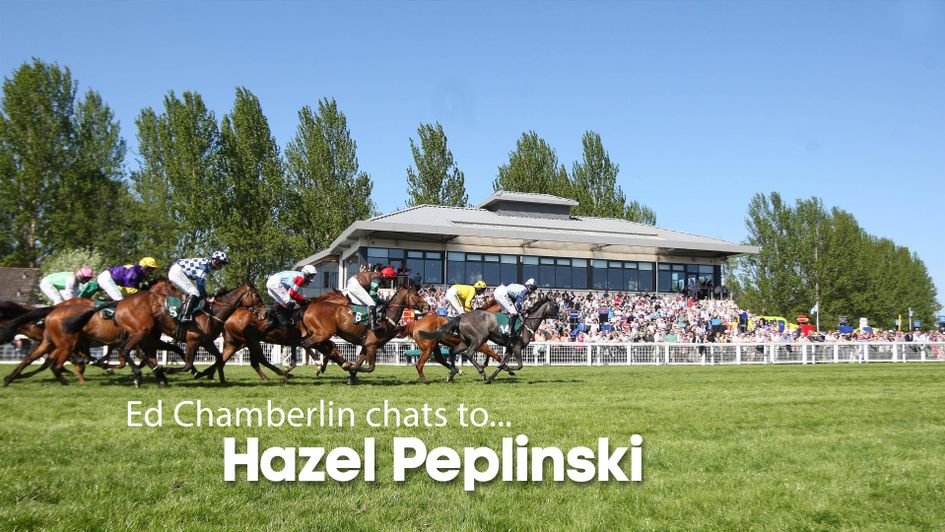
In the latest interview in his series, Ed Chamberlin talks to Perth chief executive Hazel Peplinski about the challenges faced by the independent track.
Ed Chamberlin: This is such a difficult time for our racecourses as we prepare to race behind closed doors. I’m joined by a lady with an incredible CV, Hazel Peplinski. First question how are you?
Hazel Peplinski: I’m fine thanks. Just getting used to living in lockdown with the family at home in Scotland and it’s an incredible parallel really to be living at home and yet all the stresses and concerns at Perth Racecourse. It’s not an environment you want to be making big decisions in, your living room at home, it’s surreal but we are all enjoying good health.
EC: When you talk about that stress how bad is it? How big a danger is Perth Racecourse in?
HP: It's worrying because of the unknown, we’re all working to a timescale and just don’t know the endgame. I think there are lot of racecourses piling up behind Perth. It’s quite well known we have concerns. We had cash concerns before the pandemic even hit and it is a real worry but I’m trying my best now I have my head round it to keep a perspective. We all know why the lockdown happened, we all know why there’s no racing, and the health of our families and communities are more important.
EC: Let’s rewind the clock then. You came to Perth from Hamilton where you had a very successful spell. Pre-lockdown how was it going?
HP: I had a very happy time at Hamilton. I was part-time clerk of the course and really involved with the sporting side and not the commercial one. But when my predecessor at Perth asked me to take over there it was such a privilege and I couldn’t resist the offer and off I went.
It was four years ago. We all know Perth has a unique charm, magnetic qualities that I remember since childhood, that sprinkle of stardust, so I leapt at the chance. But when I got there I soon realised it wasn’t all rosy in the garden.
There was still huge potential but arrived with a welterweight of loans that needed to be paid. We’d invested heavily, maybe £5million in the last ten years, and the assets were really good. The only thing that was missing when I arrived was a modern irrigation system and that’s the first project I pushed through because I saw what the groundstaff were having to contend with and that’s been a gamechanger in giving the horsemen the confidence they need to travel up to Perth.
But in terms of its popularity we now sell out or ladies day every single year, it was supposed to be today (Thursday) and a sunny day is forecast. That is now an iconic date for everyone in the Perth area, everyone knows Ladies’ Day is, and that sort of connection runs through all 15 of our fixtures. We have an economic impact in the region of over £11m annually and while that causes traffic chaos on raceday, the community are proud of what is an iconic rural venue.
It’s been in existence at the Scone Estate since 1908 but there’s been racing in Perth for over 400 years and we really don’t want it to stop because of the current pandemic.
EC: Overall how important was the summer of 2020 going to be for you, financially?
HP: We were so excited to be welcoming the ITV cameras for the first time. We’ve increased gate receipts by some 70% since 2016 and this year advance sales were at record levels and it was to be our watershed year. It’s been a ten year journey repaying these loans and we were probably within eight months of getting ourselves back into the black. We were so excited about 2020 because all the trends were pointing in the right direction.
We’d replaced our catering partners, the retail offering had taken a quantum leap, average spend per head had gone up 50% last year so we were on the brink and could smell the success and then the middle of March happened and we all know the rest.
EC: You’re on the cusp of everything being sorted and then the rug is pulled from underneath your feet. Talk us through it.
HP: We’re a very close-knit team, nine full-timers in the racecourse business itself, we have a hotel and 18 staff ready to go there which was relaunching at Easter time. It was an emotional time because the stark reality was dawning on people at a different pace and I remember having to check myself because I was thinking ‘that ain’t gonna happen’ but couldn’t articulate to people who hadn’t got up to speed with the enormity of what was happening.
Our office mantra is that we’re an exporter of fun, it’s what we do for a living. We organise mass gatherings and as far as all that was concerned it was lights out for the foreseeable future. I had to cope with a team who put their heart and soul into it. There were various levels of shock and disbelief and it was really, really tough.
We were having to make very tough decisions from home once lockdown started. You find yourself asking ‘are we really going to give refunds’ for April, May, including our Ladies’ Day, the Gold Cup in June, and when is this going to end? It was a little bit paralysing but we’ve now got our heads round it.
Amazingly 50% of those who had bought tickets have carried their bookings through to 2021 rather than get money back.
Time has gone on and you can now understand why it’s happened but it’s the biggest anti-climax of my career, and I’ve been in racing for 30 years, and have never seen anything like it.
EC: So where do we stand now? What do you need and what help are you getting?
HP: You probably want an accountant as a chief executive at the moment. I’m not the modern manager – I’m a farmer’s daughter, a former amateur jockey, but with a huge amount of determination, passion and competitive spirit. I’m proud of what we’ve done at Perth and won’t let it drop on my watch if I can at all help it.
You surround yourself with good people, we have a financial advisory group to try and thinktank our way through this, work out the very worst-case scenarios and work back from there. But it keeps changing so it’s tiring. We have very good bankers, they’re Irish and have seen us replay large sums before over the years so they are just trying to help us through each milestone this year.
We review the situation, we’re putting cash flows through to them all the time and we have to be realistic, we don’t know what the worst-case scenario is. When are we going to be allowed mass gatherings again? Behind closed doors is ok. I see it as a short-term necessary evil but our business is live entertainment. We’re going to be denying owners the chance to come and see their three mile chaser gallop over 18 obstacles on a summer’s day. That is really, really tough but if it’s something we need to do to move forward and get the economy re-started then we’re all up for that.
Hopefully things will calm down and we’ll be able to relax these stringent social distancing measures and get things like hospitality back on the go.

EC: What help are you getting from the sport, the BHA, other Scottish tracks, the big groups?
HP: First of all we applied for every grant and scheme going in Scotland. We’re benefitting from the government’s furlough scheme as well. Our hotel won a small award, a Scottish tourism grant, but as I said because we don’t know the end game it’s extremely difficult for the Levy Board to commit at this time to any further support than they’ve already pledged.
They’re giving us cash advances on our racecourse services grant, they’ve offered us a working capital loan but to be honest they’re not proving too popular. The repayment terms are not that appealing compared to what I can get with my own bank.
As an industry we’ve spent so many hours since the middle of March discussing self help and emergency funding and I’ve been in racing a long time and predictably during these crises, and this one is by the far biggest, stakeholders do tend to resort to their own agendas so it can get a bit feisty.
I’m hearing racecourses are viewed as commercial entities and therefore should not qualify for any financial support. But commercial – how do you interpret that? We do try and maximise profits but only so we can reinvest as much as we can back into our sport. The majority of racecourses exist for the furtherment of the sport, we reinvest all our profits back into prize-money, customer experience and our facilities.
So where is the crime in taking a commercial approach such as that? Just to optimise our effectiveness – there are big and small racecourses and British racing has a uniquely rich tapestry that we’re all very proud of and it would be much the poorer if some of the more smaller threads, represented by the smaller, independent tracks, were allowed to snag. That’s my view anyway.
EC: Of those other courses is that the likes of Cartmel, Hexham, Newton Abbot?
HP: This pandemic has struck arbitrarily. The small racecourses who have a summer season are struggling. It will be very bad luck on us to lose all the fixtures. Those who raced through the winter aren’t in the same situation but we at Perth go into hibernation. We haven’t raced or traded since last September. Newton Abbot lost the back-end of their season to that dreadful wet weather so yes they are the ones that are vulnerable because our window to trade, to prosper for the future years, is a very short one.
It all blew up just before our first April fixture and we could still be behind closed doors, if we get started, at the end of 2020. Our worst-case scenario is no racing at all in 2020 and other racecourses, if by chance they get going in the autumn, the likes of Kelso, are in a different position.
The Scottish racecourses do work together, we speak frequently on the old Zoom calls, and that has been a huge source of support.
EC: I can’t get over how everything has collided with you at the same time. Down the track Hazel is racing behind closed doors an attraction to you? I’m not saying it’s an option but if there was a weekend in July and there was ITV coverage – would that appeal?
HP: It certainly would. We’re all stakeholders working together and as I said we’re competitive, we desperately want the likes of Lucinda Russell, Nick Alexander, Lucy Normile, all the Scottish trainers to get their horses out.
They’re all chomping at the bit and horses are ready go to go. Even if it just washed our face we’d want to race. There are huge operational plans, huge compliance issues that has to be done to implement all the social distancing and hand hygiene on a raceday. With all of that our forecasts suggesting it would be worthwhile, even it we just break-even; it would get things happening for people again.
Horses in training need to win prize money and kick everything off again and we’d be very, very keen to do that. The ground hasn’t been raced on since September. I walk it every week and you can see it blooming into life at this time of year. It’s a heartbreaker to just see that but it’s having a well-earned rest and by July it will be completely level, ready to go and we would even take on some extra fixtures if they were available to try and make up for some lost time.
EC: One thing I’ve learned is the importance of the local community in racing – and that’s the key to you in Perthshire isn’t it?
HP: It is. I’ve spoken of the economic impact and we’re a well-known, iconic venue. Everybody is very proud of Perth. The hotels do well, the bars are always full, everyone in Perth knows when racing is on because the street is alive, the night before and after. Very often we stage two and three day fixtures and all the hotels fill up. We have a hoteliers night when they return their appreciation for what the racecourse does for the town by sponsoring races.
We’re very well integrated within the local community. Our hotel has helped with that because we have conferences and people stay over. It’s brought the racecourse, which can he quiet between fixtures, into a little, local hub. People turn up, go for a walk down the River Tay, come back and it’s much livelier every day now than it ever was.
EC: Finally then Hazel for local people who are worrying, racing fans who are worrying and reading horror stories that Perth might not survive. What’s your message?
HP: I’m doing absolutely everything I can, surrounding myself with people who are cleverer than I, to work our way out of this. I cannot comprehend the racing industry allowing places like Cartmel, Perth and Hexham to drop off and not exist in the future. We will be there but are competitive and want a level playing field to compete on.
We don’t want to be coming back trying to make up lost time just because the pandemic hit in March. I will be doing everything, fighting to the end, to make sure we can come back as fit and strongly as possible after this lousy virus has been sent on its way.
Responsible gambling
We are committed in our support of responsible gambling. Recommended bets are advised to over-18s and we strongly encourage readers to wager only what they can afford to lose.
Sky Bet's responsible gambling tools are detailed here and if you are concerned about your gambling, please call the National Gambling Helpline on 0808 8020 133, or visit begambleaware.org.
Further support and information can be found at GamCare and gamblingtherapy.org.