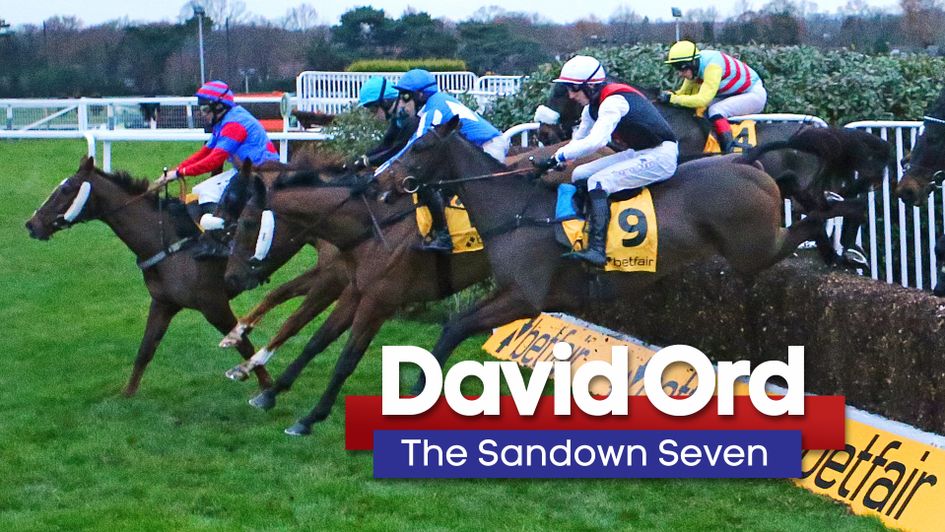
David Ord speaks to solicitor and former professional National Hunt jockey Rory Mac Neice following his involvement in the successful appeal for the 'Sandown Seven'.
Rory Mac Neice, the solicitor who represented the ‘Sandown Seven’ in their successful appeal over the London National bans, hopes that “as robust a procedure as possible” is now put in place to stop a race if the situation demands it in the future.
The Esher contest was voided on safety grounds as the wonderful Houblon Des Obeaux was attended to after suffering a fatal heart-attack on the first circuit.
But despite the deployment of a Sandown official with the yellow stop flag, the jockeys continued to the finish and were handed ten-day suspensions afterwards.
They were quashed by an Independent Disciplinary Panel in London Monday, an outcome Mac Neice was expecting beforehand.
“I was pretty confident and I thought on balance we’d win because the evidence of the riders was they didn’t see the flag. It was difficult for all parties and this isn’t a criticism of the racecourse or anyone else, but stopping a horse with a single flag depends entirely on the riders seeing that single flag,” he said.
“That is always going to be fraught with difficulty. So if the riders didn’t see it, and their evidence was they didn’t, the only remaining question was should they have done?
“I thought it was difficult to see how the regulator could argue they should have when you consider where it was. Sandown is a tricky, technical course to ride and the point where the incident occurred, pointing at the Pond Fence, is one of the trickiest parts of the course. It was also in the closing stages of the race when they are asking their mounts for maximum effort.”
So where do we go now?
“What this case has done is given the sport as a whole a window of opportunity to look at this issue. I felt it was a shame – and again this isn’t a criticism aimed at any single party, that the issue had to be dealt with as a disciplinary matter when in reality we’re taking about a safety-critical issue,” Mac Neice argued.
“All the parties need to come together to find the fix. What is that fix? Well that’s not a matter for me but the greater the warning, the more likely the chance the riders will see it. Rather than relying on one flag, there could be four, five, or six deployed. That would seem a relatively straightforward proposition.
“When it comes to stopping a race, racecourses have to make a very difficult decision under significant time constraints. I thought they (Sandown) made the right decision and as quickly as they could. When a race is stopped it puts people in close proximity to galloping horses, it’s in everyone’s interest that as robust a procedure as possible is now put in place.
“It’s in the interests of the riders, the owners of the horses who don’t want them racing after it’s been decided to stop a race, and of course the protection of the racecourse personnel on the track who could be tending to an injured horse or jockey.”
For Mac Neice education isn’t an issue – the riders at Sandown were fully aware of what was expected of them.
“All of the jockeys said in a very clear manner on the day of the appeal that they knew what a yellow flag meant – that the race was over. In those circumstances, there is no sense in continuing had they seen it as the race was over.
“It’s a difficult situation for everyone, including the racecourse, and for what it’s worth everyone on the day tried their best. It’s just a shame the matter had to be resolved as an adversarial disciplinary process. From my perspective it would have been much better to have dealt with it as a safety-critical issue that required the input of all parties to find a solution.”
The Professional Jockeys’ Association have joined Mac Neice in calling for more flags to be accessible to make it clearer – and easier – to stop a race.
What is abundantly obvious is a lone man with a solitary flag isn’t enough – even if his waving is deemed to be of acceptable urgency.
Perhaps six would do the trick but as David Yates pointed out in his column in the Mirror on Thursday, we need only look across the channel for another solution.
In France, a klaxon sounds to make it clear that the race is to be stopped. At Sandown jockeys admitted to hearing a whistle as they passed the Pond Fence but felt it was a warning of an obstruction at the obstacle.
A different, distinct sound such as the klaxon, used only when proceedings need to be halted, would leave no room for doubt.
There’d be no excuses for anyone not responding to it, alongside a series of flags. Robust, straightforward and no grey areas. Let that be the legacy of the London National debacle.