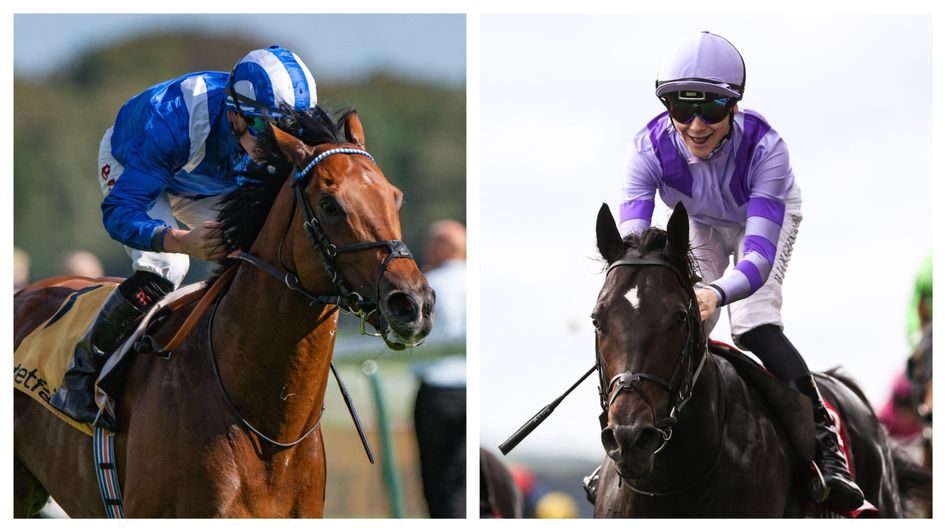
Lewis Tomlinson revisits the Group 1 sprinting scene in Europe after the recent dual successes of Almeraq and Comanche Brave.
“They all take turns at beating each other.”
It’s a barb that has been commonly thrown at Pattern-level European sprints in the UK and Ireland for several seasons now, the division’s perceived dearth of quality and lack of a clear pecking order having led to varying degrees of criticism and disinterest amongst racing voices.
Now, I must admit, I remain a faithful devotee of the Group 1 sprints. I love the longevity of many of the top sprinters, the fact that they regularly retain healthy field sizes and as a man not averse to backing a 40/1 outsider in the right circumstances, they provide plenty of opportunity for me to try and take a money from a bookmaker in my favourite way possible, cheering a longshot pick scrambling home into a never-dangerous fourth of four places. Punting successes rarely feel much sweeter than that, I find.
But even for someone as fond of these races as I am, in 2025 the accusation was very much found to be true, with each of the eight British and Irish Group 1 sprints going to a different horse.
In fact, only one of those top-level scorers - Sprint Cup winner Big Mojo – won domestically in lesser Group company during the same season, having also landed the Pavilion Stakes on his comeback (though it is worth acknowledging that the Aussie-trained Nunthorpe heroine Asfoora also took the Prix de l’Abbaye at Longchamp).
Nevertheless, that the Group 1 winners weren’t confirming their superiority at a slightly lower level was rather telling of a muddled division. Plenty of capable horses, but no great ones. Even Lazzat, who still finished 2025 as Timeform’s top-rated European sprinter, failed to win again after a Queen Elizabeth II Jubilee Stakes success that hinted that he could become the dominant sprinting force.
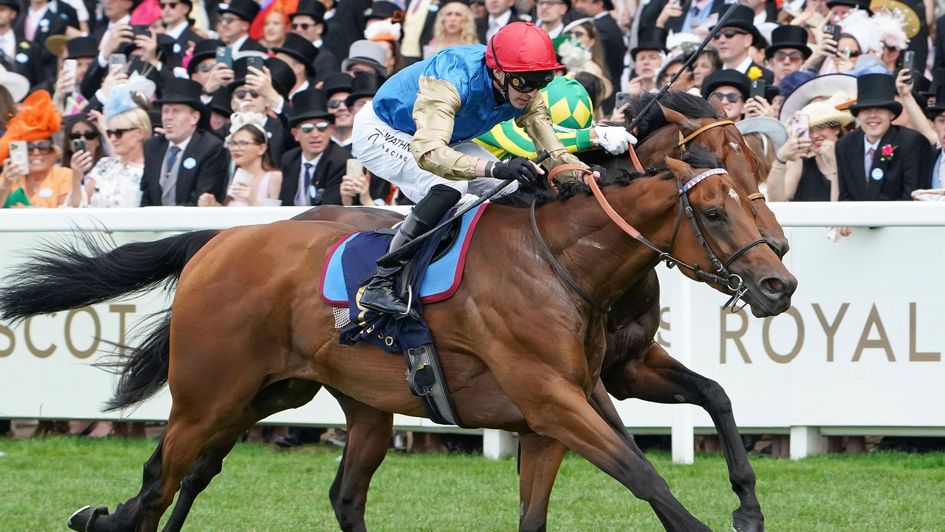
Even allowing for a rather subdued spell of outstanding horses in the division, the near-total parity of last year was a bit of an anomaly; Bradsell, Shaquille and Highfield Princess all recorded multiple Group 1 wins in the preceding seasons, but it’d be fair to say that several of the top-level sprints proved thin in their absences; without intending any disrespect to the horses or their connections, the likes of Powerful Glory, Moss Tucker and Montassib might return as Pointless answers if you were to ask a knowledgeable racing crowd to name a Group 1 winner in the same timespan – the recent roll of honours of the very best sprints sometimes reading as less of a “Who’s Who” and more of a “Who’s That?”
But the early autumn in 2026 has provided us sprint fans with some green shoots, as in consecutive weeks, Almeraq and Comanche Brave have notched their second Group 1 successes of the season. Both are 4-y-os, both are relative newcomers onto the top-level sprinting scene, and both still appear to be firmly on an upward curve. Could these horses drag the sprinting scene from out the doldrums, and just how far down into them did we go?
Now, it’s worth contextualising that, in the years preceding the pandemic, racing fans were treated to a freakishly talented group of domestic sprinters; Battaash, Blue Point and Harry Angel were all able to fire in performances rated 130+ by Timeform with regularity, whilst Marsha and the US-trained Lady Aurelia also broke that barrier when filling the first two positions in the 2017 Nunthorpe. Mecca’s Angel never quite managed to breach the 130 ceiling, though her back-to-back 129-rated victories in the preceding renewals on the Knavesmire mean she’s also more than worthy a mention when discussing great sprinters of the era.
The Australian-trained Nature Strip (132) the only horse to since break that 130+ barrier on these shores, achieved when handing Twilight Calls a four-and-a-half length beating in the 2022 King’s Stand Stakes. In fact, the best performance since Covid by a British-trained sprinter came from the fragile Minzaal, who posted a rating of a 127 when blowing apart a quick-ground Sprint Cup back in 2022, his final career start having suffered a slab fracture to his knee in the process of that victory.
That being said, the average rating of the best British or Irish trained runner across recent five-year periods has been in gradual decline since 2010 across the majority of British sprinting Group 1s, the phenomenon maybe not quite as immediate as some may believe; that set of pre-pandemic superstars perhaps masking what was becoming an increasingly shallow pool of rivals for them to beat – or to capitalise at the top level in their absences.
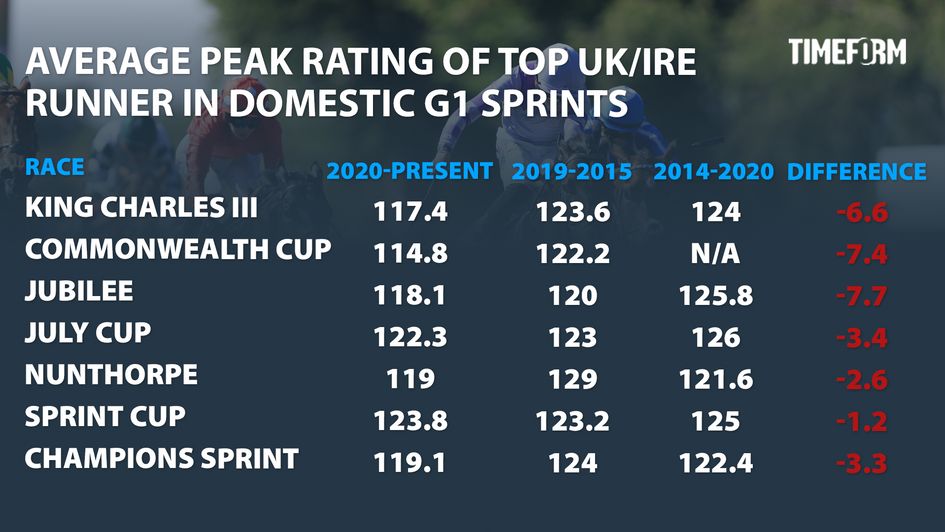
The exceptions to this are the aforementioned period of absurd strength for the Nunthorpe between 2015 and 2019 and an unsurprising slight pick-up for the Champions Sprint after being repackaged from its former guise as the Diadem Stakes, but the overall story of decline remains easy to read.
The traditional Royal Ascot open sprints have been the chief sufferers – most notably that of the Jubilee, the average peak rating of the leading local runner more than a half a stone lower than that of a decade earlier.
The July Cup, another race that often has some international flavour to it – although not quite with the same amount of overseas success, has faced a slight deterioration, just as has the Sprint Cup, although Almeraq’s 126-rated winning effort has given that race a recent boost. The Commonwealth Cup, introduced only in 2015, has also seen a rapid reduction of 7.4lb in the average rating of its winner, its status as a Group 1 even coming under threat by the European Pattern Committee back in 2024.
Trends within racing come and go, and most can be explained by market forces, which perhaps makes it even more surprising that an increasingly speed-focused breeding industry hasn’t translated to a better quality of sprinters on the track – though it probably wouldn’t have taken Nostradamus to predict that the likes of The Wow Signal, Cappella Sansevero and Coulsty wouldn’t prove major assets to the bloodstock world.
It’s hard to blame the Eastern-bound talent drain either for the lack of top sprinters on these shores at present, the sprinting divisions in Australia and Hong Kong - home to Ka Ying Rising (137), by Timeform’s assessment the best racehorse on Earth at present – regularly superior to their European counterparts and therefore rarely a source of much interest for their buyers.
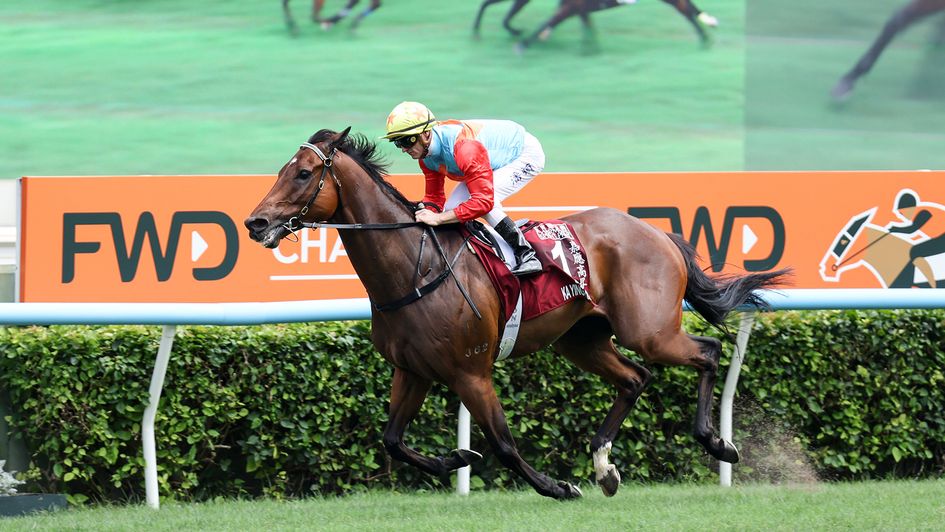
In fact, it was a middle-distance export in the shape of Redkirk Warrior (127) who proved the biggest loss to the domestic scene on Timeform ratings. He won both starts over 10f for William Haggas prior to his reinvention as Group 1 winner over half that trip for David Hayes in Australia, though he failed to make an impact when returned to Britain for cracks at the Diamond Jubilee and July Cup.
Peniaphobia (125), a Super Sprint winner for Richard Fahey, continued to develop from Tony Cruz after being exported and is probably the most successful ex-British sprinter to have plied in his trade in Hong Kong, Kevin Ryan’s Prix Robert Papin winner Atomic Force and Wings Of War, who won a Mill Reef for Clive Cox, not really scaling the same heights during their time in the Far East more recently.
It's also a salient point to make that the lack of a standout sprinter provides the sport with a different type of positive, giving trainers that fish in a different pool to the international heavyweight operations a chance to taste success at the top. The talents of Ed Bethell, Jim Goldie, Adam West and Julie Camacho – all of whom gained breakthrough Group 1 successes with their sprinters in recent seasons - have long been familiar to those who follow racing across all levels and it’s clearly healthy for the ecosystem of the sport for yards that lack the financial clout to mix at the top table over Classic distances to have a division where the big guns don’t quite possess the same depth as they do elsewhere.
Nevertheless, there are reasons to have some positivity for a potential upturn in the fortunes of domestic sprinters. Blue Point wasn’t at his best until aged five but sired top-level sprint winners in Kind Of Blue and Big Evs from his first crop and can also count this season’s Minster Stakes winner Elmonjed and Double Rush, whose 118-rated victory in Wokingham was rated as the best sprinting performance seen at Royal Ascot this year, amongst his progeny.
The similarly late-maturing Starman also made an immensely encouraging start to his stud career, with his freshman crop including Commonwealth Cup winner Venetian Sun, Karl Burke’s filly now joint-top of the 3-y-o sprinting pecking order in the UK after her rating of 118 was equalled in France at the weekend by Katie Scott’s upwardly-mobile Naana’s Shadow. Neither of those stallions could be accused of proliferating “cheap speed” into the breed by any means.
Things also make for kinder reading at minor Group level; races like the Minster – a sensibly-positioned seasonal return for many a top sprinter -, the Chipchase, the Coral Charge and the Bengough all maintaining a reasonably similar level of quality across the 15-year period.
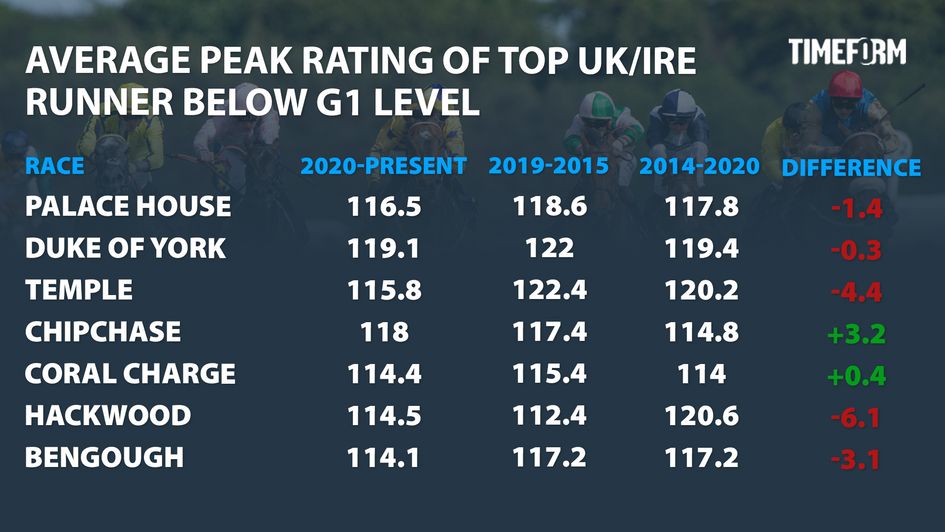
The Palace House Stakes – remarkably won by a Group 1 scorer every year in the 2010s – and the Temple Stakes (another race whose Group 2 status had been under threat) had been making been for slightly disconcerting reading on the figures, but Night Raider produced well up-to-scratch winning performances (both 118) to pump the average of those races back up this year. It stands to reason that these early season contests will always attract Group 1 performers in need of a comeback run and it was clearly an easier task for the likes of Kingsgate Native, Sole Power or Battaash to record a solid 120s figure in this type of contest than it would be for horses like Rumstar, Mgheera or Kerdos. It’s almost worth mentioning that Newcastle’s switch to Tapeta has seemingly had a positive effect on the profile of the Chipchase, its unique nature as a mid-season Group race on a synthetic surface helping it to now regularly attract horses with top-level form.
The good sprinters are still there, but we’ve not quite had an out-and-out top-notcher for a while and until one re-emerges, it seems the gap in quality between Group 3 and Group 1s will remain more negligible than the Pattern intends.
Perhaps more so than in other any division, great sprinters often find their calling by accident rather than by design. Inisherin is out a Prix Jean Romanet-winning mare and had his first three career starts over one mile, Derby aspirations surely in mind at the beginning of his Classic season, but the pace he showed when leading a Guineas field for the best part of six furlongs clearly opened connections eyes to other possibilities.
Lazzat himself had two tries at a mile before he first tackled a bare six furlongs, whilst it’s easy to forget Muhaarar won a Greenham and finished mid-field in a Poulains before reverting to sprinting – you’d wager if either had shown the same aptitude over further, they’d have also been lost to the sprinting scene.
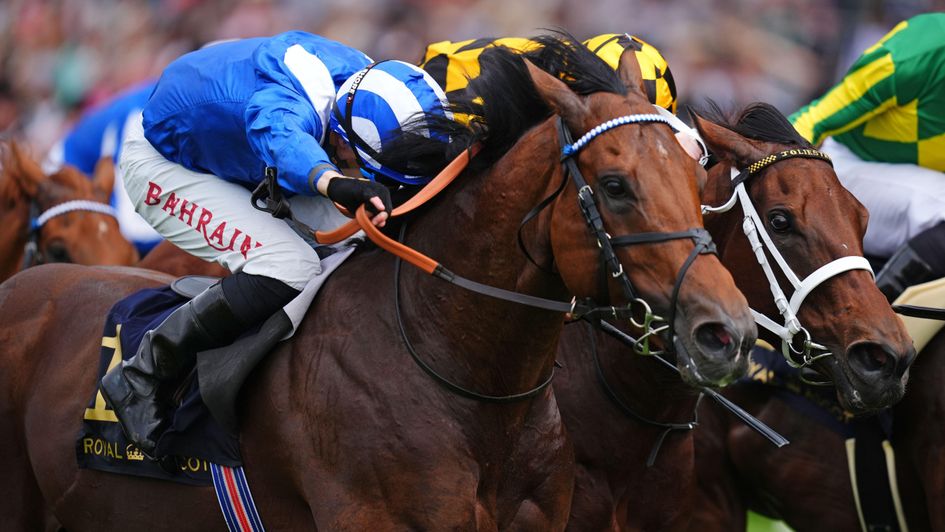
The July Cup has seen plenty of success for one-time milers switching disciplines; Alcohol Free and U S Navy Flag particularly well established over further before dropping back, whilst Notable Speech’s unsuccessful attempt last year will be a mere footnote in the story of his illustrious career, another five Group 1s added to his tally after going back up in trip.
It’s therefore quite fitting that Comanche Brave and Almeraq have both come from left-field to find themselves as the leading lights in UK & Irish sprints. They aren’t particularly young horses as they enter the last few months of their 4-y-o campaigns, but they have added a much-needed flow of new blood at the top table, both so fresh to the scene that neither had even competed in a Group-level sprint this time year.
Comanche Brave, fifth in the Irish Guineas and third in the Solonaway last season, very much fits the “repackaged miler” mould, whilst Almeraq was merely the winner of a Yarmouth novice and an Ayr 0-90, his rating so low that he found himself balloted out of the Sprint Cup last time around.
The pair could clash again on Champions Day – Comanche Brave could only manage seventh behind Almeraq in the Jubilee – but both have improved since that meeting and a rematch would rate amongst the highlights of Ascot’s late-season Group 1 fest.
Whether either of the two up-and-comers can finally break that 130 barrier remains to be seen, but it’s hugely exciting to have a pair of sprinters who are have quickly established themselves as the standard-setters without their ceilings quite yet being exposed.
More from Sporting Life
- Free bets
- Racecards
- Fast results
- Full results and free video replays
- Horse racing news
- Horse racing tips
- Horse racing features
- Download our free iOS and Android app
- Football and other sports tips
- Podcasts and video content
Safer gambling
We are committed in our support of safer gambling. Recommended bets are advised to over-18s and we strongly encourage readers to wager only what they can afford to lose.al
If you are concerned about your gambling, please call the National Gambling Helpline / GamCare on 0808 8020 133.
Further support and information can be found at begambleaware.org and gamblingtherapy.org.