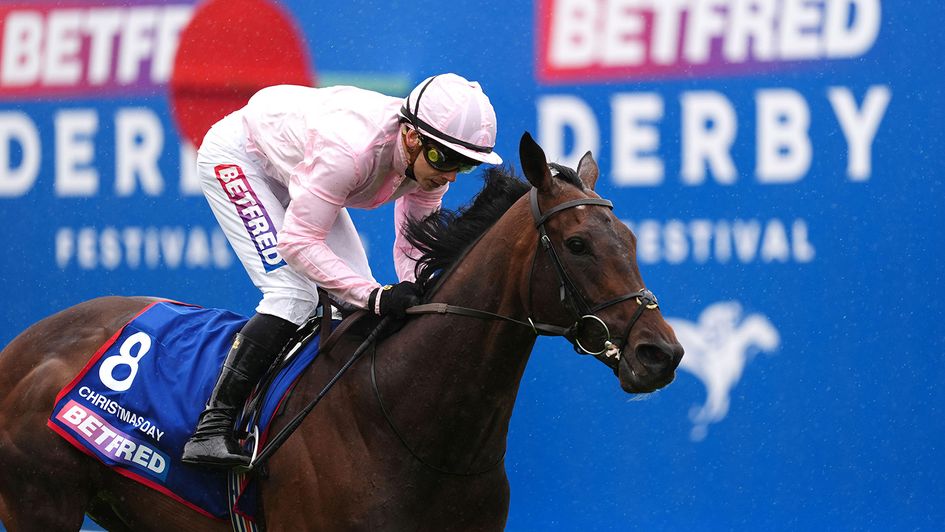
With Camelot the sire of Saturday's Derby winner Christmas Day, John Ingles looks at the improved record of Derby winners at stud this century.
Renowned Italian owner-breeder Federico Tesio is famous for claiming that ‘the Thoroughbred exists because its selection has depended, not on experts, technicians or zoologists, but on a piece of wood: the winning post of the Epsom Derby. If you base your criteria on anything else, you will get something else, not the Thoroughbred.’
Tesio had his own success using Epsom Derby winners, as one of his best creations, Donatello, who won all his starts in Italy and suffered his only defeat when second in the Grand Prix de Paris, was by a Derby winner, Blenheim, and so was his Ascot Gold Cup winner Botticelli, a son of Blue Peter. The same two colts were just a couple of Tesio’s 22 Italian Derby winners. Donatello also sired an Epsom Derby winner, Crepello.
But while Epsom’s winning post might have been all-important in Tesio’s era, by the end of the twentieth century, his quote was beginning to look badly outdated. If it was true that Derby winners were fundamental to the thoroughbred breed, then the crucial role of a Derby winner at stud was to produce other Derby winners to keep Tesio’s line relevant. But that clearly wasn’t happening on anything like a regular basis in the latter decades of the century.
In consecutive years, 1970 and 1971, the Derby went to two of its greatest winners of the whole century, Nijinsky and Mill Reef, both of whom were great grandsons of Tesio’s unbeaten champion Nearco. Nijinsky went on to become the last colt to win the Triple Crown, while Mill Reef, rated 141 by Timeform, won the Arc later at three, both colts beaten only twice in careers of 13 and 14 starts respectively.
At stud, both Nijinsky and Mill Reef also went on to sire Derby winners of their own. Nijinsky was arguably at something of a disadvantage when it came to siring Epsom contenders by standing at stud in Kentucky, but from there he produced three; Golden Fleece in 1982, Shahrastani in 1986 and Lammtarra in 1995, the last of the trio a posthumous winner for his sire from his final crop. Meanwhile, at the National Stud, Mill Reef had a shorter stallion career than Nijinsky but produced two Derby winners, Shirley Heights in 1978 and Reference Point in 1987.
But in the last three decades of the twentieth century, only one other Derby winner produced a Derby winner of his own, and that was Shirley Heights, sire of the 1985 winner Slip Anchor. Neither did any of the late twentieth-century Derby winners sire a Derby winner of the current century.
It wasn’t as if there weren’t any standout Derby winners from these decades who came after Nijinsky and Mill Reef. Grundy, Troy, Shergar and Generous (a grandson of Nijinsky), were all fellow ‘greats’ according to John Randall and Tony Morris’s classification of Derby winners in A Century of Champions, while The Minstrel, Teenoso, Slip Anchor, Shahrastani, Reference Point, Nashwan and Lammtarra were all reckoned to be ‘superior’ winners of the Derby, judged on overall career performances.
Shergar, for one, didn’t get much of a chance to prove himself as a stallion for reasons which are well known, but others had no such excuses. The Derby winning post didn’t exactly bestow a magic touch on the stud careers of others who passed it first. Six consecutive Derby winners of the 1990s – Quest For Fame, Generous, Dr Devious, Commander In Chief, Erhaab and Lammtarra – all ended up at stud in Japan, either going straight there at the end of their racing careers or not long after.
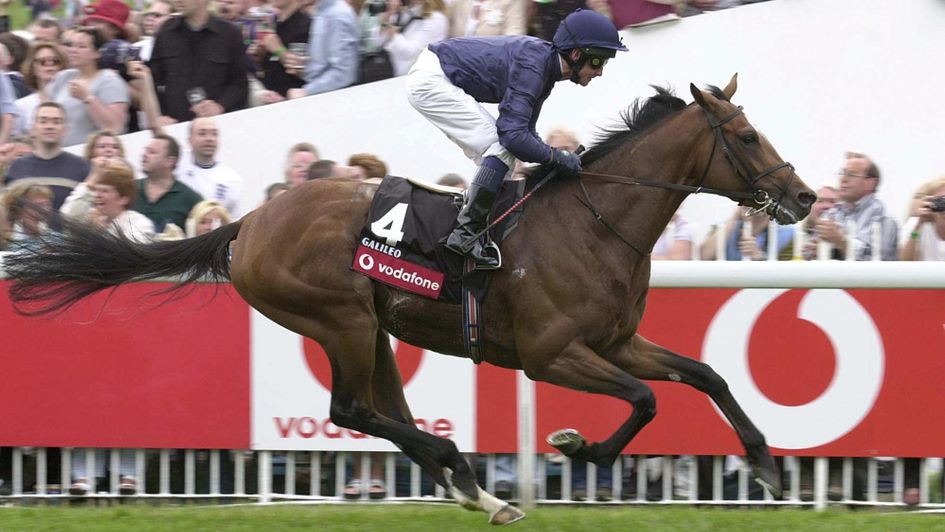
But a new century has brought with it a very different status for Derby winners at stud, at least for more of them. On Saturday, Camelot became the sixth Derby winner this century to sire a Derby winner of his own – that’s twice as many, in a shorter period, than in the last thirty years of the twentieth century.
The turning point came with Galileo in 2001 whose own male lineage goes back just four generations to Nearco. Not only did Galileo become the first Derby winner since Shirley Heights to sire a Derby winner – that was New Approach in 2008, a member of his third crop – Galileo went on to become the most successful sire in Derby history with Ruler of The World, Australia, Anthony Van Dyck and Serpentine bringing his total number of winners to five. Ironically, Galileo’s final Derby winner in 2020 suffered the ultimate indignity for an Epsom hero, with Serpentine being gelded after his export to Australia, but Galileo had set a precedent which others were to follow.
His half-brother Sea The Stars, the winner in 2009, was the next to deliver a Derby winner with the victory of Harzand for the Aga Khan in 2016.
The 2011 winner Pour Moi, who had been one of four Derby winners for Montjeu – not an Epsom Derby winner himself but winner of the French and Irish versions – had a largely unsuccessful career as a Flat stallion (and who was producing jumpers in France at a fee of just €3,000 this year), but he still managed to come up with a Derby winner when Wings of Eagles sprung a surprise in 2017.
A year later, Darley stallion New Approach provided a first Derby winner in the Godolphin colours when Masar was successful. Last year, it was another of Galileo’s Derby-winning sons, 2014 winner Australia, who was responsible for Lambourn, while Saturday’s winner Christmas Day is a son of Camelot who was the last of Montjeu’s Derby winners in 2012.
Galileo might have gone some way to restoring the credibility of the Derby winner at stud after a decade when it seemed like victory at Epsom was more likely to lead to a one-way trip to Japan. But he was also the start of another phenomenon, being the first of Aidan O’Brien’s now dozen Derby winners shared with the Coolmore partners who also owned Pour Moi.
In addition to Australia and Camelot, Coolmore’s Irish stallion roster includes two of their more recent Derby winners, Auguste Rodin and City of Troy, who both had their first foals arrive earlier this year. By as early as 2029, therefore, it could be that another Derby winner will have one of his sons pass that famous winning post first.
More from Sporting Life
- Free bets
- Racecards
- Fast results
- Full results and free video replays
- Horse racing news
- Horse racing tips
- Horse racing features
- Download our free iOS and Android app
- Football and other sports tips
- Podcasts and video content
Safer gambling
We are committed in our support of safer gambling. Recommended bets are advised to over-18s and we strongly encourage readers to wager only what they can afford to lose.
If you are concerned about your gambling, please call the National Gambling Helpline / GamCare on 0808 8020 133.
Further support and information can be found at begambleaware.org and gamblingtherapy.org.