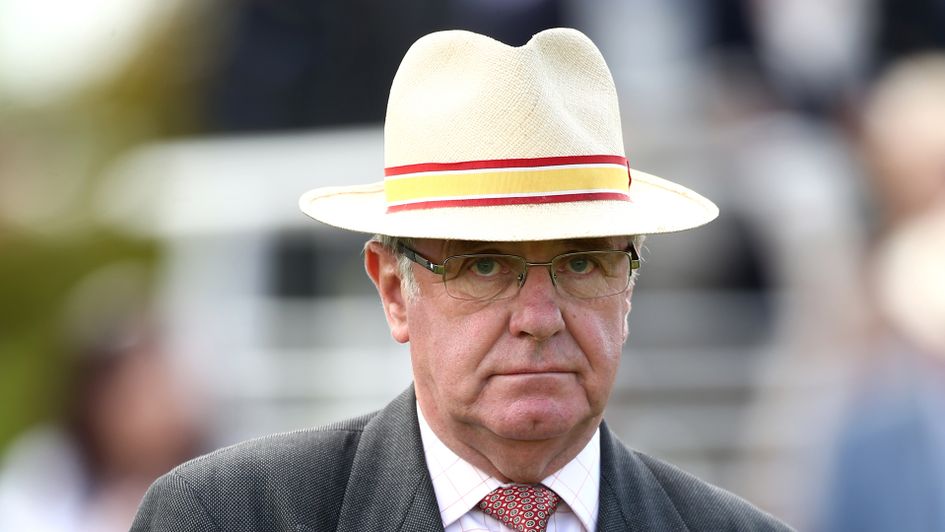
Following 51 years in racing - he started out as a jockey but injury curtailed that career - and 23 at Goodwood Racecourse, Clerk of the Course Seamus Buckley is retiring at the end of Goodwood's 2017 Flat season which concludes on Sunday, October 15.
He recalled some of the best times at the Qatar Goodwood Festival: "The Duel on the Downs between Frankel and Canford Cliffs made the hairs on the back on my neck stand up - very unusually the horses were clapped going to the start and it was very emotional to see how people were so devoted to them.
"The other race that stands out for me is Double Trigger's third Goodwood Cup victory (1998)- he fought back and hung on to win in the last 110 yards. The way the racegoers rushed down from the March Stand to the winner's enclosure to welcome him was remarkable."
He lives in the village of Singleton, just a mile and a half away from the track, and is not planning to move away. However, he will let his successor, Ed Arkell, get on with the job, though being available to provide advice if asked.
Buckley remarked: "Goodwood have been very loyal and given me a wonderful life. I want to go out on a high.
"In retirement, I might go and learn how to play golf properly, I love my garden, and I will get around a little bit - I am not a great traveller and don't fly too well. But I would like to see more of this wonderful country and visit people I have not seen for years."
He outlined a normal working day: "I am always in work by 7am on a non-raceday and I can do a lot in an hour on the computer, answering emails and so on. Then Sean Martin, the head groundsman, comes in, we chat about the work for the day and then it all happens. I am in charge of nine permanent staff, plus up to 30 casual staff working on a raceday.
"The racecourse is 700 feet above the sea and you never know whether the rain will fall there. I live down in the valley in Singleton and sometimes when it is raining there, it is not at the racecourse."
Prior to joining Goodwood, he worked as head groundsman at Epsom Downs Racecourse, home of the Derby.
"I was probably lucky as the make-up of the two racecourses are almost identical. The ground is on a chalk base and dries very quickly so I knew what I was up against at Goodwood.
"Epsom was not the easiest racecourse to look after and I had 13 or 14 Derbys there and managed the training grounds too when there 500 to 600 horse in training. I knew that going to Goodwood that I would be doing the same thing - trying to keep moisture in the ground.
"I was very fortunate to work at with my friend Rod Fabricius, who brought me down to Goodwood. He headhunted me. I wasn't clerking at Epsom and it was a wonderful career move to come to Goodwood."
One of his conditions before he agreed to join Goodwood was the introduction of a new watering system, with the boom spraying Upton Irrigator replacing pop-up sprinklers. He also introduced a new mix of harder grasses to the course and changed fertiliser treatments after detailed soil analysis.
"I was proud to get my diploma in turf management 20-odd years ago after a year and a half of studying at a college near Pulborough one day a week - it wasn't easy going back to school, but it has proved very helpful.
"In today's world, it is very important to produce good ground. The days of firm ground are over, because people will not run their horses on it. Horse are trained on an artificial surface so they are used to an easier surface and my job has been to produce ground without jar in it.
"Having two bends does spread the load. When I first came, we only had the one Group One race (the Sussex Stakes) and now we have three, which is a great feather in Goodwood's cap and the higher prize money has helped enormously.
"I have always wanted the Lennox Stakes to be promoted to Group One, but people are a bit cold about having a seven-furlong Group One as well as a Group One mile race. They say the same horses will want to run in both races, which I think is a load of rubbish. It would give a horse who does not get a mile an opportunity over seven furlongs to win a Group One. I think we will get it eventually as there is no a Group One seven-furlong race in Britain."