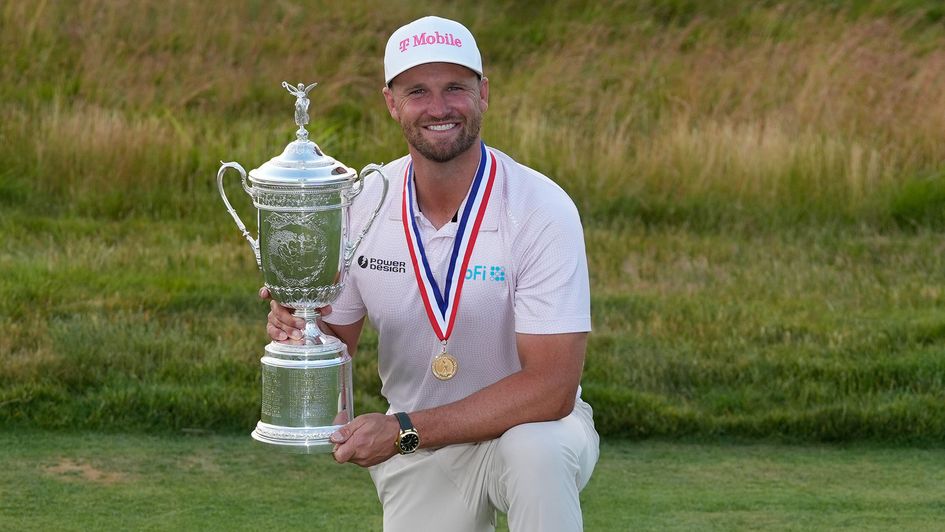
Whatever happened in the final round of this US Open, Wyndham Clark was going to create a legacy for himself.
Win, and that legacy would be one of the two-time major champion; a higher echelon, a place where names are harder to forget. Lose, and it would be infamy. Ask any golf fan who won this major in that year and they might have to pause, might not even know the answer. Ask who surrendered the six-shot lead, and they'll reply immediately with the name Greg Norman.
Clark's very present sports psychologist (I don't think I could pick Dr Bob out of a line-up, but I'd stop Jules in the street) wouldn't allow for this kind of framing, but like it or not part of his mission was to avoid joining Norman on one of the darker pages of the history books, and instead join him on that list of golfers with two majors, alongside the likes of Johnny Miller, Bubba Watson, Dustin Johnson, and Bryson DeChambeau.
Unlike all of those named, he did so as an American villain on American soil, barracked by members of the crowd who were drunk, dimwitted or likely both. It was a performance of profound resolve to do this with every word uttered from a certain section of the gallery urging his ball towards danger. Not one of the millions of amply brain-celled people watching could in the end have begrudged him this second US Open given what he had to go through to get it.
So nearly did he lose to a brilliant charge from Sam Burns, but while fortune had favoured Clark earlier in the week, there's a satisfaction in seeing him make it count. Had he not done so, it would have been necessary to question the extent to which spectators were able to influence the outcome of this tournament. Clark had been told convince himself that he was the fans' favourite, but no amount of pop-psych kidology could hide his reality – that the crowd carried others while attempting to cow him.
There ought to be a serious reckoning here, because crowd behaviour is a growing problem which has already expanded beyond Long Island and is beginning to take root. The fear is that this is no nadir; that from here on, spectators at golf tournaments will feel emboldened by what they see and hear and the anonymity they can find behind the ropes. Thankfully, Clark shut them up this time, but this cannot be left to the players in future.
While stories of redemption following last year's assault on an Oakmont locker will no doubt wander into sycophancy, Clark's performance here demands that we begin with the scale of his achievements. This is a world-class golfer whose amateur career was derailed by the death of his mother, whose entire adult life was framed by it. As a professional he underachieved for many years, and then over the last four he has shown the world the brilliance he's always been capable of.
It's that story which ought to have earned him more support than he received and so vile was the spectacle that it's not possible to say that he won't care. Perhaps he will. Perhaps his second major championship will be remembered less fondly than his first because of it. All we can say for sure is that having led after rounds one, two and three, Clark held them off to win after round four. It wasn't always pretty and what came from the sidelines was downright ugly, but it's his name carved once more into silver.
Shaky start sees Clark almost caught
Clark looked in big trouble when he bogeyed the fifth from the middle of the fairway, bigger still when he missed a par putt of less than four feet at the seventh, his attempt barely qualifying for that description because it barely touched the hole. By now, Sam Burns had closed to within one shot and as Clark's playing partner was the world number one, he was surrounded by danger. Never did he lose the lead but never during the first eight-point-five holes did it look anything but a matter of time.
In the circumstances, the shots he hit from the side of the ninth green to the back of the 11th were of the highest class. Clark almost holed his third to the final hole on the front nine when a fourth bogey appeared on the cards, then did what everyone else had failed to and stuck it in close at the treacherous 10th. Get that approach wrong and the game might well have been up, sooner than it had been for Norman in 96. Instead, Clark got it spot on, out-Schefflering Scottie Scheffler with precision sharp enough to draw blood from his opponents at last.
Scheffler missed, then missed again at the 11th, and suddenly the grand slam dream looked at least a year away. Meanwhile, Clark was back to five-under, so clearly a score good enough to win, probably by two or even more. Just as his boldness at that 10th hole had helped him to power clear on Saturday, a different shade of the same quality allowed him to restart. We were back at the first tee, only with a deal Clark would probably have accepted: the lead cut significantly, but so too the number of holes left to play.
The final incision upon Scheffler nearly came at the very next hole, where Scheffler hit it to 18 feet so Clark brazenly hit it to 17 on the very same line. But while Clark couldn't better Scheffler's missed birdie putt and had to settle for par, up ahead Burns' prospects of catching him ended with a three-putt. Burns at this point could still win, of course he could, but probably not by getting to Clark's number. Now it was in the hands of the leader, pars at 11 and 12 suddenly looking more like strides towards victory than stutters in the face of it.
Clark clings on after Burns runs out of time
Those voices in the crowd had been intent to derail him and Clark's bogey at the 13th gave them renewed vigour, as up ahead Burns holed from inside 20 feet for birdie at the 16th to move once more within one. Clark didn't flinch but Burns did, his birdie putt after a fine approach to the par-three 17th as timid as you'll see from the hands of one of the best in the game. Another quality iron shot went unrewarded at the 18th, where this time the putt was good but the line was ever so slightly off. Both will be replayed while he tries to sleep tonight.
This all made Clark's task simpler in much the same way that Scheffler's late misses on Saturday had. Providing he'd been permitted to look towards a leaderboard, he would've known by now that three pars do the trick and all the better too, because his drive at the 16th didn't show even a hint of peel when it needed to bend.
Here, Burns' late misses were brought into focus, because from Clark's position off the tee, he could now afford to work backwards from making a five.
Yet there was time for one more putt, from 25 feet, to find the hole for a four. Another birdie, this time surely the decisive one. And did you hear that? It sounded a bit like a cheer. Now, the tournament within Clark's grasp, the worst of the crowd beaten by their own excesses, it all looked like an American really was about to win the US Open and the one on the course, not the one in the clubhouse.
There was another twist, at the 17th, where Clark three-putted from distance, but at least there was a familiarity in what lay in front of him: four for the US Open. He'd done it at LA Country Club, where some harshly criticised the execution of a tee-shot which ended where he wanted it to end, and this one was similar only with rough to smother it. Clark though found the green, cosied the birdie putt up to the hole, and hung on to win by one. In the end, that margin underplays his authority and the way he went about leading from the very start. There is no harder event in which to do it than this.
Clark is a champion who perhaps changed perception without changing anything. He's still the man who smashed up the locker last year, still the man who hurled a driver into a sponsor board, still the man who refers to himself as Dubya, still the man who might find the original Dubya's politics a little on the liberal side. But he's other things too, and one of them is a two-time major champion who earned both of his US Opens with a strength of character he must've inherited from somewhere.
This wasn't the fairy tale Father's Day story of Scheffler completing a career grand slam on his 30th birthday with his two children green-side. It was more a kind parable, meaning to be inferred, about a son who has found it difficult to find his way with only one parent to guide him, presented here as a golfer who had nobody but his caddie to turn to while desperately trying to defy the will of people who by rights ought to have been on his side.
Wyndham Clark is his name and it's one for those history books, the pages they all want to occupy. Enormous credit is due.