Ben Coley reflects on a gripping first day at Bethpage, where Europe made an excellent start in their attempt to keep hold of the Ryder Cup.
Three players, two different outcomes
Much has changed in golf in recent years, but there's been something very close to constant over the span of the last two Ryder Cups: a big three of Scottie Scheffler, Rory McIlroy, and Jon Rahm. Lately, that has been the order, the gaps between them wider than they once were. But around the time of Rome, Rahm was just ahead of McIlroy and not far behind Scheffler.
At the end of day one at Bethpage, Rahm and Tommy Fleetwood were the only two players whose records read 2-0-0, Rory's a still excellent and unbeaten 1-0-1. Scheffler and Bryson DeChambeau were the only players whose records read 0-2-0. These are the five best players in the event right now, and three of them remain the very best in the world. Europe's stars all delivered and, despite flashes, their US counterparts ultimately failed to.
Given that Scheffler was winless in Rome, where DeChambeau was absent, it is possible to define that closer-than-it-looks renewal by his failure to win a single match. Could it be that this Ryder Cup follows a similar pattern, and the US is left to regret Scheffler's performance?
Before all this, it was McIlroy who struggled at Whistling Straits, where Scheffler first properly announced himself to the world. European captain Padraig Harrington was forced to bench his star man on Saturday afternoon, before an emotional McIlroy won his singles match on Sunday but couldn't stop the US from romping to a record win.
Unless he performs considerably better on Saturday morning, it isn't unthinkable that Scheffler finds himself in a similar position. And here's the most remarkable part: he's winning PGA Tour events at a higher clip (35% of his last 40 starts) than he is Ryder Cup matches (30% lifetime) so far. Those keen to compare him with Tiger Woods have another way of doing so.
Scottie Scheffler: first reigning world no. 1 to lose both Friday Ryder Cup matches since Tiger Woods in 2002
— Justin Ray (@JustinRayGolf) September 26, 2025
Bethpage... Beige?
Did the United States inadvertently set up a golf course for their number two player, rather than their number one player? It certainly felt that way at times during Friday's opening foursomes, with the rough very little hindrance. In some instances being in it even helped, because players regularly struggled to control spin from the fairway, a problem magnified by the number of uphill approach shots.
It was in some ways good for Bryson DeChambeau, who almost drove the first green and played nicely. But he did not win, and neither did Scottie Scheffler, whose precision advantage was undermined. What's more, the world number one was coupled with the shortest driver on either side and Russell Henley's ability to hit fairways mattered very little with the rough so sparse.
Given that the US side features a two-time US Open champion in DeChambeau, the reigning US Open champion in JJ Spaun, two-time major champions Xander Schauffele, Justin Thomas and Collin Morikawa and four-time major champion Scheffler, it would be interesting to hear what the logic of removing all of Bethpage Black's famed menace was. In general, tougher courses suit better golfers.
And there is some irony in the fact that DeChambeau himself produced his finest performance here in New York, at Winged Foot, a similar golf course, when it was protected by brutally thick rough. It's under these conditions that his off-the-tee advantage is accentuated, and it's under these conditions that Scheffler can be relied upon to plot his way to a score regardless.
The USA could have aimed for a set-up which suited their two best players, the best of both worlds. Instead, they went to their safe space, the formula that worked before, hoping that it would work again. That decision may have failed to acknowledge their opponents, and it surely failed to recognise that when you've got by far the world's best player, you do not want to level the playing field.
Less trust in the rookies...
Not every captain has trusted their rookies, however they might've spoken about them beforehand. Did Keegan Bradley show enough faith in his on the first morning of the Ryder Cup, when he selected only one of the four?
Because however you slice it, Ben Griffin and Cameron Young are two of the form players not just on the US team, but in all of golf. One is super-long and one is long enough. They've both been making putts for fun. At a bomb-and-putt Bethpage, Young in particular ought to be right at home and so it proved when he starred in a fourball win in the afternoon.
And yet even at home, even with a baying crowd who booed when Europe hit their opening tee-shots and went silent for the USA, Bradley didn't trust his rookies to go out there and deliver in the toughest pairs format there is. Instead, he went for Justin Thomas, Harris English, Collin Morikawa, Patrick Cantlay and Xander Schauffele, all out of sorts, but all having played in one of these before.
Thomas and English were his worst two players in the morning, Morikawa not much better. Schauffele and Cantlay, neither of whom particularly impressed, snuck a narrow win after their opponents bogeyed the final two holes. It's hard to imagine the rookies would've performed any worse once they'd got past that first tee. Certainly not Young, at least.
It would be malpractice if Cam Young sits in foursomes tomorrow because of some "stick to the plan" silliness.
— Kevin Van Valkenburg (@KVanValkenburg) September 26, 2025
...than trust in the process
When things have gone well, Europe have often spoken about how sticking to the plan has been key. When they've gone badly, such as at Hazeltine, deviating from the plan has been blamed. The message since 2016 has been simple: if we don't win this Ryder Cup, it won't be because we made a tactical error, it will simply be because we were beaten by better golfers that week.
But in most walks of life, and certainly in other team sports, back-up plans are considered vital. We hear it all the time in football, for example, and great managers have so often been defined by their ability to adapt, to solve problems they didn't or even couldn't have seen coming. Plans are important but they simply have to retain a degree of fluidity, contingency; wedding yourself to something is seldom a good idea.
So, did Luke Donald make his first mistake in failing to react to Friday morning's foursomes? Was it a mistake not to allow himself to change things to make room for just how good Matt Fitzpatrick's performance was? He wasn't just the pick of the Europeans, he was by far and away the best of 16 golfers who played in the morning. What more could he have done?
Europe's next-best player was Tyrrell Hatton, who was also on the bench for the afternoon, whereas Bradley elected to send Thomas out again despite his abject display and was rewarded for that. It seems both captain have plans they want to stick to, and there's very little that can be done to change their minds. This is simply the modern way in the Ryder Cup.
And in fairness to Donald, at least he can point to his results.
One moment to sum up a contest
I'm sure there will be many who disagree with this, but when DeChambeau showed the guts and class of a double major champion to birdie the 17th hole on Friday evening, his team standing dramatically behind him in the camera shot, he turned to the crowd, away from his playing partner, and marched like a man on a mission to the next tee.
I don't think a single member of the European side would've done anything but turn to their partner in that moment.
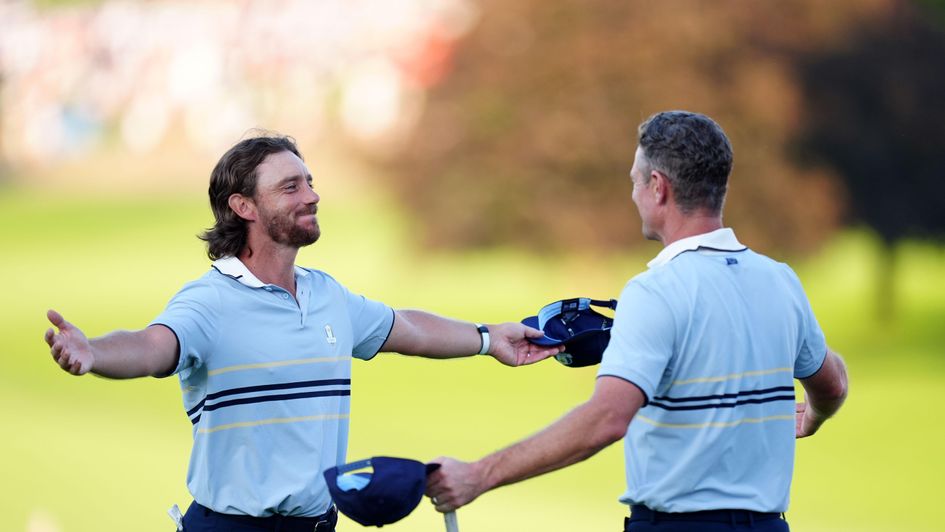
When DeChambeau then found a nasty lie with his tee shot to the final hole, he needed Ben Griffin to step up and make a birdie. To Griffin's immense credit, he might well have done so had Justin Rose not beaten him to it to win the match for Europe, turning immediately to his partner Fleetwood to celebrate.
Griffin had a partner whose instinct was to try to carry him on his back, rather than lift him to his feet.
Bryson in the zone, hugely admirable, but he's holed that and marched ahead of a struggling, lost Griffin to the next tee. You might need the guy to step up.
— Ben Coley (@BenColeyGolf) September 26, 2025
A game of millimetres
In the end, a day which went so well for Europe ended with USA feeling like they narrowly avoided disaster. Largely, that was because of the final matches of both sessions, where Cantlay once again stood up in an impressive display of fortitude and then, just when he needed him, found Sam Burns riding to the rescue with a birdie-par finish.
McIlroy and Lowry, clearly irked by something said to them midway through the match, held a commanding lead when 2up through 11 holes. But the USA won the 12th and 13th to turn the tide, latterly when Cantlay's putt lipped in and McIlroy's lipped out. At the 14th, Cantlay this time saw a short putt spin sideways, rejected by the hole as not good enough, before he and McIlroy exchanged birdies at the 16th to remain all-square.
McIlroy's putter, seemingly intent on apologising for what happened earlier, came to the rescue as he halved with Burns at the 17th, before the pair both missed chances on 18. It was the only game of the day which ended halved. That might not have been quite what Europe hoped for when in command, but they won both sessions. Job done will be the message.