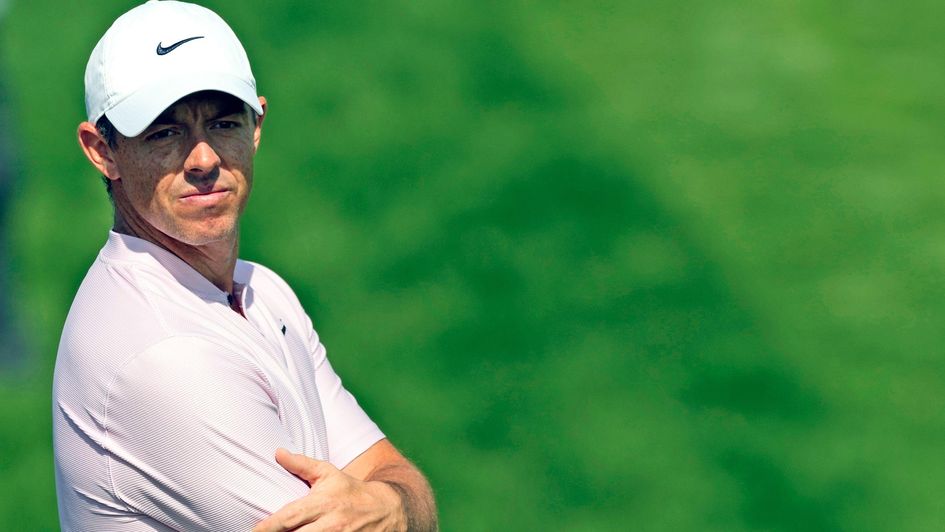
Rory McIlroy hasn't won a major since 2014 for two reasons: he has not had many chances, and when those chances have come along, he has not quite played well enough.
That is the simplest explanation. It overlooks some of the things he could control and some that he couldn't. It affords him the benefit of the doubt when it comes to bottle, that unrefined word that gets wantonly tossed around, and on the other side it ignores things like how well Cameron Smith putted that day, the width of the 18th fairway at LACC, and so on.
The 'why' is something McIlroy and his team will have spent hours considering. Why hasn't he had many chances? Why hasn't he played quite well enough? Is it something to do with pressure which is both external and self-imposed? Has he done the right things in the run-up? In asking questions like these, has he added unnecessary complication to a game he can make look so simple?
This year, he'll play more golf ahead of the Masters. Perhaps that will do the trick. He'll return to Valhalla, the scene of his last major victory a decade ago. He's added length to his driver shaft. Like almost every player who has reached the top of this most confounding of sports, there is always something to be tweaked; a new schedule, a new lie angle. For every painful Sunday, there is the hope that Thursday brings.
But one thing we ought to be clear on is that McIlroy has not tossed away a hatful of majors since he won two of them within the space of a month. The following summers were not imbued with opportunity. Think back to those seven years, from 2015 to 2021, and there's one major which stands out as a chance let slip. It is easy to forget that even then, at Augusta, he began the final round three shots behind Patrick Reed.
That is the only time in a decade McIlroy has teed off on Masters Sunday with a realistic chance. When he got on a roll at Birkdale and again at Carnoustie, it was from a position of virtual impossibility. His first PGA Championship top 10 since winning, in 2019, came from 14 strokes behind the leaders with 18 holes to play. At Winged Foot, as at Pebble Beach, he was always too far back to matter.
During this spell – seven whole years – McIlroy's Expected Majors return was 0.20 according to DataGolf. Put simply, based on his performances in the majors, the anticipated return was in effect zero.
This is why we ought to draw a line to separate 2015-2021 and the two years that have followed.
In 2022, when McIlroy's putter went cold on that infuriating Sunday at St Andrews, the one he was meant to win, his Expected Majors return climbed to 0.53 – the fourth-highest return of his career, more than two-and-a-half times the previous seven years combined. In 2023 came the fifth-highest, 0.39, owing to the way he played in the US Open where Wyndham Clark held him off.
Combined, McIlroy's figure for the last nine years is 1.12. If we stretch it to a decade and include 2014, it climbs to 2.32, and his actual return is 2.00. He is behind expectation by a tiny margin, and it's this which is the indictment: for a player of his quality, McIlroy has not played well enough in the majors. To misdiagnose McIlroy as a bottler, someone who can't take a chance when it comes rather than hasn't, is to miss the point entirely.
"That was a little bit special from McIlroy" ⚡
— Sky Sports Golf (@SkySportsGolf) January 21, 2024
Rory is NOT messing around today... pic.twitter.com/FqrrAajCrr
McIlroy is good enough to win a major again, but to do so he needed to get chance back on his side. The only way to do that was by being closer to the lead than he was at any stage from 2015 to 2021. For context, he is within two entering round four in about 25% of non-major starts, and after seven years batting at 0% in the majors, the last two have seen him match that non-major figure.
This is why McIlroy has passed up only two significant chances to win majors. If he can engineer one more chance per year for the next several, the sort of contending consistency he has elsewhere, the prospect of him failing to win another becomes small.
So when McIlroy makes his way to Augusta this April, perhaps he'd be wise to put down Marcus Aurelius and consider the words Numquam ponenda est pluralitas sine necessitate: plurality ought never be posed without necessity. That is, the simplest explanation for any given problem is the one most likely to be correct. Occam's razor.
In his quest to become a major champion again, McIlroy need only recognise that he's simply not had enough opportunities. That is the simplest explanation, and it is the right one. Now that he's worked out how to create them again, all he need do is keep on doing the same thing. Then, his two strongest attributes – generational golfing brilliance, underrated resilience – put the odds firmly in his favour.
As McIlroy well knows, that quote misattributed to Einstein, the one about how madness is doing the same thing over and over again and expecting different results, doesn't apply to golf. Madness would be to rule out McIlroy if he keeps doing the very same things he's done for the last two years.
Safer gambling
We are committed in our support of safer gambling. Recommended bets are advised to over-18s and we strongly encourage readers to wager only what they can afford to lose.
If you are concerned about your gambling, please call the National Gambling Helpline / GamCare on 0808 8020 133.
Further support and information can be found at begambleaware.org and gamblingtherapy.org.