The pendulum of public opinion swings swiftly in matters regarding Manchester United.
After their 1-0 defeat to Arsenal at Old Trafford on the 2025-26 Premier League season’s opening weekend, Ruben Amorim’s side would be roundly praised for a performance that deserved a more favourable outcome. A week later, following a 1-1 draw away to Fulham, the Red Devils were thrust back into crisis rhetoric for a sub-par display that contained too many flaws familiar from last term’s dismal 15th-place finish.
A few days later, elimination from the Carabao Cup at the hands of League Two Grimsby, and Amorim's comments afterwards, only piled more pressure on the manager and his team.
Finding analytical balance when it comes to United is difficult; the size of their fanbase and the scope of their past success leads to a polarisation of opinions and narratives. But on the evidence of 29 Premier League games under Amorim – and with just seven wins in that time – it is more than reasonable to suggest the manager’s tactical inflexibility is hamstringing the Red Devils.

When United appointed Amorim in November 2024, the feeling was one of modernity and rebirth. Here was a coach hailed as one of Europe’s brightest tactical minds, the man who had ended Sporting CP’s 19-year title drought in Portugal with a bold and structured 3-4-3 system. It was meant to be a marriage of visionary coaching and a global super-club aching for clarity.
But nine months on, clarity looks more like rigidity and vision is shading into myopia. With a win rate of just 24 per cent, Amorim’s insistence on his favoured 3-4-3 system has become the story. The results are poor, the football disjointed and United already look like a club bracing for another false dawn.
Amorim’s back-three devotion is no secret. During the spring of 2024, when he was linked with the Liverpool job, ESPN reported that his “unwavering allegiance” to the shape was one of the factors that cooled Anfield’s interest. That same unwavering quality is now defining his Old Trafford tenure. And not in a good way.
At Sporting, Amorim’s 3-4-3 was a revelation. He had a squad built for it: quick, aggressive centre-backs comfortable covering wide spaces; wing-backs who could both overlap and defend with equal energy; and a midfield pairing that balanced power with guile. The system functioned beautifully. Sporting dominated domestically, often overwhelming opponents with pressing and vertical transitions.
The Premier League is a harsher ecosystem and United, even after more than £300m of investment since Amorim took charge, is still not fully equipped for the precise specifications of the manager’s dogma.
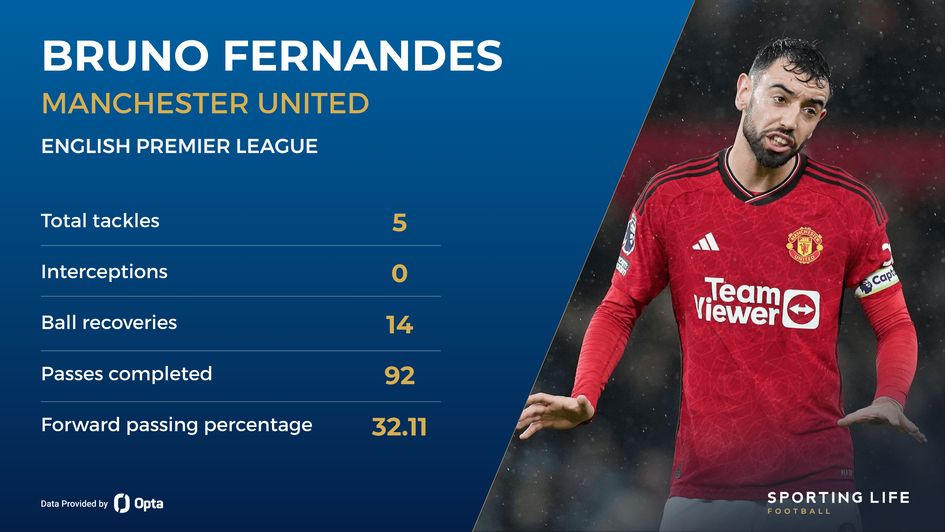
Bruno Fernandes is the clearest example. Within Amorim’s 3-4-3, he is stationed in the double pivot. That means deeper positioning, defensive tracking and safer, metronomic passing. But Fernandes is not a metronome; he is a disruptor. His game is defined by high-risk creativity, threading impossible passes into the box and playing on the margins of error. In deeper zones, those risks turn into liabilities, with turnovers launching dangerous opposition counters.
Contrast that with Fernandes as a No.10 in a 4-2-3-1, or the advanced midfielder or inverted winger in a 4-3-3. There, his high-risk passing is devastating rather than dangerous; turnovers don’t instantly punish you and bravery is rewarded. Amorim’s double-pivot suffocates that freedom, shackling United’s most creative player in service of a structure that simply doesn’t fit him.
Amad Diallo’s case is just as glaring. Last season he emerged as one of United’s most exciting prospects, a winger with the confidence to isolate defenders and cut inside on to his stronger foot. But now, repurposed as a wing-back in Amorim’s 3-4-3, Amad has been forced into a role that requires him to track back, defend his flank and provide width through overlapping runs. None of that comes naturally.
The result is a player caught between two responsibilities: not quite defending, not quite attacking. His instincts tell him to drift inside, combine centrally and shoot; the system tells him to hug the touchline, overlap and recover 60 yards when United lose the ball. In a 4-3-3, he would be liberated to play higher and wider. In a 4-2-3-1, he would slot in on the right of the attacking three, where his knack for drifting into goal-scoring positions would be maximised. Right now, the 3-4-3 turns a breakout star into a misfit.
Then there is Kobbie Mainoo, perhaps the most frustrating casualty of Amorim’s stubbornness. Mainoo’s rise over the last two seasons has been one of United’s few genuine success stories: a teenager playing with composure and vision beyond his years, carrying the ball through pressure and scoring decisive goals in clutch moments. He was tipped as the foundation of United’s midfield for the next decade.

Yet this season, through United’s first two league fixtures, Mainoo has played zero minutes. Reports suggest he is unsettled, with some even claiming he may consider leaving if his opportunities don’t return. The reason, again, is structural. Amorim’s double pivot demands positional discipline and the athleticism to cover much more ground than is required of a central midfielder in a 4-3-3 or 4-2-3-1. Mainoo’s technical nous is dampened and the minor athletic flaws of a still-developing 20-year-old have become the talking point.
Amorim’s system delivered dividends in Portugal, but the Premier League punishes dogmatism. Pep Guardiola has reinvented his City side half a dozen times to stay ahead. Jurgen Klopp adjusted his pressing scheme as players aged. Even Mikel Arteta, who arrived at Arsenal with a clear plan, has flexed between systems to accommodate the realities of squad building.
Amorim, by contrast, seems determined to prove his system right, regardless of whether the players fit it. So far, results have proved the opposite. If Amorim refuses to adapt, his stubbornness will sink his Old Trafford reign.
More from Sporting Life
- Fixtures, results and live scores
- Expert xG analysis and features
- Transfer news and done deals
- Football and other sports tips
- Download our free iOS and Android app
- Podcasts and video content
Safer gambling
We are committed in our support of safer gambling. Recommended bets are advised to over-18s and we strongly encourage readers to wager only what they can afford to lose.
If you are concerned about your gambling, please call the National Gambling Helpline / GamCare on 0808 8020 133.
Further support and information can be found at begambleaware.org and gamblingtherapy.org.