
One month on from the EFL Cup final victory that gave the Erik ten Hag era its first tangible success Manchester United face the same opponents for a match of even greater magnitude.
Not long ago there was tentative speculation that Man Utd could challenge for the Premier League title but now, with Tottenham Hotspur rid of Antonio Conte and Liverpool climbing the table, their place in next season’s Champions League could hinge on besting Newcastle United – again.
It won’t be as easy as last time. Their 2-0 win at Wembley came courtesy of a quietly efficient performance and, crucially, Newcastle’s own difficulties at the time, coming off the back of a three-game winless run.
A lot has changed since then. Eddie Howe has his team back to their best while Man Utd are without the man who holds the team together and excelled in the EFL Cup final: Casemiro.
Newcastle, buoyed by the fans at St. James Park, will be a much sterner test this Sunday. They could swallow up the three-point gap to Man Utd and with it plunge Ten Hag’s near-perfect debut season into dangerous territory.
What we learnt from EFL Cup final
It was an uneventful game at Wembley but nevertheless one with huge implications for how each side will approach their second league game of the season.
Most notably Ten Hag instructed his team to sit in a conservative formation, happily conceding territory and rarely pressing in the opposition third in order to suffocate Newcastle. Howe likes to play predominantly in the transition, and faced with a lower block his team are regularly stumped.
From that pragmatic stance Man Utd simply had the better players and took their chances, although there were some tactical movements in the second half that deserve our attention.
First Howe brought on Alexander Isak and switched from 4-3-3 to 4-2-3-1, with Isak frequently picking up the ball between the lines and driving forward in possession. For 25 minutes he outmanoeuvred Casemiro and drove Newcastle into more advanced areas before shuffling the ball out to the wingers.
Ten Hag managed to shut it down, however, with the reverse formation change, swapping his 4-2-3-1 for a 4-3-3 and plonking Scott McTominay and Marcel Sabitzer next to Casemiro in the middle, creating a brick wall of defensive bodies that blocked Isak’s path.
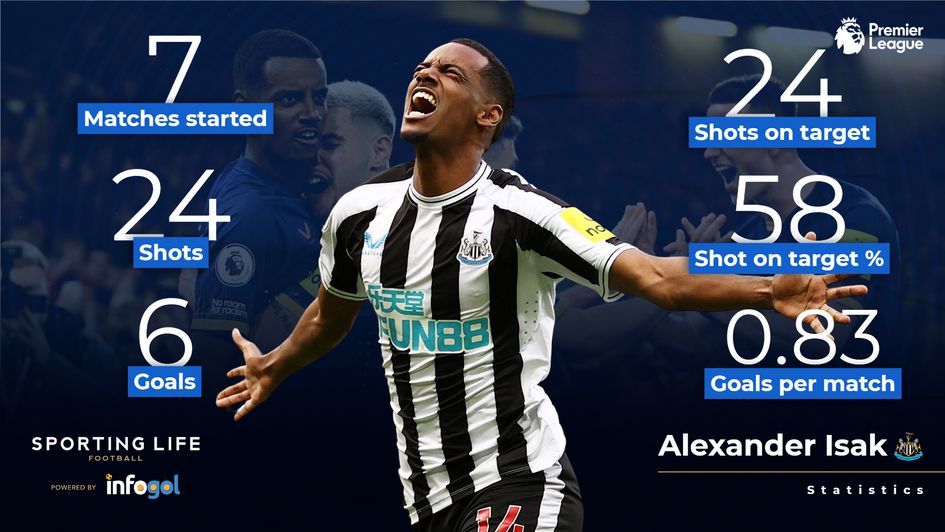
This Sunday, in-form Isak – with three goals in the last two Newcastle games – will surely start, while Sabitzer and McTominay will be tasked with keeping him it bay without their leader, Casemiro. That changes everything.
Isak’s movement the secret weapon
Neither of Man Utd’s goals in the final are likely to happen again. The first, Casemiro’s header from a set-piece, was entirely against type (Man Utd are joint-bottom of the league for goals from set-pieces, with three, while only four teams have conceded fewer set-pieces than Newcastle’s five) and the second was a goalkeeping error from Loris Karius. Nick Pope is back for this one.
So instead let’s focus on the other end. Isak has been exceptional recently, intelligently dropping into the half-spaces, moving wide of the opposition midfielders to receive progressive passes from Bruno Guimaraes and becoming the link man between Newcastle’s defenders and direct wingers.
For too long Howe’s side have been nullified by those deeper blocks, but with a connector like Isak they can now arrive in the final third at pace even from their own build-up play. McTominay and Sabitzer will likely be too slow to track Isak properly.
A lot rests on whether Ten Hag uses Bruno Fernandes as a number ten, with a 4-4-2 shape off the ball, or whether he anticipates the Isak danger and adds Fred to make a central three, moving to a 4-5-1.
If it is the former, then on home soil Guimaraes should be able to dictate the tempo, using the inverted wingers (no team is quite as narrow as Newcastle) to overload the centre of the pitch and bring Isak into play.
Saint-Maximin could leave Anthony free
It will be a tight game with few chances, and even if Isak and Guimaraes connect well it’s unlikely Newcastle will be able to convert final-third possession into big chances. In fact, even with all their advantages, it could be argued Man Utd are more likely to exploit the tiniest lapse in concentration in a compact defence.
That’s because Allan Saint-Maximin, back in the starting line-up recently and highly likely to start now that Miguel Almiron is injured, is not defensively reliable.
He will often switch off and fail to track back, as we saw in the 2-1 victory over Nottingham Forest, when Saint-Maximin was withdrawn at half-time because Brennan Johnson was getting too much space.
The visitors have two different ways to exploit this. Jadon Sancho hit a season-high of four successful take-ons in his last league start, against Southampton, while Antony has shown himself to be a very good impact player off the bench in recent matches.
If the starter doesn’t take advantage of Saint-Maximin’s presence on the same flank, fresh legs from the bench might.