
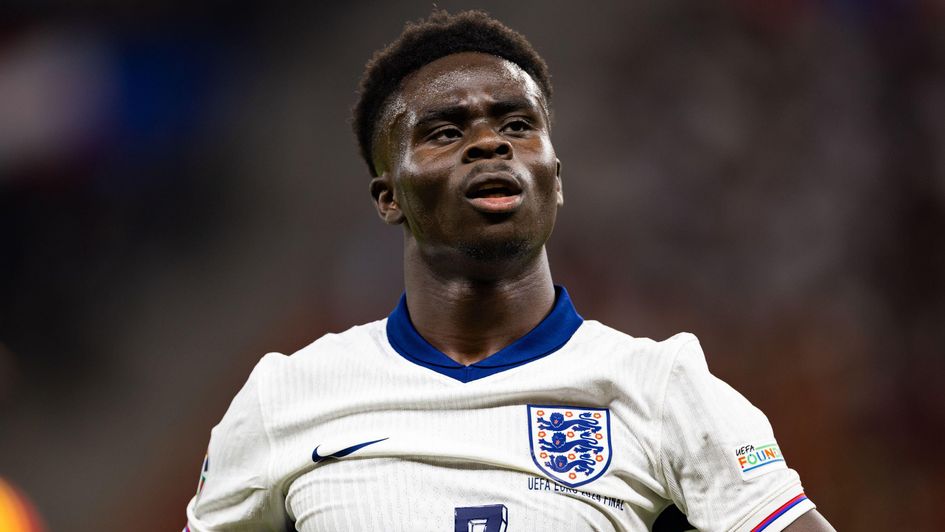
Bukayo Saka's statistical line from Arsenal's Champions League final defeat to Paris Saint-Germain in Budapest was almost impossible to believe.
Four completed passes. Zero shots. Zero chances created. Zero successful take-ons.
For one of the most gifted wide forwards in world football, it was the kind of performance that immediately raises eyebrows.
For England manager Thomas Tuchel, preparing to lead the Three Lions into a World Cup that kicks off in less than two weeks, it should raise considerably more than that.
Because the version of Saka that carried England through Euro 2024 increasingly feels like a distant memory. During England's run to the final in Germany, Saka was arguably their most consistently threatening attacker.
While Harry Kane battled fitness issues, Phil Foden struggled for influence and Jude Bellingham carried a huge creative burden, Saka repeatedly provided the spark.
His stunning equaliser against Switzerland rescued England's tournament. His ability to drive past defenders gave the side width, penetration and unpredictability.
Whenever England looked short of ideas, Saka offered a route forward.
At the age of 22, it felt inevitable that he would continue climbing. Instead, the numbers tell a different story.
The first warning sign is productivity. In 2023/24, Saka enjoyed the most productive Premier League season of his career, scoring 16 goals and providing 12 assists. His 28 goal involvements placed him among the division's elite attackers and reflected a player operating at the peak of his powers.
The following season brought a decline. And the season that has just ended brought another.
By the conclusion of 2025/26, Saka had recorded seven Premier League goals and six assists. Thirteen goal contributions remains a respectable total, but it represents a drop of more than 50 per cent from his peak campaign and his lowest league return since 2020-21.
There are mitigating factors, of course. Injuries disrupted his season. Arsenal's attacking burden has been shared more widely. Footballers do not improve in a perfectly linear fashion.
Yet the concern is not simply that Saka is producing fewer goals and assists. It is the way he is producing them.
Two years ago, Saka was one of the Premier League's most terrifying isolation attackers. Full-backs dreaded facing him one-on-one because he attacked relentlessly.
He carried the ball at speed, beat defenders repeatedly and constantly forced opponents into emergency situations.
Today, he feels like a different type of player. Still intelligent. Still efficient. Still technically outstanding. But less explosive. Less direct. Less willing to take risks.
Even his dribbling profile reflects that shift. Saka completed 101 dribbles in the Premier League this season at a success rate of roughly 50 per cent. Those are perfectly healthy numbers, but they are not the figures of a winger dominating games through individual aggression. They are the figures of a player operating within a carefully controlled structure.
That structure may be the key to understanding what has happened.
Mikel Arteta's Arsenal have evolved into one of Europe's most sophisticated teams. Every movement is choreographed. Every positional relationship is meticulously maintained. Every phase of possession is designed to maximise control and minimise risk.
The approach has delivered remarkable results. Arsenal are Premier League champions. They reached the Champions League final. They are arguably the most tactically coherent side in Europe.
But there is a growing suspicion that the same system which has elevated Arsenal collectively has constrained Saka individually.
The winger who once thrived in chaos increasingly appears governed by order.
Rather than receiving early and attacking space, he often receives once Arsenal have established possession. Rather than repeatedly isolating defenders, he frequently participates in circulation patterns designed to maintain structure. Rather than gambling on difficult actions, he increasingly chooses efficient ones.
From Arsenal's perspective, that makes perfect sense. From England's perspective, it may be a problem.
International football is not won through structure alone. Eventually every contender reaches a moment where systems break down and somebody has to produce something unexpected.
Spain have Lamine Yamal. France have Kylian Mbappe. Brazil have Vinicius Junior. England need Saka.
The difficulty for Tuchel is that there are very few realistic alternatives. There’s no Cole Palmer, Foden or Jarrod Bowen, and Noni Madueke, Saka’s Arsenal understudy, remains inconsistent.
England's strongest attacking setup still features Saka on the right. Which is why Budapest should concern them. Not because one bad performance suddenly makes him a bad player. But because that performance felt like the extreme version of a trend that has been developing for two years.
The Saka who inspired England at Euro 2024 looked capable of deciding a World Cup. The Saka who disappeared in Budapest looked like a player increasingly shaped by system football.
With the tournament about to begin, England will be hoping the former version reappears quickly.
More World Cup content from Sporting Life
Safer gambling
We are committed in our support of safer gambling. Recommended bets are advised to over-18s and we strongly encourage readers to wager only what they can afford to lose.
If you are concerned about your gambling, please call the National Gambling Helpline / GamCare on 0808 8020 133.
Further support and information can be found at begambleaware.org and gamblingtherapy.org.