Shinnecock Hills provided a demanding examination in the third round of the US Open. Ben Coley picks out his key takeaways.
'You must play boldly to win'
This quote belongs to Arnold Palmer and is often recited during big tournaments where the winner lives up to the demands of The King's statement.
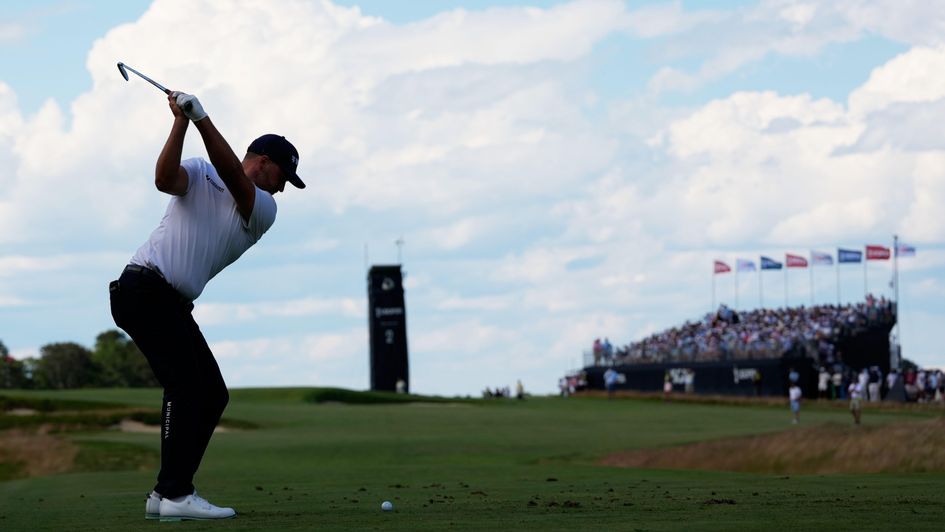
Wyndham Clark still has a bit more work to do to win the US Open, but at the brutal 10th hole on Saturday he produced a moment of boldness which could go a very long way towards making him a two-time major champion.
We'd seen Xander Schauffele make double-bogey, we'd seen Rory McIlroy's earlier charge take a hit when he couldn't hold the green, and countless approach shots go through the back of the treacherous par-four. Clark's did the same. Like so many before him, the leader carried his wedge too far and couldn't prevent his ball from disappearing down the slope at the back.
But while Schauffele and McIlroy were among those taking their medicine, removing the big error and leaving themselves mid-range putts each would go on to miss, Clark stepped up and hit one of the most quietly significant and downright impressive shots of the championship. Rather than carry the false front as others did to ensure the ball didn't return to his feet, Clark thumped his wedge into it, got the release, got the check, and had six feet rather than 20.
The putt looked like missing, but after a trip around the edge of the cup settled in the bottom of it. Fortunate, yes. But Clark played boldly, and he did so again with his bunker shot at the 11th for another par.
Later in the round, after a rare mistake at the 15th, Clark fired a wonderful approach to the par-five 16th for an eagle which moved him seven shots clear and will be considered by most to be the shot of the day. I'm not so sure. If he goes on to win, remember the one at the 10th, the one where he refused to take the safer path. Palmer would've approved.
We got you. pic.twitter.com/RuCsMiJCh3
— U.S. Open (@usopengolf) June 20, 2026
Scheffler looms but could be closer
While all that was happening around the turn, unbeknown to Clark, Scottie Scheffler was making his task just that little bit more straightforward. From holes three to 16, Scheffler made a menacing charge that Clark must surely have noticed. Roars reverberated around Shinnecock's grandstands when he chipped in at 14 and holed for birdie at 15. Another came to salute his approach to 16, where he so nearly made eagle.
But after that run, Scheffler missed a short par putt on 17, and a short birdie putt on 18. Had he played those two holes in 3-4 rather than 4-5, he would have been sure of his place in the final group and Clark would've had to play the final stretch knowing that the gap between his score and Scheffler's is key to this entire tournament. Might that little bit more scoreboard pressure have influenced how Clark performed?
Scheffler charged, brilliantly, like the champion that he is. Then Shinnecock bit back at him and left some doubt as to how likely his prospects of capturing the career grand slam on his birthday are. Sunday is the first day in his career that Scheffler will have that opportunity. The chance of it being the last took a a hit, both from the scores he had to write down, and the effect they had on what Clark saw ahead of him.
'It's been very fair, it really has'
I've selected a Tommy Fleetwood quote here because he popped up on the television as I was beginning to write about the set-up, but the truth is this isn't about Fleetwood, it's about the USGA. Eight years ago they received a barrage of criticism on Saturday as the course became borderline unplayable. This week, criticism went the other way over the first two days, as viewers demanded something more akin to 2018.
That really does capture the sense of damned if you do, damned if you don't which faces the organisation each year at their marquee championship, but we should be very clear about the way Shinnecock has been presented. I can't find a single issue in what they've come up with to this point. It should be the blueprint for how to go about producing a tough spectacle which is as close to fair as golf should ever be.
By the end of this week, it seems most will be satisfied. Players, certainly, but viewers too. We're heading to a situation where very few break par and, whoever wins, they'll have had to face a variety of challenges including wind speeds and directions, perhaps a bit of fog, and greens which materially changed from one day to the next. The USGA have controlled what they could control exceptionally well.
I find myself wondering what does it really matter if the winner shoots six-under or one-under? Nothing, to me. What I like to see from a US Open is players being kept at their limit, forced to make decisions, asked to hit a variety of shots, challenged mentally as well as technically. How do you respond to a bunker shot affected by a stone or two? How do you get back into position? How do you stay even-keeled when luck runs out?
Shinnecock might be my favourite active venue because of the ways in which it meets this demands. OK, there's still a tendency towards the longer drivers, but maybe that's just the game today. Otherwise, it both looked and felt like an exceptional venue managed exceptionally well by the people on whom there was perhaps the most pressure. Faultless.
50 yards from the flag, but can't hold the green.
— U.S. Open (@usopengolf) June 20, 2026
It's a bogey for Rory at 10. pic.twitter.com/gUTFU1XO1B
Key Open trial?
In 2018, Shinnecock provided some key pointers for the Open Championship at Carnoustie a month later. There, Xander Schauffele was second, Tony Finau contended, Tommy Fleetwood added 12th to second, Justin Rose added second to 10th, and both Webb Simpson and Zach Johnson supplemented their strong performances in the US Open.
It made sense. Shinnecock's leaderboard featured a raft of Open specialists, Henrik Stenson another one of them, and even a former Junior Open champion in Patrick Reed. Daniel Berger took a while to showcase his abilities on UK linksland but did so in 2021; Tyrrell Hatton and Matt Fitzpatrick have since won the Dunhill Links three times between them and contended for the Open, too.
Even Haotong Li, twice in the top five in our Open, can be seen tucked away in an eye-catching 16th at Shinnecock, alongside 2010 Open champion Louis Oosthuizen, so the parallels were clear and logical. Shinnecock is exposed, somewhat links-like, with echoes of Scotland. There can be no finer place in the USA to test the skills needed in a month.
So, if on Monday your instinct is to scour the Open Championship market and start building a portfolio, the final leaderboard here should be the first port of call. Those who shone on what looks to be a firm, fiery, windy weekend get bonus points and whatever the outcome, it's these players who ought to arrive at Birkdale feeling like they have all the tools they need.
Reid all about it
A rare note on the broadcast: Mel Reid was a brilliant addition to Sky Sports' coverage. That had been clear all week, but in the lengthy and sometimes difficult preamble alongside Nick Dougherty and Rich Beem on Saturday afternoon, she was especially impressive.
Beem is ever so likeable and very good at the job too, but I must admit his habit for accelerating when he has something he really wants to say can make it a bit difficult to listen to sometimes. Dougherty has become a skilled anchor, able to nudge things along in the right direction. Reid though was the star, speaking eloquently about Wyndham Clark and the route he's taken to where he is today.
Reid is qualified to talk about Clark in a more empathetic way than some of us can be guilty of. Clark lost his mother when at college; Reid lost hers back in 2012 and it significantly hampered her professional career. She spoke powerfully about the profound impact losing a parent can have and how it changes you as a person; she explained why that should give us pause before deciding we know all about who Clark is.
But she didn't shy away from holding him to account, either. It was a clinic in balanced, nuanced analysis and while this particular point of discussion presented her with an opportunity to offer a unique perspective, the truth is all week long Reid has shown all of the skills of a top-class pundit, whatever the topic.
Regular viewers of the LPGA Tour coverage will be familiar with this by now but whether there or in Sky's coverage of majors, I hope we see much more of her in future.
Mel Reid has been fantastic all week and that on Wyndham Clark was mega. Star of the broadcast so far for my money.
— Ben Coley (@BenColeyGolf) June 20, 2026
My red-hot take
Right, in the spirit of trying to make a reasonably bold prognostication because that really is what sells, I will say this: Cameron Young is a fabulous golfer, but I have my doubts as to him becoming a great one.
It's been a transformational 12 months for Young, really since he qualified for the US Open last year and again showed up well in a major, despite his form at the time being best described as patchy. There is no denying that his record in the biggest events in the game is good: seven top-10s in 21 starts, chances to win the Masters, the PGA, and the Open. More chances will likely come, too.
But while his putting improvements complemented the awesome driving with which we've become accustomed and helped him to pinch the Players Championship from the pocket of Matt Fitzpatrick, I still see weaknesses in his game which may limit his potential. Young's approach play has become more consistent but still isn't elite very often. His work around the green, likewise.
Beyond the numbers, there's just something about his game that makes me wonder whether we're in the golden spell right now, that spell Padraig Harrington spoke about; the one where golfers make hay and then return to a slightly lower level, where they spend hour upon hour on the range, trying to find a path back.
Young may find that his chances begin to run out, because his B-game is nowhere near the same level of the very best players in the sport. We've seen that this week, just as we saw it over the weekend of the PGA. Of course, we've also seen his A-game this year, and it was good enough to dominate when the PGA Tour returned to Doral, the type of venue which accentuates the things he's best at.
This take has the potential to go badly wrong, but that's sort of the point. To put a bow on it, I'll say this: from today forward, Ludvig Aberg wins more golf tournaments. His B-game is better, he's more consistent, and the step Young has taken over the past 12 months is still to come from Aberg. That would take him close to the very top, and one day he might even get that far.
Woe is we
Saturday morning's US Open controversy, before play began, concerned Bryson DeChambeau and what constitutes appropriate scrutiny and criticism of the two-time champion who huffed and puffed his way to a third missed cut in as many majors this year.
This is one of the world's best players and, if he misses the cut in the Open Championship, he'll have failed to make the weekend of a major all season. For context, Rory McIlroy once missed back-to-back cuts in majors – that was in the year 2010. Scottie Scheffler has missed three in total, the same number DeChambeau has notched up in about 10 weeks. Jon Rahm's missed cut this week was his second since 2020.
By any and every measure, it is unusual that a player so capable has missed three straight cuts in major championships. What makes it more unusual, more deserving of scrutiny you might say, is that the same player suggested recently that in a post-LIV world, he might stop playing in other events. Were that the case this year, hypothetically, Bryson DeChambeau would've played six competitive rounds in six months.
"I'm in that weird space right now, I don't know what to do either," DeChambeau said. "Content creation or professional golf. I don't know what to do right now." It would be fair to say most found this unconvincing; the bargaining tactic of a man with an ego to match his subscriber count. Still, these are DeChambeau's words, and he would surely want us all to register them.
Bryson DeChambeau has missed the cut in three straight majors for the first time in his career. pic.twitter.com/D0o9T0D5ji
— Golf Digest (@GolfDigest) June 20, 2026
This is a generational talent telling us that he may stop playing professional golf outside of majors, for which his exemptions will run out in the not-that-distant future. So, when people ask what's going on, when they discuss whether he wants to be considered a 'serious golfer', they do so because the man himself wants us to believe that he may not actually want that; that likes and comments might appeal more than trophies.
What's fascinating about Bryson the player, one of the things that separates him, is that the gap between his good and bad is so wide. This year there's been a lot of talk about Scottie Scheffler dropping a level – that means finishing 24th once and runner-up a few times instead of first. Scheffler's ceiling is extraordinarily high but what's more extraordinary is that his floor is higher than most very good players.
DeChambeau's ceiling, seen pre-LIV Golf in the 2020 US Open and elsewhere on the PGA Tour, and post-LIV in his standout performances on that circuit plus his 2024 follow-up at Pinehurst, is just about as high as anyone's. His floor, however, is lower than any other would-be elite golfer. It is significantly lower than Rahm's, perhaps lower even than less able LIV players like Tyrrell Hatton and Joaquin Niemann.
Viewed that way, a run of missed cuts was always possible, but it's DeChambeau's own threat to walk away from Tour-level golf, his insistence on trying to wow everyone by saying he asked an AI chatbot how to fix kinks in his swing, his blind commitment to single-length shafts and 3D printers, that demands a different set of questions. That is part of the deal if you want to position yourself as unique.
Fundamentally, questions and criticisms are part of the fabric of sport. We should probe, we should seek answers. And we – or, to be more specific, people whose entire online personality has been dedicated to the proud defence of the collective honour of a subset of golfers – should lighten up a little. This is a silly game at its core, but its strength is how intoxicating the pursuit of understanding it can be. That includes trying to figure out the enigma that is Bryson DeChambeau. Otherwise, he's just another golfer, and that's one thing DeChambeau has never been.
A glimpse of the future
It was a fine week for the amateurs at the US Open, five of them making the cut and the two biggest names, Jackson Koivun and Miles Russell, playing together in Saturday's third round. All things being equal, without rotten luck with injuries or one of the many thousands of other things that can interfere, these two should be competing against each other at the very highest level in a few years.
Russell, aged 17, hasn't even started college yet. He's set to join Florida State along with his friend, Charlie Woods, and he'll do so as the standout junior in the world. The left-hander has already made cuts on the Korn Ferry Tour and the PGA Tour and his future is extraordinarily bright.
Koivun's future is now. The top-ranked amateur before he turns professional after the US Open, Koivun is set to make his pro debut at the John Deere Classic where he will immediately be priced up among the favourites. That's an indication of the reputation he has, the regard in which he's held, the strength of his amateur form. Already, DataGolf make him comfortably PGA Tour-grade and with the prospect of much more to come.
On what we've seen so far, Koivun's key strengths are two-fold: he looks a supreme iron player, the best way to ensure a long and successful career, and he looks pretty deadly on the greens. That reminds me most of Jordan Spieth among the last decade or two of promising young Americans. Koivun will have achieved a lot if he gets to three majors and it speaks to his talent that these don't seem inappropriate terms.
Spieth also perhaps serves as a note of caution but for now let's focus on the positives, and perhaps another way to liken these two players. Remember where Spieth won his first PGA Tour title? That's right, the John Deere Classic.
The future is now.
— U.S. Open (@usopengolf) June 20, 2026
Jackson Koivun and Miles Russell are playing together today. pic.twitter.com/Llieri9HDl