Ben Coley reflects on the early action in the US Open, where Rory McIlroy, Ludvig Aberg and Tommy Fleetwood are all close to the lead.
Nobody had the foggiest
We had checked the hour-by-hour forecast, being sure to select the closest weather station. We had put a figure on the likelihood of what the locals call T-storms for no good reason. We had wondered about the stimp and the watering and the knock-on effects of all of this. Might the late starters become early starters? Might that play into their hands?
Then everything changed for the first time, at about 5am, when the latest macro-forecast suggested that not only would those later starters be fine to play after all, but that they might suddenly be disadvantaged as a result. Now, with play in the US Open set to begin to time, those out in the afternoon appeared set to face high winds then and more winds on Friday morning.
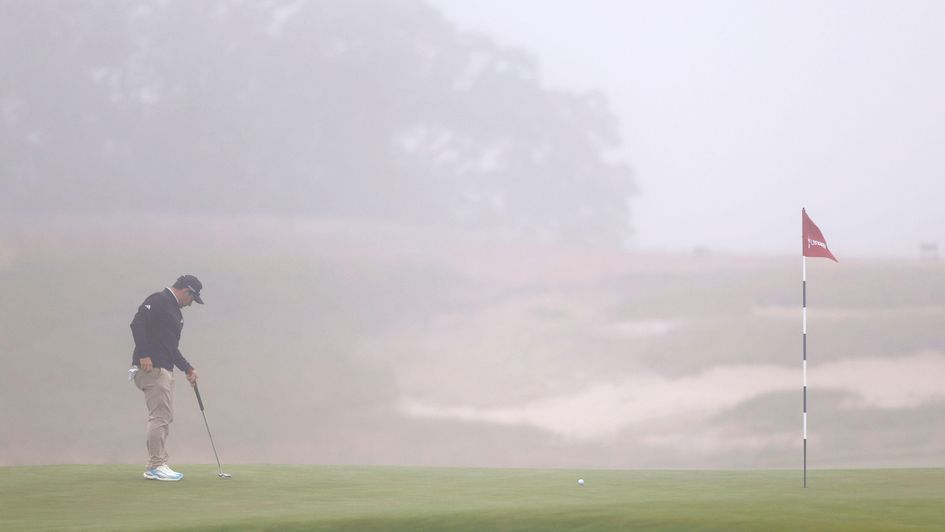
But nobody had accounted for fog. Fog wasn't in the models, fog wasn't given a percentage. There was neither a predicted likelihood of fog, nor a predicted density of the fog should it arrive. And so it turns out that when it came to trying to declutter a complicated US Open by applying weather filters which are the only way we can convince ourselves half the field simply can't win, nobody had the foggiest.
James Nicholas, a qualifier born locally, enjoyed the honour of hitting the first tee shot at 6.45am local time. He did not enjoy the pleasure of following its flight as it disappeared into the grey wall and it was a surprise that another 20 minutes passed before the horn blew to signal the suspension of play. No high winds, no electrical activity. This isn't Torrey Pines, there's not meant to be a marine layer, yet it could play a key role in the outcome of the tournament.
On that we will have to wait and see but as the USGA provided quarterly updates in the form of quote tweets, each promising the substantive update the quoted tweet had failed to deliver, it became clear that those due out in the afternoon would not complete their rounds. Now to try and establish exactly how many holes they might complete, and whether a long Friday is better than a full Thursday.
Certainly though, this was a missed opportunity for the early starters. The wind was down at 8am as players waited impatiently on the putting green and the driving range, some cursing that they'd set their alarms for 4am only to be left waiting around. As is often the case, Padraig Harrington said it best: "To be honest, we'd love to get playing. Even if I couldn't see where the ball is going I'd want to go play!"
Come the end of the week, it may be that the best time to play golf was the two hours when the fog just wouldn't lift.
One of the best talkers in the game.
— U.S. Open (@usopengolf) June 18, 2026
Fog delay thoughts with @padraig_h. pic.twitter.com/J1OciTJgXV
Everything becomes clear(er)
As the day unfolded, as the fog gave way to a good test of patience and skill, those later starters did appear to have the best of it. The wind still blew, but even removing Clark's outlier round from calculations the later starters as a collective appeared to have it easier. The numbers have that advantage at 1.12 shots, but that's before they head out on Friday morning. That gap could widen.
All the more reason for Rory McIlroy to be a little angry at himself for a bogey-bogey finish that turned a 67 into a 69. McIlroy had played wonderfully and his irons had been as hot as his putter, but too hot at the eight where his strike was so pure that it cut through the wind and went long of the green. On nine, he rode the wind and missed left, unable to get up and down.
Both mistakes were small, both were magnified, and combined with the fact that he was on the wrong end of a draw bias will mean that he has work to do when he returns to the course on Friday afternoon. As things stand, McIlroy is one of a remarkable seven former US Open champions in the top 10. He's the only one of the seven who played in the morning, and may prove to be the only one of the seven who let slip a dream start.
Power set to reign again
Shinnecock in 2018 painted a confusing picture when it comes to the value of long driving. On the one hand, Brooks Koepka won, Dustin Johnson was third and Tony Finau was fifth. On the other, players like Daniel Berger, Webb Simpson, Zach Johnson, Patrick Reed and Henrik Stenson were all inside the top dozen. The underlying correlation was broader than any specific skill. Ability won.
The US Open typically does favour big hitters and that message was very clear in 2016, 2017, 2019, 2020, 2021, 2022, 2023 and 2024, but it hadn't been in 2018, and it wasn't in 2025 either. There's some data that suggests Oakmont did favour the powerhouses but the bottom line is JJ Spaun won and that Robert MacIntyre, in second, Viktor Hovland in third and Tyrrell Hatton in fourth are not in the extremely long category. Length might've helped, but it didn't win.
Here, on a course which wasn't as firm as perhaps anticipated and with greens allowed to run slow on account of the forecast wind, the early signs were clear. When Sam Stevens joined Ludvig Aberg in the lead, with Sam Burns and Rory McIlroy tied for third, with Kris Reitan, Maverick McNealy and Max Greyserman all close behind, it was hard to spot the short hitter. Brian Harman, a major champion, very much stood out.
By the time the morning wave had finished, a bogey-bogey finish cost McIlroy the lead and handed it to Stevens, a long, quality driver of the ball. McIlroy and Aberg were right on his tail. Then, in the evening, Wyndham Clark powered to six-under through 16 holes, pursued by fellow former winners Gary Woodland, Matt Fitzpatrick, Dustin Johnson and Jon Rahm, with Bryson DeChambeau just one shot further back.
Without underestimating Harman, the former Open champion who contended in a largely big-hitters' US Open in 2017, there's every chance we're adding to the Johnson-Koepka-Woodland-Rahm-Fitzpatrick-Clark-DeChambeau list, not the Spaun one.
Nine years. Worth the wait.
— U.S. Open (@usopengolf) June 18, 2026
Every shot from Rory's eagle on 5. pic.twitter.com/mPiabyN6UJ
Two nines, one familiar tale
Everyone wants different things from a golf course but one thing most can agree on is that being able to score if you play exceptionally well but punished if you play poorly is a good start. Certainly, that's what the players want to see. That seemed to be exactly what Shinnecock served up and credit must go to the USGA for striking the right balance with the things they could control.
Slow greens were absolutely necessary and so were sensible pins, yet even with them it was tough to break par. Keith Mitchell couldn't do it, but it was Keith Mitchell who single-handedly encapsulated that sense of punishment and reward with a round in many ways the embodiment of his entire PGA Tour career.
This is a player who, when graduating from the second-tier circuit over a decade ago, was quietly talked about as someone just that bit different. It's easy to see why. Few players over the ensuing years have been so reliably long and straight from the tee and that elite quality has helped him to a very good career, just not one of the level he surely ought to have reached.
When everything came together he won a Honda Classic at a hard golf course against world-class opponents, but that was nine years ago and a second title has eluded him. Last year he started so well so often that it became a bit of a running joke. The cruel part is that nobody ever really expected him to hang around and finish the job, because for so long now that's what he's often threatened but always failed to do.
Here at Shinnecock, an opening 41 highlighted a player who doesn't know how good he is, who is hard on himself, whose potential will never be realised while he makes something complicated out of a simple, old-school golf swing which moves as though under the command of a maestro conductor.
Then Mitchell became the seventh man in history to break 30 in a US Open, his 29 strokes featuring four birdies, one eagle, and no mistakes. The impossible made effortless by a man in an impeccable cardigan-visor combo which is now as familiar as his first-round leads and ties for 29th.
It was somehow fitting that Patrick Rodgers, the longstanding maiden who has never realised his potential, was there to warmly congratulate Mitchell on the best nine holes of his life, the sort of recovery effort which ought to be the spark that lit the flame. He really is that good. Perhaps one day he'll say so himself.
41-29 🤯
— U.S. Open (@usopengolf) June 18, 2026
Keith Mitchell shoots an even-par 70 with neither nine in the 30s. pic.twitter.com/DwuK6bzaBK
Mockers on Tommy
When Tommy Fleetwood birdied the brutal par-five 16th, then rolled in nice par saves at the following two holes, one of the Sky Sports team referenced those slow greens and hinted that they might just help Fleetwood to hole out with greater authority. There was an element of 'say what you see' to the analysis given the timing, but like many Fleetwood fans I'll buy into any positive thrown out and in that moment, it all made perfect sense.
Then he three-putted the first when stood over a good birdie chance, missed another good birdie chance at the second, and three-putted the third too from similar range. From level through nine holes and with the easiest stretch ahead of him, Fleetwood's putter forced him onto the back foot. Soon after the second of those mistakes, television coverage cut to Patrick Reed holing out for par from 15 feet. It was a jarring contrast.
It will be so very hard to win this championship without limiting what you might call silly mistakes, even in tough weather. Three-putts from close range – these were 30 feet and 25 feet respectively – qualify as that and even someone as even-keeled as the Englishman must surely have been a little hot under the collar. The opportunity he'd earned by holing out well just before the turn had vanished within an hour.
But then again, Fleetwood's superpower is that, actually, he doesn't let this stuff get to him in the way that it might his fans. Birdie at the easiest hole on the course followed by his shot of the day to five feet at the next, one of such quality as to almost remove putting from the equation, got him back to level par. Sticking around that score all week might be the mission.
Play the slope? Nah. He'll just take it right at it.
— U.S. Open (@usopengolf) June 18, 2026
Tommy leaves himself a great birdie look at 6. pic.twitter.com/Jb5DEORVyY
'I'm just trying to make bogey'
Ludvig Aberg was involved again from the off and whatever comes of his performance this week, I'll say it again: this in my view is a major champion in the making, potentially one of the finest European golfers we've seen. Majors aren't given out and he'll have to earn it, but this is just his 11th attempt and the fifth time he's played some kind of part, even if it's of course very early days. Prior to this particular major my worry was that his short-game and course management would catch him out, but there were some good signs midway through his second nine on day one.
Deep in conversation with experienced caddie Joe Skovron, the pair standing in thick rough to the left of the fourth fairway, Aberg was caught saying: "I'm just trying to make bogey." That's a line we've heard already this week, because it's what Brooks Koepka said was in his head the moment he found position Z eight years ago. Koepka made the bogey back then and, thanks to taking his medicine on Thursday, so did Aberg.
Aberg made three double-bogeys in the Masters this year, but since then he's gone five major championship rounds without one. And after getting the five he wanted at the toughest hole on what was his closing nine, he added five more pars to complete another excellent day's work. Should he keep doubles off the card for three more days, perhaps that first major is as close as Sunday. Fifth time lucky would keep him well ahead of the curve.
A pair of 69s in the Åberg/McIlRoy grouping.
— U.S. Open (@usopengolf) June 18, 2026
They are each one back of leader Sam Stevens. pic.twitter.com/FDoOnESEiB