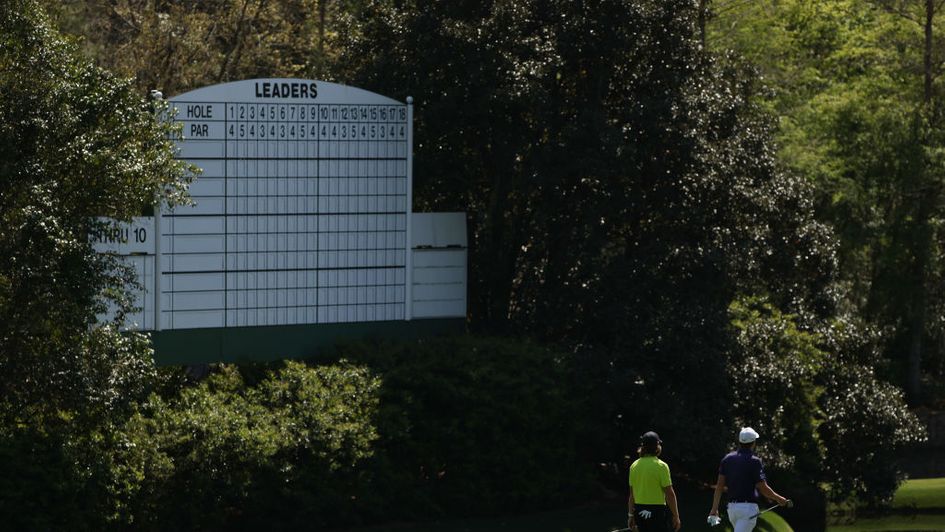
Prepare for the start of the Masters with our hole-by-hole guide to Augusta National, including scoring averages, hole rankings, and more.
1st (Tea Olive)
- 445 yards, par four
- Historical average: 4.236 (rank 6)
A deep bunker on the right of the fairway and trees both sides make for a daunting start, while long and left of the undulating green both spell big trouble. The hardest hole on the course in 2012 and again in 2017, it's never played less than par, but last year was a tad easier than usual.
2nd (Pink Dogwood)
- 585 yards, par five
- Historical average: 4.770 (rank 18)
Driving into the trees on the left cost Padraig Harrington a nine in 2009, but Louis Oosthuizen memorably holed his second shot for an albatross in the final round in 2012. An important early birdie chance and the easiest hole given lack of threat on second shot compared to 13 and 15. Extended by 10 yards in 2024 via a new tee box.
3rd (Flowering Peach)
- 350 yards, par four
- Historical average: 4.071 (rank 14)
Shortest par four on the course but a pear-shaped green with steep slope in front allows for some wicked pin positions. Charl Schwartzel pitched in for eagle in the final round en route to the title in 2011. Provides some of the best front-nine drama late in the tournament with anything from two to six feasible and pressure packed into second shot regardless of tee-shot choice.
4th (Flowering Crab Apple)
- 240 yards, par three
- Historical average: 3.282 (rank 3)
The back tee – not always used – turns it into a beast, with the green sloping from back to front. Phil Mickelson took six in the final round in 2012 and finished two shots outside the play-off. Jeff Sluman’s ace in 1992 remains the only hole-in-one and it always represents a challenge, the only recent exception being under soft conditions in November 2020.
5th (Magnolia)
- 495 yards, par four
- Historical average: 4.267 (rank 5)
Jack Nicklaus twice holed his second shot in 1995 and Colin Montgomerie did it in 2000, but it is another devilishly difficult green. To clear the fairway bunkers requires a 315-yard carry and the hole was lengthened by 40 yards for 2019. Regularly the hardest or next-hardest hole these days, with that bunker almost a shot penalty and scrambling very difficult.
6th (Juniper)
- 180 yards, par three
- Historical average: 3.135 (rank 12)
From a high tee to a green with a huge slope in it. Five holes-in-one – including Jamie Donaldson in 2013 – but Jose Maria Olazabal took seven in 1991 and lost by one to Ian Woosnam. Has played under-par once and we'll see the hole scared when the pin is front-left, but back-right makes it a real test of precision. Still, after the two holes prior it marks the start of a potential scoring run to the turn.
7th (Pampas)
- 450 yards, par four
- Historical average: 4.156 (rank 10)
What used to be a real birdie chance has been lengthened by 35-40 yards, while trees were also added and the putting surface reshaped. A very narrow fairway and more bunkers – five – around the green than any other hole, but expect plenty of birdies again when the pin is at the front. Among the par-fours, only holes three and nine produce more of them.
8th (Yellow Jasmine)
- 570 yards, par five
- Historical average: 4.813 (rank 15)
The bunker on the right, about 300 yards out, pushes players left and from there it is harder to find the green in two up the steep hill. Still a good birdie chance and Bruce Devlin made an albatross in 1967. Yet to play over-par and providing the bunker is avoided, eagle opportunities await.
9th (Carolina Cherry)
- 460 yards, par four
- Historical average: 4.133 (rank 13)
The tee was pushed back 30 yards in 2002. The raised green, with two bunkers on the left, tilts sharply from the back through three tiers and anything rolling off the front can continue down for 50-60 yards. Telling that the softer 2020 renewal saw it play easier as players could control their spin, which is key. Provides contentious, key moment in 2025 final round when McIlroy made birdie and was also key to Woods win in 2019.
10th (Camellia)
- 495 yards, par four
- Historical average: 4.296 (rank 2)
A huge drop from tee to fairway on this dogleg left and then a climb back up to the green. It was here that Rory McIlroy began to fall apart in 2011 with a seven, while Bubba Watson clinched the title in 2012 by making par in the play-off from the trees. Most players now opt to try to turn a three-wood around the corner and catch the downslope. Front-right pin is brutal regardless as bunker is no good and left risks run-off. Hitting the green is job done.
11th (White Dogwood)
- 520 yards, par four
- Historical average: 4.303 (rank 1)
The start of Amen Corner. Toughest hole in 2011, 2014, 2015 and 2018 and extended by 15 yards in 2022. Best remembered for Larry Mize’s chip-in in 1987 and Nick Faldo’s back-to-back play-off wins, and a hole where par is always a good score. Expect plenty to bail out to the right of the green and take their chances with a chip, although some have still found water from there. Edges moniker of hardest hole on the course now and anyone starting the back-nine 4-4 is gaining on the field.
12th (Golden Bell)
- 155 yards, par three
- Historical average: 3.267 (rank 4)
Probably the most famous par-three in golf. Narrow target, water in front, trouble at the back, it has seen everything from a one to Tom Weiskopf’s 13 in 1980. Defending champion Jordan Spieth took seven in the final round in 2016 in a dramatic back-nine collapse and Tiger Woods made 10 in the final round in 2020, before birdieing five of the final six holes. Still yet to average under-par in a single renewal despite being a short-iron and plays the toughest of the four par-threes despite being the shortest. Perfection.
13th (Azalea)
- 545 yards, par five
- Historical average: 4.775 (rank 17)
The end of Amen Corner. Massive dogleg left, lengthened by 35 yards for 2023, with scores ranging from Jeff Maggert’s albatross in 1994 to Tommy Nakajima’s 13 in 1978. Sergio Garcia saved par after a penalty drop from a bush in 2017, went on to beat Justin Rose in a play-off and named his first child Azalea 11 months later. Extra yards mean it's no longer quite the easiest hole and disaster does lurk, as we saw even when McIlroy laid up in 2025.
14th (Chinese Fir)
- 440 yards, par four
- Historical average: 4.162 (rank 9)
The only hole on the course without a bunker, but three putts are common on the wickedly difficult green. Course record holder Nick Price took eight here in 1993, while Mickelson holed his approach en route to his 2010 victory. Another hole where finding the right portion of the green can make the difference between a three and a six but fair to say it is for many the weakest in the back nine.
15th (Firethorn)
- 550 yards, par five
- Historical average: 4.781 (rank 16)
Often a tough decision whether to go for the green in two across the pond on the hole where Gene Sarazen sank his 235-yard four-wood shot for an albatross in 1935. There have also been three 11s here and the hole was lengthened by 20 yards in 2022, but still one of the best opportunities to score and no chance it'll play over-par as it did once, in 1998. McIlroy added another famous shot to this hole's history when drawing a mid-iron to inside 10 feet when tied for the lead in 2025, only to miss the eagle putt. Garcia meanwhile did make eagle en route to victory in 2017.
16th (Redbud)
- 170 yards, par three
- Historical average: 3.138 (rank 11)
Woods' memorable chip-in in 2005 came the same year as 73-year-old Billy Casper's 14, while Ian Poulter, Shane Lowry and Tommy Fleetwood are among the players to record holes-in-one. That Woods shot might be the most famous in the entire history of the Masters and a hole that always presents the possibility of even better, with a hole-in-one particularly likely to the traditional Sunday pin.
17th (Nandina)
- 450 yards, par four
- Historical average: 4.164 (rank 8)
The famous Eisenhower Tree was removed after suffering storm damage, making for an easier tee shot on the hole Rose double-bogeyed when one off the lead in 2007. Nicklaus birdied here to take the lead as he won his 18th major in 1986 and so did McIlroy en route to his Grand Slam-winning victory, albeit that required extra holes after bogey on 18. Underrated green is one of the best on the course. Ten yards added this year and could play a fraction tougher as a result.
18th (Holly)
- 465 yards, par four
- Historical average: 4.232 (rank 7)
The drive through an avenue of trees was made much harder when the tee was moved back 60 yards in 2002. The fairway bunker from which Sandy Lyle got up and down to win in 1988 is now 300 yards away. Conditions, from wind to pin placement, can wildly influence scoring but tends to be a birdie chance in the final round.