When the curtain comes down in May we will probably look back on Arsenal’s trip to Liverpool as the day the Premier League title was decided.
Victory for Mikel Arteta’s side means they should be 13 points clear of Manchester City when the two meet later this month (albeit having played two more matches) and with a remaining fixture list that doesn’t get any harder than a stuttering Chelsea at the Emirates.
Defeat on Sunday for the Gunners will put the title race in Man City’s hands. It is arguably a bigger game than that ominous fixture at the Etihad.
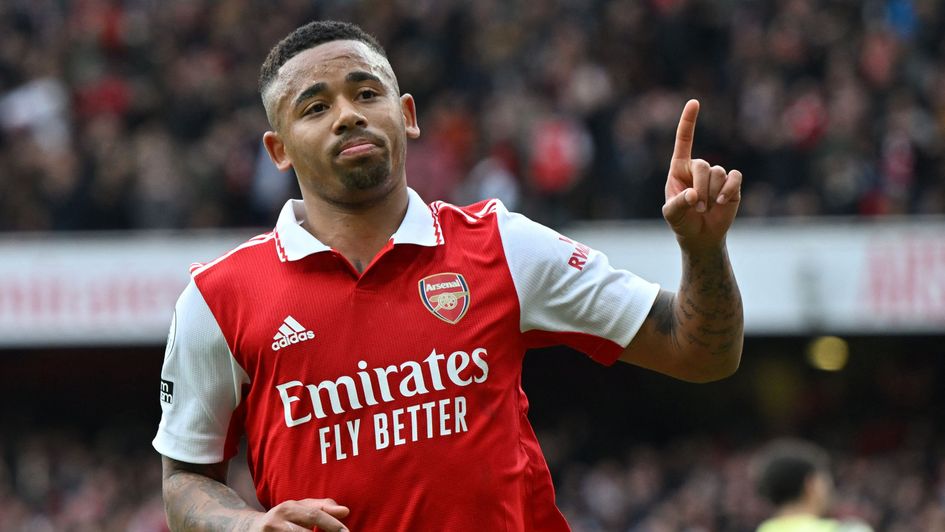
Gabriel Jesus’s return was perfectly timed. Arsenal have maintained their form so well during his four-month absence that we had almost forgotten the enormous influence the Brazilian had on setting the tone for Arsenal’s season, but his brace in the 4-1 victory over Leeds last weekend was a timely reminder: Jesus is precisely what they need to stay ahead in the title race.
Jesus combines Nketiah and Trossard traits
By the time Jesus was withdrawn on the hour mark against Leeds he had already managed 60% more touches of the ball (55) than Eddie Nketiah averages over an entire 90 minutes (34.3), which is the starkest indication of just how much he adds compared to the stand-in.
Jesus’s tenacity, his forward-driving intent as he picks up the ball in deeper areas, was what pushed Arsenal into such an advanced position in the title race over the first third of the campaign, turning what had often looked like stale possession under Arteta into something urgent and vital.
That quality is hard to quantify, although much of his creativity outside the penalty area is easier to capture.
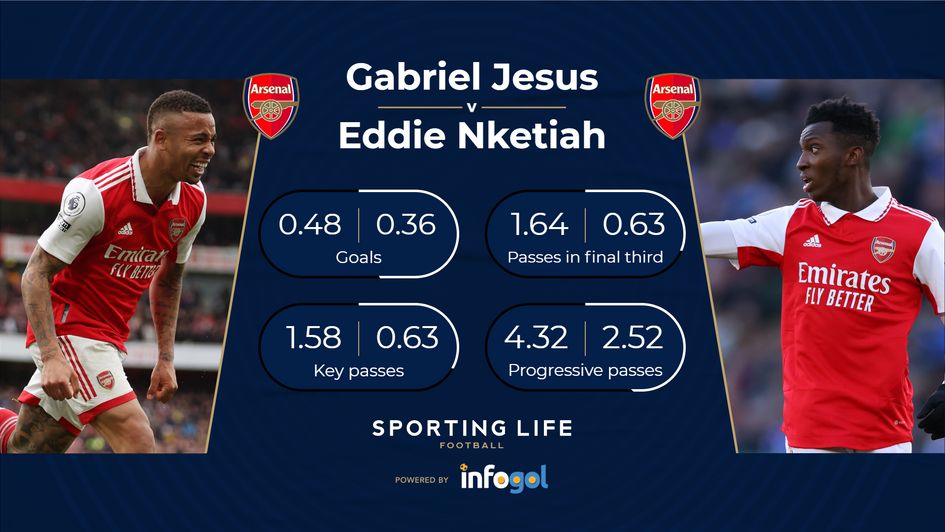
Nketiah might have scored at a fairly similar rate but the Brazilian is considerably more effective at the more advanced aspects of the modern striker: Jesus plays two-and-a-half times more passes into the final third than Nketiah, and produces about double the number of key passes, progressive passes, and shot-creating actions (4.32 to 2.52) on a per 90 basis.
This is not news to Arsenal fans – or to Arteta, who has taken to fielding Leandro Trossard as the central striker in the month leading up to Jesus’s return.
But although Trossard, regularly swapping positions with Gabriel Martinelli as a fluid false nine, amassed an incredible six assists in his four matches as a centre forward, he cannot produce like Jesus inside the penalty area.
Trossard had a grand total of 13 touches in the penalty area across those four games and just six shots, whereas Jesus had 10 touches in the box and four shots in a mere 60 minutes against Leeds.
There really isn’t any need for a deeper dive than that; Jesus is a clear upgrade on Nketiah while matching the creative qualities of Trossard, combining the traits of his two deputies.
Return strengthens Arsenal’s left
Martinelli’s influence on the left wing has grown markedly since February following a quiet winter for the 21-year-old.
His six goals and one assist in his last six Premier League appearances is obvious evidence of a winger whose sheer directness and power is an important counter-balance to the trickery of Bukayo Saka on the right. More often than not, the aim is for Saka to pull the opposition over to one side before a quick switch allows Martinelli to build up speed.
However, there are times when Martinelli has looked isolated on the left due to Oleksandr Zinchenko’s instructions to move into central midfield rather than overlap, and Martinelli’s recent form can be partly explained by the low quality of opposition.
As Arsenal get ready for some more challenging fixtures, starting with Liverpool at Anfield, they would have anticipated Martinelli getting trapped – without Jesus, that is.
Jesus has a strong preference for roaming out to the left wing, much in the way Trossard has been doing recently, but unlike the Belgian Jesus ensures Arsenal have two powerful dribblers able to double up on the opposition right-back.
When you add to the equation Arsenal’s deeper bench – and new ability to swap out Martinelli for Trossard depending on the opponent’s defensive shape – it’s clear Arsenal are a more robust and balanced team with Jesus back.

Liverpool’s press will define Jesus influence
How this changes the game at Anfield is almost impossible to predict because Jurgen Klopp’s tactical choices have proven so erratic this year.
In the 4-1 defeat at Man City a bizarre 4-2-4 formation allowed the hosts to easily pass through midfield and, taking the front four out of the game, released Jack Grealish and Riyad Mahrez to run into wide open space.
Clearly a similar strategy against Arteta, a Pep Guardiola disciple, will yield similar results, allowing Jesus to join Trossard or Martinelli in terrorising Trent Alexander-Arnold.
Even if Liverpool are a little more conservative and in a narrow 4-3-3, as in the 0-0 draw at Stamford Bridge in midweek, then Jesus – moving left – will expect joy against Liverpool’s error-prone right-back.
In fact, Klopp’s side continued to look shaky across the back line at Chelsea, with Ibrahima Konate and Joel Matip both seeming uncomfortable under pressure, which is where Jesus’s brilliant off-the-ball work could prove fruitful.
His pressing is among the best in the division, which is partly why his scurrying presence in the first team is such a psychological lift to the Arsenal players.
Assuming he starts, Jesus can hound the Liverpool defence into a shrunken performance and continue Arsenal’s resurgent form in spring.
He is exactly the injection of assertive, line-breaking energy Arteta needs to both overwhelm a fragile Liverpool and lead the side into the most important run-in of their careers.