There are simply no winners in a climate that reduces all managerial projects to bursts of form over a few short weeks, but English football has sleepwalked into this position.
Every Premier League manager is under pressure within months or sometimes weeks of their appointment, the concept of a year to bed-in ideas so distant now that even otherwise rational people in the media find themselves burying a head coach after days in the job.
Thomas Frank has been subjected to this scrutiny and those reactionary opinions more than most, which is perhaps the inevitable side effect of managing a ‘Big Six’ club but also speaks to a more profound problem symbolised in Frank's management style.
In the age of hyper-sensitivity from the stands, when nobody is given time to get their ideas across and everybody has to hit the ground running, ideology takes on a significance that goes far beyond results.
Supporters need a clear vision if they are to get on board and excuse even mild bouts of poor form, and without clarity on the tactical direction there is quickly an assumption that nothing is being done, that the club is drifting aimlessly.

Frank is not one of those kinds of coaches, and ironically that is exactly what drew Spurs to him in the first place. His flexibility was the exact opposite of Ange Postecoglou’s dogmatism, supposedly meaning Tottenham would play with variety and professionalism, letting go of kamikaze football to embrace something altogether more sensible.
The problem is that without positive results sensible looks senseless.
Frank’s Spurs have no identity to speak of beyond set-piece prowess. Almost every single one of their Premier League performances has been a vague, formless spectacle, the football technically happening but the ball more or less wafting up and down the pitch like its playing in the background of a TV drama.
It has driven the Tottenham fans to despair and, with just four more Premier League points than at this stage last term, it is universally assumed Frank is on his way out.
On the surface that seems entirely understandable given the quality of the football and the absence of any forward momentum since his appointment.
But listen to Frank’s post-match comments and an alternative theory develops, hinting at the fundamental problem with our short-fuse, fast-moving churn of managers and their tactical identities.
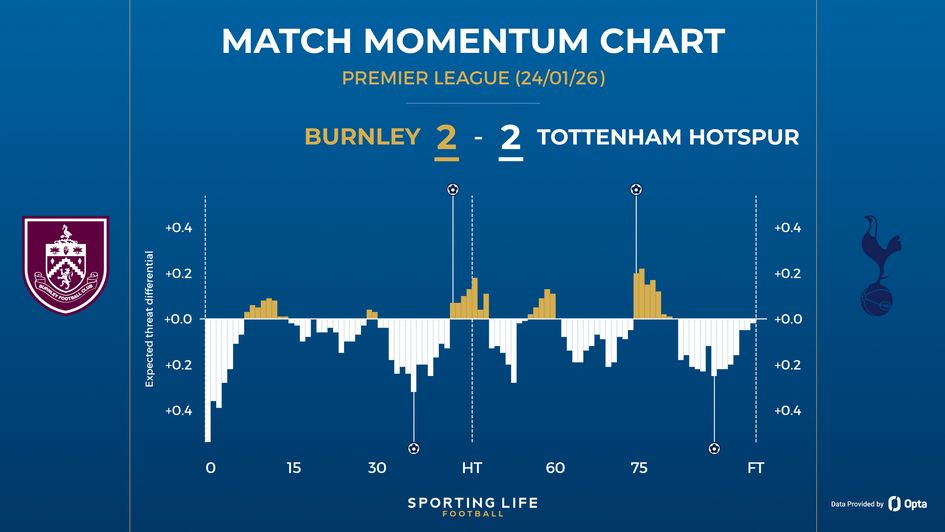
“I'm sure [the fans] can recognise and acknowledge, especially the first half, the improvement we've done there, and could and should have put it out of sight, but also acknowledge the will-power and character of the team that keeps running, keep fighting, to the end,” Frank said after the 2-2 draw with Burnley.
“We just need to keep going. We do so many things right,” he added, suggesting that only in small moments are his team let down, by confidence more than anything else.
“I think I said that many times, they actually are in an okay level, but apparently because of where we are now, we need to do more, to make sure we get the wins over the line.”
This follows a pattern with Frank. So many times this season he has tried to convince journalists that things are broadly on track, that performances are improving, and that only minor details need to shift.
That he feels so differently from the rest of us is worthy of investigation.
Here is the flip side of what our junk-food diet has done to us. We demand colourful tactical philosophers because we can see their progress even when results aren’t forthcoming, but as we have become addicted to that norm we have lost sight of what the more flexible tactician looks like.
Well, it looks like this.
Without a handbook full of tactical buzzwords to share around the fan base a manager’s tactics will look utterly hopeless while confidence is low and before the foundations have been fully integrated.
This is precisely why the Franks of this world have always demanded patience. It’s just that these days nobody ever gets it, a situation that has gone on for so long we have forgotten what in-process looks like and have lost the capacity to step back and afford somebody time; time not just to get bad results but to look like the basic premise is wrong.
It is of course too much to ask in the modern game, not when so much money is riding on European qualification, and Frank looks destined for the sack within the next few weeks.
But as Spurs lurch back in the other tactical direction, having burnt through yet another manager unable to match the super-club ambitions with its mid-table reality, it may be worth remembering a long-forgotten virtue.
Real patience means sticking out tough times, means putting faith in a manager even when there is nothing to have faith in. It’s a hard sell, but then so too is Tottenham Hotspur, seven years and five managers on from Mauricio Pochettino and seemingly going further backwards each year.
They need a deep cultural reset. That won’t happen if there is no space to fail.
More from Sporting Life
Safer gambling
We are committed in our support of safer gambling. Recommended bets are advised to over-18s and we strongly encourage readers to wager only what they can afford to lose.
If you are concerned about your gambling, please call the National Gambling Helpline / GamCare on 0808 8020 133.
Further support and information can be found at begambleaware.org and gamblingtherapy.org.