
Ruben Amorim is not going to change his formation.
He has painted himself into a corner, staking his reputation on what ought to be just one aspect of a manager’s tactical system but has become an important metaphor for what his time as Manchester United manager represents.
To change it now would be to admit defeat and lose all credibility. To keep it admits defeats and loses him all credibility.
Amorim has accrued 34 points in 33 Premier League games in charge and the 3-1 defeat to Brentford felt like a regression back to the very start, prompting a question that has only begun to emerge this season.
What is Amorim actually trying to do?
It has taken a long time for pundits to ask, mainly because people have conflated the idea of a formation with a tactical strategy. What he’s trying to do, they’d say, is a 3-4-3.
But that isn’t an idea, isn’t a system.
So, let’s answer that basic question.
The point of Amorim’s football is total possession and territorial control. Man Utd have tended to fly out of the blocks this season and pepper the goal with shots, the target being to grind the opponent into psychological submission.
The aim is to get them sitting deep, conceding ground and the ball.
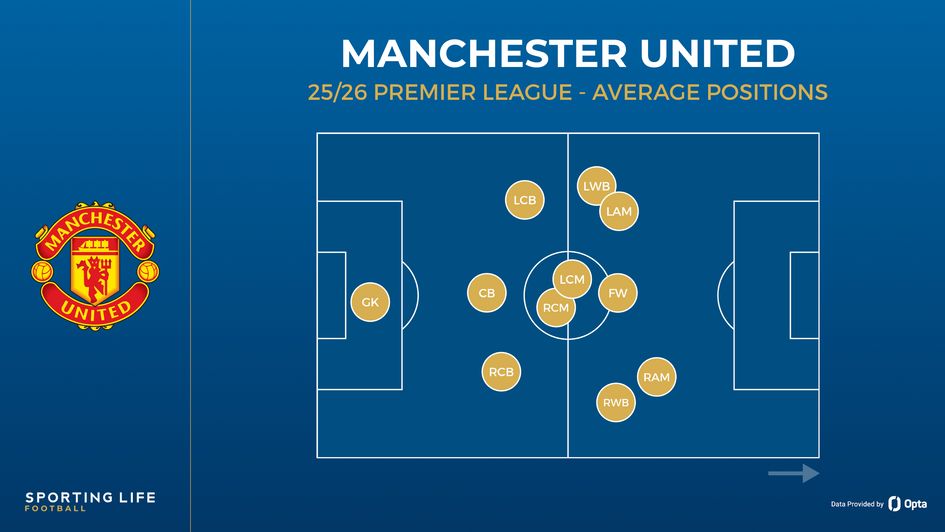
From this position the 3-4-3 comes into its own. A five-man forward line has numerical advantage in attack and a box midfield of two sixes and two tens has a spare man against the opposition midfield.
From a position of dominance, the players then get the freedom to move about, with tens drawing wide and wing-backs coming infield, for example, creating fluency and unpredictability.
When the ball is lost, the swarming counter-press can quickly win it back because, with an outside centre-back stepping out into midfield, there is once again a numerical advantage in every single area.
That is the idea in a nutshell, and it’s a good one – as long the other team are willing to let you pummel them into that cowering position in the first place.
Igor Thiago scores again!
— Football on TNT Sports (@footballontnt) September 27, 2025
Brentford now lead 2-0 within 20 minutes against Man United 🔥
📺 @tntsports & @discoveryplusUK pic.twitter.com/UoCsgCdYXe
Sporting, Benfica, and Porto are substantially better than the rest of Liga Portugal, roughly the equivalent of Arsenal, Liverpool, and Manchester City playing in a division with mostly Championship teams and a few from League One.
A tactical philosophy built on absolute domination of the space makes total sense here.
It simply does not in England.
The standard is too high, the pressing too well choreographed, and the counter-attacks too effective for Man Utd to shape things. Nobody has that luxury.
Man City and Liverpool at their respective Pep Guardiola and Jurgen Klopp peaks had it for a few years, and that really is that when it comes to the entire history of English football.
So, it isn’t long before Man Utd are forced backwards, the formation becomes decompressed, and all the problems of the 3-4-3 come out. Most importantly, the wing-backs drop to make a flat five, leaving just two central midfielders to cover the entire width of the pitch.
"Everything is important in this club... we need to win every game and we are not doing that"
— Football on TNT Sports (@footballontnt) September 27, 2025
Ruben Amorim reacts to another loss for Man United this season 🔴
🎙@julesbreach | 📺 @tntsports & @discoveryplusUK pic.twitter.com/tCobdZuqVC
It’s a basic problem of space.
Unlike a 4-3-2-1, in which the two central midfielders and the number ten occupy different columns of the pitch, meaning there are three players spread out to stop forward passes, the 3-4-3 has the sixes and the tens aligned, one in front of the other.
That’s two people’s width to block the spaces. It’s that simple.
And it can’t work. You can use that system if you’re happy to be the reactive team playing largely on the break – see Oliver Glasner’s Crystal Palace or Antonio Conte’s Chelsea – but not if, as is the case these days, you are a super-club hoping to dominate with attacking football.
Those compressing space in a midblock, waiting to break, can keep small distances between the midfield two and the back five. A forward-thinking team cannot.
Amorim’s big idea is inherently flawed, and confusing when you see it in action, but it is decipherable.
We know what Amorim is trying to do. It’s just the wrong shape - and, more importantly, fundamentally the wrong idea for a Premier League ‘Big Six’ club.
More from Sporting Life
Safer gambling
We are committed in our support of safer gambling. Recommended bets are advised to over-18s and we strongly encourage readers to wager only what they can afford to lose.
If you are concerned about your gambling, please call the National Gambling Helpline / GamCare on 0808 8020 133.
Further support and information can be found at begambleaware.org and gamblingtherapy.org.