
Alex Keble explains why Leeds did well despite learning on the job on Saturday – but expects a thriving Philippe Coutinho to expose them on Thursday night.
Leeds will take time to unlearn Bielsa’s methods
“I want them to know how strong that was, how good that was,” Jesse Marsch said after Leeds were narrowly beaten by Leicester. “We’ve got to relieve the stress a little bit. I told them: ‘If we keep playing like this, we’re going to get all the points we need.’ The only negative is the result.”
For the most part, that analysis is fair. Leeds were considerably more defensively solid than we had seen in the final six matches under Marcelo Bielsa, although Leicester are far from formidable opponents at the moment and the game turned once Brendan Rodgers worked out this was – by and large – the same old Leeds.
It will take a while for Leeds to unlearn the unique man-to-man pressing system of their last manager, which explains why there were times today when the players rushed back into old habits. Granted, for long stretches they were calm and ordered in sitting a little deeper than usual and pressing in select moments, but particularly in the second half the Leeds midfield became tangled up as players began to follow their Leicester counterparts rather than hold their ground.
Without the injured James Maddison, Leicester had not found it easy to build purposefully through the lines, making Marsch’s new instructions easier for the Leeds players to follow. But credit to Rodgers for bringing Kelechi Iheanacho on for Jamie Vardy; having noted the deeper Leeds defence had not left much room for Vardy in behind, he brought Iheanacho on to drop between the lines.
It is between the defence and midfield where Leeds were most vulnerable under Bielsa thanks to the man-to-man system leaving huge gaps for vertical passes into the number ten zone. Iheanacho came on and within six minutes had assisted the winner, giving the ball back to Harvey Barnes in an area Leeds are so often under-stocked.
Marsch is right to be optimistic. Leeds had many chances in the first half and proved they will be capable of dialling down some of the most excessive aspects of the Bielsa tactical philosophy. But in the short-term, opponents will continue to find room between the lines, starting with next weekend’s opponents Aston Villa...
Coutinho revels in Gerrard’s new diamond 4-4-2
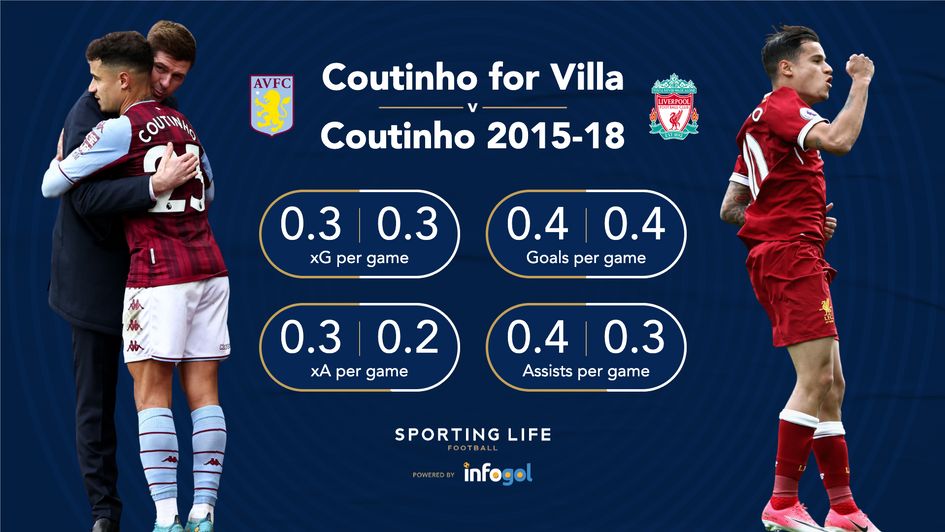
Philippe Coutinho, who now has three goals and three assists in six starts, will certainly enjoy those spaces against Marsch’s Leeds. Considering how he excelled as an advanced eight towards the end of his time at Liverpool, and was rarely played anywhere other than the left wing at Barcelona, it is perhaps unsurprising that Coutinho has rediscovered his best form in a system that prioritises cramming the half-spaces with bodies.
But Villa did not use dual tens today, moving – for the first time under Steven Gerrard – to a diamond 4-4-2 that put Coutinho at the heart of everything Villa did. He was constantly in control, floating around the ten space to set his team away at speed in the attacking transition, completing 91% of his passes.
Gerrard’s tactical switch was probably a response to Villa’s difficulty controlling games with possession, despite this being the manager’s preference. They have won 19 points from 10 matches in which they have held the minority of possession and one point from the four in which they have held more than 50%, reflecting the fact Villa are simply more cohesive when forced to compress space between the lines and then break quickly.
However, they have had some problems with getting the ball forward recently due to the use of Coutinho and Emiliano Buendia behind a striker. Villa lacked the pace to counter, hence Gerrard fielding Ollie Watkins and Danny Ings together in the front line to stretch Southampton. It worked consistently, Villa holding a mere 38% possession but always looking assured, breaking neatly through those dual strikers.
The usual issue with a diamond 4-4-2 is conceding too much room on the flanks, which Gerrard countered intelligently by instructing Ashley Young to push up into the midfield line and, on the other side, John McGinn to sprint out to help Matty Cash. We will see a lot more of this formation over the coming weeks.
Rice absence is the difference at Anfield
Liverpool were not always in charge in the evening kick-off; West Ham had a few good chances to score, breaking behind Jurgen Klopp’s very high defensive line to catch Ibrahima Konate looking a little bit uncomfortable in central defence. But overall it was a deserved win and had Mohamed Salah not had a rare off-day Liverpool would have won by a bigger margin.
The difference was in midfield, where West Ham just could not cope with how Sadio Mane, Salah, and Luis Diaz all repeatedly dropped off the front line to overwhelm central midfield. The Liverpool midfielders were particularly sharp at playing quick passes into feet, finding a forward with space to turn on the ball and drive the visitors back.
It is hard to imagine this happening if Rice had been there to shepherd things, not just screening himself but setting the midfield line closer to the defensive one. He is without doubt David Moyes’ most important player and the catalyst for virtually everything West Ham do. It was always going to be tough at Anfield. Without Rice, almost impossible.