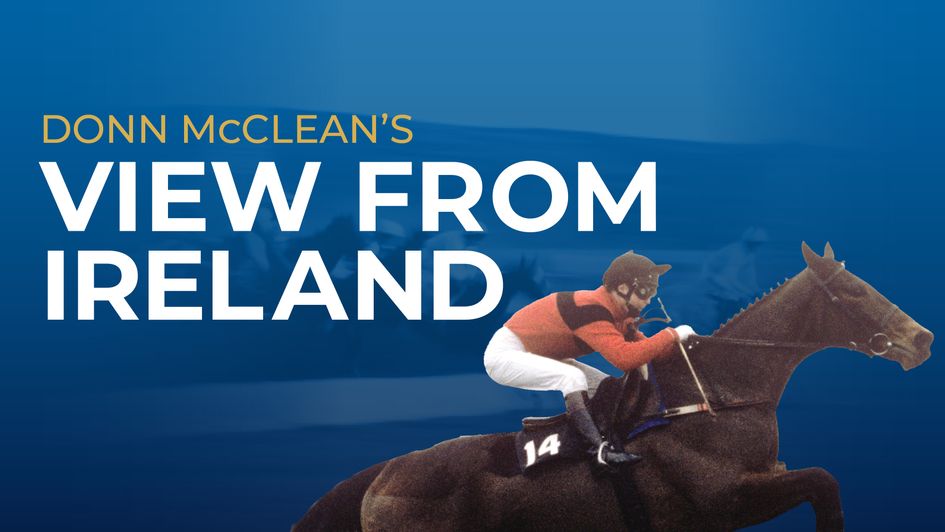
There are iconic images in racing, and Dawn Run is at least two of them.
There’s the Jonjo punch of the air as he and she cross the winning line in the 1986 Cheltenham Gold Cup, and there’s the hat-in-the-air shot a couple of seconds later, high above all the heads, packed deep, and every single one of them trying to assimilate all that had just happened.
A young Willie Mullins – known best then as son of the legend who trained Dawn Run – was on his way back under the stands (she can’t win from there) when he heard the roar from the crowd. He looked back, couldn’t see the racecourse, couldn’t see the horses, but he saw the hat going into the air and he knew that she had won.
There are iconic commentaries too. There’s the Shergar one:
“The Derby is a procession. Shergar is 10 lengths clear … there’s only one horse in it. You’d need a telescope to see the rest!”
And there’s the Red Rum one:
“And he’s coming up to the line to win it like a fresh horse …”
And then there is Dawn Run.
“The mare is beginning to get up. And as they come to the line … she’s made it!”
Sir Peter O’Sullevan. Spine-tingling.
“Dawn Run has won it! Dawn Run has won it!”
There was so much in that victory. It wasn’t just the drama of it, the fact that she looked beaten at least twice, and that last-gasp effort. Nor was it just the fact that it was the Gold Cup, the Cheltenham Gold Cup, the blue riband of National Hunt racing.
There was all that went with it: the first mare since Glencaraig Lady, the first Irish horse since Davy Lad, and, most importantly, the first Champion Hurdle winner ever to win the Gold Cup. Still Dawn Run is out on her own, she remains the only horse to have the pace and the speed to win a Champion Hurdle and the class and the grit and the stamina to win a Gold Cup. And all of it laced in the sadness and the poignancy of her fatal fall in the French Champion Hurdle just a couple of months after her Gold Cup victory.
Paddy Mullins’ mare was a pioneer in many respects. Bought for 5,800 guineas at Ballsbridge, she was ridden in her first three bumpers by her owner Charmian Hill, and she won the third of them, at Tralee. She was ridden to two more victories in bumpers by her trainer’s son Tony, before she embarked on her hurdling career.
She progressed for hurdles. She won the Findus Beefburger Hurdle at Leopardstown and she won the Forenaughts Hurdle at Punchestown before she went to the 1983 Cheltenham Festival for the Sun Alliance Hurdle. She had to give best to the Michael Dickinson-trained Sabin Du Loir there, but she ran a big race to finish second
She went to Liverpool three weeks later and won a handicap hurdle over two miles and five furlongs, and a day after that, she ran a massive race to finish a close-up second to the Champion Hurdle winner Gaye Brief in the Aintree Hurdle, when she had the second and third from the Champion Hurdle, Boreen Prince and For Auction, as well as the Stayers’ Hurdle winner A Kinsman, behind her. Then she went to Punchestown and, on her final outing that season, won the Champion Novice Hurdle.
A busy novice hurdling season was followed by an even busier time of it in 1983/84, as she graduated to open company. She won at Down Royal and she won at Ascot, with Jonjo O’Neill on board for the first time, and she beat her old rival Gaye Brief in the Christmas Hurdle at Kempton, at a trip and track combination that should have sharper than ideal for her.
She won the Irish Champion Hurdle at Leopardstown in January, the Wessel Cable Irish Champion Hurdle as it was then, and she went to Cheltenham as a warm order for the Champion Hurdle, with her old rival Gaye Brief ruled out through injury. She won all right, she wasn’t impressive in so doing, but she stayed on strongly up the hill to contain the challenge of outsider Cima, getting home by three parts of a length in the end.
She kicked on again that season. She went on to Aintree and landed the Aintree Hurdle, before going to France and winning the Prix La Barka over almost two and a half miles. Then she went back to France in May for the French Champion Hurdle, the Grande Course de Haies d’Auteuil, run over three miles and one and a half furlongs, and she won that too.
It was an extraordinary season. Dawn Run raced nine times that season, the 1983/84 season, and she won eight times, her only defeat coming at Naas at the hands of Boreen Deas, to whom she was conceding 22lb. She won the Irish Champion Hurdle and the Champion Hurdle and the French Champion Hurdle, thereby becoming the first horse to complete the tri-nation Champion Hurdle treble.
The people went to see her when she made her chasing bow at Navan the following November, and she didn’t disappoint. She jumped really well for a debutante, and she was impressive in beating Dark Ivy and Buck House, more of whom anon. As ill-luck would have it, a setback ruled her out for the remainder of the 1984/85 season, which meant that, novice status blown, she had to compete in open company when she returned at the start of the 1985/86 season.
She returned in the Durkan Brothers Chase at Punchestown in November 1985, which she won impressively, before going to Leopardstown at Christmas and winning the Sean P Graham Chase, where she beat Buck House again. Then it was back to Cheltenham in January for what we now know as the Cotswold Chase, her first run at Cheltenham since she had won the Champion Hurdle almost two years earlier.
All seemed to be going well as the race progressed, she was bowling along in front for Tony Mullins, jumping well, when she got the last ditch wrong and unseated her rider.
“Cruising, coasting in the lead,” went the commentary. “18 wins behind her, it’s two years since she’s been beaten, and this, only her fourth race over fences, but certainly her best performance of jumping so far. And this is the last open ditch. (Sense of urgency.) And she’s a bit close there. (Sense of foreboding.) And she’s gone!”
Apparently none the worse for that mis-hap, Paddy Mullins got his mare home and prepared her for the Gold Cup. At the owner’s instigation, Jonjo O’Neill was reinstated for the blue riband event. When he rode her in that Gold Cup, it was his first time riding her in a race since he had won the Champion Hurdle on her exactly two years earlier.
And that Gold Cup, the 1986 Gold Cup, one of the most memorable Gold Cups in modern history. She was always going to face competition from Run And Skip for the lead, and she did. Jonjo lined her up on the inside and she led, just, with continual pressure coming from Run And Skip on her outside. He made a mistake at the first fence in the back straight first time, but he recovered to join her over the seventh and eighth and ninth fences and down the hill.
The pair of them had a nice break on their rivals as they straightened up for home first time, and Dawn Run moved on as they raced past the winning post and set off for their final circuit. She dropped her hind legs in the water though, and that allowed Run And Skip back up on her outside again and, when she got in tight to the fifth last fence, and ceded her share of the lead, it looked unlikely. But then that engine, then that rally, then that willingness, under the Jonjo drive, to get back up and collar Wayward Lad.
“The mare is beginning to get up!”
Cue riotous celebrations.
“Jonjo O’Neill punches the air, as the mare has made turf history.”
Sir Peter O’Sullevan again.
“Everybody on their feet. Erupting here at Cheltenham."
Check out our Cheltenham Festival GOAT series
- Ben Linfoot on Istabraq
- Phil Turner on Night Nurse
- John Ingles on Dawn Run
- Matt Brocklebank on Sprinter Sacre
- David Ord on Kauto Star
- Dan Barber on Big Buck's
- Tony McFadden on Best Mate
- Ian Ogg on Quevega
More from Sporting Life
- Free bets
- Racecards
- Fast results
- Full results and free video replays
- Horse racing news
- Horse racing tips
- Horse racing features
- Download our free iOS and Android app
- Football and other sports tips
- Podcasts and video content
Safer gambling
We are committed in our support of safer gambling. Recommended bets are advised to over-18s and we strongly encourage readers to wager only what they can afford to lose.
If you are concerned about your gambling, please call the National Gambling Helpline / GamCare on 0808 8020 133.
Further support and information can be found at begambleaware.org and gamblingtherapy.org.