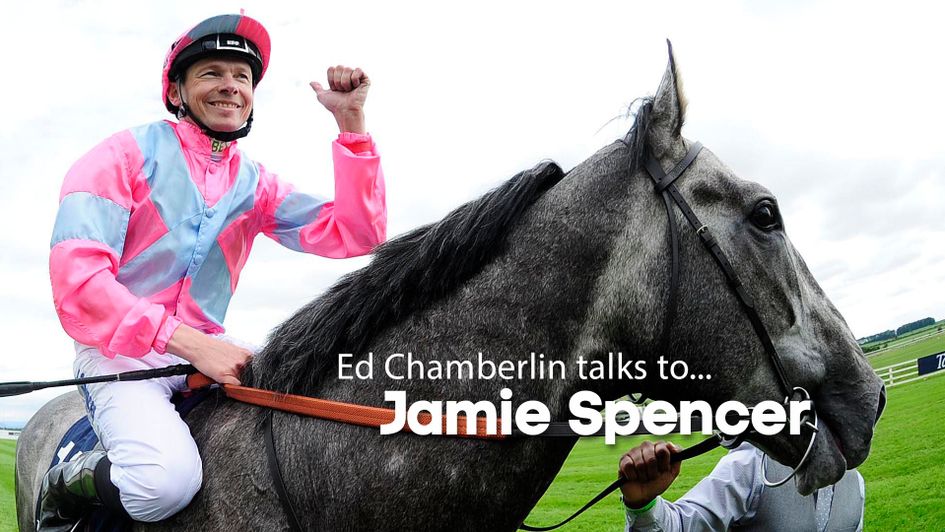
Ed Chamberlin chats to top jockey Jamie Spencer about his current rehabilitation, his highs and lows in the saddle and what the future holds for him.
Ed Chamberlin: The latest Sporting Life lockdown interview features a man who is one of the best jockeys of the modern era, and a man who recently had a horrible fall on the gallops and broke his hip. Currently in recovery, it’s the mercurial talent that is Jamie Spencer. First up Jamie, how are you getting on?
Jamie Spencer: I’m slowly getting better. I can feel improvement every day but it’s very slight. As long as I keep improving every day that’s the important part and I’ve been fortunate that I’ve steered clear of infection after being in the hospital, I can count myself lucky.
EC: I think I’d say you were on the unlucky side. How difficult was it, with everything going on in the world right now, to spend time in hospital?
JS: I don’t moan a lot but it was the longest three days of my life being in the hospital. There was nothing pleasant about it. I had to wait a day for my operation and then was in two days after that. But it’s amazing when you put your mind to something, I had to pass the hospital physio to be allowed out and show that I could walk unaided on crutches and I made sure I was able to do that when they came to do the test. I wanted to get out as quick as possible and once I got home and into my own surroundings it was all fine.
EC: What’s the recovery like now, what’s your routine?
JS: I obviously damaged my hip but I broke my femur as well so I’ve got a rod from my hip to my knee down to the femur and I’ve got a nail, I can’t think what it’s called, from my hip back up to my pelvis. Structurally I’m very sound and I can 100 per cent weight bear on the leg, it’s just the muscles, obviously it takes time from the operation for everything to settle down, the nerves and what not. It’s going good, I do an hour every day with my physio, Kevin Hunt, and to be honest I look forward to doing it. It’s been going good so far and he’s happy with my progress. We take a lot for granted as you just get on the horse and ride it a lot of the time, but these sort of things make you learn a lot more about your body and do what you need to do. It’s been an interesting period, I suppose.
LISTEN: Ed's full interview with Jamie Spencer...
EC: Do you have a target in your mind in when you might be able to get on a horse again and be race riding again?
JS: I’ve consciously put no target on it because I want to be 100 per cent before I ride. The worst thing I could do is come back and not be 100 per cent, a million people have done it before me and I don’t want to be another one in those statistics. I spoke to Norman Williamson, he came back after a short time with an injury and Ruby came back from a femur within eight weeks. But I’m not putting any timescale on it, with the times we’re in there’s no rush. Nobody knows when we’re going to be racing so there’s no point in me putting a date on it, I’ll just take each day as it comes. But I’m putting 100 per cent in so when I do get back I won’t have taken any shortcuts.
EC: That’s a great attitude to have and we all wish you well and hope it’s sooner rather than later when you’re back. I imagine you’re chatting to colleagues a lot that are probably feeling a bit sorry for themselves as well, although you’ll give them a bit of perspective with what you’re going through. How are they, there must be a few jockeys out there that are suffering financially as well as mentally, it must be very tough?
JS: A lot of us are in fortunate positions that you’re not living week to week on riding fees, but you can be sure there’s a lot of fellows out there that are having six to eight rides a week and it’s the riding fees that feeds them if they’ve one or two kids. It’s a difficult time, I think now they’ve started a payment scheme but that can only last so long, so we just hope we can get back racing. The best thing everyone can do is safely get back to work and find some sort of normality.
EC: And for you, I’ve been looking through your career, this is by far one of the worst injuries you’ve suffered, but you’d had a pretty good run up until now hadn’t you in your 25 years or so?
JS: I’ve been fortunate. I’ve had plenty of falls, I came down at Goodwood eight or nine years ago when Ryan Moore did a lot of damage to his body I got brought down in that fall with him and I broke my thumb. I’ve had minor things, last summer I did ribs, I’ve done toes, fingers, I did my elbow as a kid, but nothing that ever hindered me, you could always strap yourself up and continue. This is my first big one and I got a text from Ruby saying ‘if you’re going to do it do it properly’ and I got a text from Charlie Swan this morning saying ‘I broke six arms, a collarbone, 10 ribs, a tibia and I was lucky’ so I thought that was amusing.
EC: I’ve got an Injured Jockeys Fund hat on as a trustee, but how useful and important are they for you at the moment?
JS: They’re very important, I like people that offer their help and don’t force it upon you and Lisa Hancock has been brilliant, she’s emailed me, she called me and she’s left it in my hands for when I need their help. Obviously I’m lucky that I have my own things in place but Lisa is going to help as regards using the hydropool in Sir Peter O’Sullevan House when the time is right. I’ve been using a guy for nutrition, too, I had a long conversation with him, so they’ve been very helpful.
EC: It’s time to look back on your career and happier times, Jamie. Looking back on when you first started there were some big and intimidating names in the weighing room, what was it like going in there for the first time?
JS: When you’re young you don’t really understand so you just go along with it. You think it’s just the norm. Mick Kinane and Johnny Murtagh were there and you just think it’s normal. On Sunday’s we had Cash Asmussen and Pat Eddery, Frankie was coming over for Godolphin, so you were used to it. I always looked forward to Cash Asmussen coming as he used to bring five whips with him every time he came to Ireland to ride and he’d hand the whips to the apprentices, which is a nice gesture. You’d look at the declarations to see if Cash had a ride to get there early and get a whip off him. He’s a classy man. There were some great jockeys around then.
EC: Who were your mentors?
JS: Mick Kinane was the big thing because he was the Irish jockey that was heading to England to ride in the big races. So we all looked up to him, it was the same with Johnny Murtagh who’d be about 10 years behind Mick. Everyone looked up to Mick Kinane as he was winning all the big races. He was a very humble man, he could’ve won the King George on the Saturday and you’d see him at Roscommon on the Monday. He never changed.
EC: And you were winning big races so early in your career, at 17 in fact, and making a big impression. The first big one I remember was Brian Boru in 2003 and that was a huge one for you personally wasn’t it, particularly with what happened with your great friend Kieran Kelly, who tragically died after a fall at Kilbeggan?
JS: It meant a lot. It was a difficult time. I was 23 and we’d lived in the apprentice school originally from when I was 15 to 17, then I lived in digs and then Paul Moloney, Kieran Kelly, another guy called Paul and I decided to rent a house together which was a lot of fun for a few years. So we’d lived together a similar amount as time as you do with your family. It was a difficult period. He was a great fellow, Kieran, he’s sorely missed. There’s not many days I don’t think about him. I dedicated that win to him, he was one of my best friends, you never forget something like that.
EC: That must’ve been so difficult. But then your career just took off and the big job, the Ballydoyle job, when you look back at that do you think it came too early in your career, were you too young for it?
JS: Christy Roche was stable jockey for Aidan O'Brien in the early years and he did say to me ‘I think it’s coming too soon for you’, but sometimes you’ve just got to go along with things and if it works it works and if it doesn’t it doesn’t. I suppose I look back now and it wasn’t a good period for my career, but you learn from it and move on.
EC: You were unlucky though, when you look back on the great horses they’ve had over the last 20 years, they just weren’t around when you were there were they?
JS: That’s just the way it goes. The two-year-olds weren’t there, they only had One Cool Cat and he was generally a disappointment but sometimes you’re lucky sometimes you’re not, I don’t really see it as being unlucky. It is what it is, it’s in the past and I look to the future.
EC: Did you come out of the job with a bit of extra steel, thinking right I’ll show people that I am a top jockey and the real deal?
JS: It was sink or swim time. I got on with it, came back to England and got riding. I had a decent enough year the next year and carried on since.
EC: And you were Champion Jockey a couple of times, which is a fantastic achievement, but did it take its toll, the long grind?
JS: Yeah, I guess so. I suppose it’s different now with the timescale of the championship, but yeah it took its toll. I enjoyed doing it and being part of it, but at the end of it all it sort of drained me and at the end of 2007 I didn’t enjoy that year. Basically, to be Champion Jockey, you have to sacrifice everything. Financially it’s not smart, as you fly here, there and everywhere doing your brains on planes and at the end of it you get a trophy. I don’t want to sound condescending about being Champion Jockey but sometimes you have to have your financial head on too.
EC: Was that the point at the end of 2007 where you thought the future for me is quality over quantity in terms of rides?
JS: Yes it was, there’s only so much juice in the lemon you can squeeze out. I just thought it was time to take things steadier and enjoy it more which I have done since. I wouldn’t do it if I didn’t enjoy it. There’s a million other ways you can earn a lot more money than being a jockey, but it’s an enjoyable thing to do, it’s been good to me and I’ve basically being doing my hobby for 20-odd years. I’ve had a bit of a reality check by getting this injury but other than that it’s been good to me, you get to see the world, work with people that you like and so on.
EC: It sounds to me like you’ve got the balance right now. In that time what horses stick out what have been your favourite moments and your favourite horses?
JS: Generally the horses that you have something to do with in the mornings as well. You get a bit more satisfaction out of that if you’ve been galloping them, you see their improvement in their physicality and their ability. When you’re riding them before they’ve even raced and been part of that progression it’s an exciting part. Sariska would be one. It was an exciting time and I rode her in basically all of her races, she was very good to me winning the Oaks. One horse I didn’t have much to do with off the track was Fame And Glory, but to win the Ascot Gold Cup, for me it’s the race of the meeting and it was a memorable occasion.
EC: It’s interesting what you say about being there in the mornings, as I associate you more now with the bloodstock side of things, but you’ve obviously got that trainer placement gene in you as well and is that a satisfying thing when you say to a trainer, be it David Simcock, whoever, listen this horse is going to be capable of this?
JS: Yeah of course, sometimes the mornings can be more pleasant than the afternoons. You just see the way the horses are changing and improving. The majority of horses will disappoint you. It’s just the way it is, if it wasn’t the case everything would be a top horse, but when you find a good one and it keeps improving there’s a lot of satisfaction in that.
EC: As far as tracks are concerned, is the straight track at Ascot your favourite?
JS: I like Ascot, it’s been good to me. It’s a demanding racecourse and you get to know it. They don’t always win but generally, if a horse is good enough, I can get it to run as well as possible on that track.
EC: Does it drive you mad that that’s the sort of pigeon hole you have for your style, straight track, Ascot, hold-up horses, how frustrating is that for you?
JS: I don’t really know, I don’t get too bothered about it. People pigeon hole me, but I won last year’s Irish Guineas making the running, as soon as the stalls opened I decided to make the running, it wasn’t the plan, but he broke well and got in a good rhythm. Sometimes you’ve got to go by feel. I’ve always been that type of rider. Tying me down to instructions isn’t really going to work. I go by feel, I’ve always had confidence in my own ability. If it goes wrong I’m big enough and bold enough to take the flak. But you have to be brave enough to take the chances. Racing’s a game of opinions and everyone is allowed one. I don’t know whether I’m stupid or robust, I’m not sure, but I’m able to take the abuse.
EC: That’s fascinating. I think on ITV last year, it might’ve been Royal Ascot, I said you were just in a class of your own at Ascot, I used words like world-class and deadly and the stick I got on social media for saying that about you, I thought to myself crikey if I’m getting this what do you get every day? And it sounds like you can handle that quite easily. What would you have been like if there had been social media around say 15 and 20 years ago, would it have been so easy then?
JS: I wouldn’t have thought so. But there’s bigger things in the world than horse racing. It’s a bubble and it’s a small bubble. The people who are inventing a vaccine for coronavirus, that’s important, a horse getting beaten, in the grand scheme of things, isn’t important. It’s only important when you’re living inside the bubble. But when you have children you quickly work out life isn’t as serious you can make it out to be.
EC: Well said Jamie, I couldn’t agree more. Let’s go back to 2014 and the retirement decision, was your mindset then similar to what it was in 2007?
JS: I was basically a bit stale. When you work for an owner it’s more difficult than working as stable jockey for a trainer. When you work for an owner and they have horses with 20-odd different trainers, there’s a good chance 50 per cent of those trainers don’t want to use you. You’re forced upon them by it, so most of the time you’re riding for people that don’t want you to ride for them. It becomes difficult to keep everyone happy. So I didn’t really enjoy that. I like the confidence when someone books me to ride a horse. They’ve booked me because they want me, that I’m going to suit the horse, rather than the owner has told them to do so. I got offered a big contract to do very little and I was going to take it, but it got to November and I just thought ‘to hell with it all, I’ll just paddle my own canoe’ and go back and enjoy racing at my own speed. Don’t race Monday and Tuesday unless it’s for something important and be the captain of my own ship. It’s worked very well since, I have commitments to stables and some owners, but as a rule I’m in control. Monday and Tuesday if David Simcock’s got three runners and I say to him I don’t want to go racing, he’s fine with that as he knows I’ll be in Tuesday morning, Wednesday morning, Thursday, Friday and Saturday if needed. It’s not a case of me being lazy it’s just that I’m in control of my own destiny.
EC: And now would it be fair to say riding abroad has become a bigger part of your life? Hong Kong and Australia as examples, how much have you enjoyed that?
JS: It’s been good. I think from August last year I did six out of seven weekends in America, Churchill Downs, Canada, I spent a lot of time travelling and then Australia as the year goes on. I enjoy the travelling, I’ve plenty of experience now and people call upon that. It’s interesting and no two trips are ever the same.
EC: What would you say you’ve learnt from it and what would you say we as an industry can learn from these countries, America and Australia in particular?
JS: In America it’s very simple a lot of them are funded by the slots, so the money is there and they can do it. Australia their tote system is huge, TAB, and it’s not rocket science, but whether we like it or not we’re tied into the bookmakers until the end of the day by the looks of it. As far as prizemoney goes the Australians just laugh at us, they say ‘what’s it like going off to race for two quid?’ It’s just the way it is. We have the best horses in England, Ireland and France and they got bought to go out to America, Hong Kong and places. You never see someone going to Australia to buy a horse to race over here, other than a good sprinter perhaps, or going to America to race in Europe. So we have the horses.
EC: And our history. They must be jealous of our history and our Derby and those type of races?
JS: Of course, but that will only wash for so long. We need to do something at some stage. Hopefully Alex Frost with the tote, I’m a big fan of his, hopefully he can get it off the ground. If anyone can he can, he’s a very bright man. If that takes off racing will be in much better shape.
EC: In the time you’ve spent in the saddle you’ve seen so many different eras, you talked about Kinane and Murtagh, then Fallon and Frankie and now the new brigade if you like. How good a crop of jockeys have we got now with Ryan Moore, Andrea Atzeni and James Doyle etc?
JS: It’s all changed now with diet and fitness, they’re very fit nowadays. You look at Oisin Murphy for example he rides out every single day, doesn’t miss a trick, works hard, young Tom Marquand he’s doing very well, they’re the future of the sport. It’s good to see as there was a lull there for a while, there wasn’t too many new people coming in for a 10-year period. But it’s amazing how time goes, I look at James Doyle and remember him starting as an 18-year-old spotty teenager, William Buick at a similar age, but they’re senior riders now in many aspects, brilliant jockeys. Pound for pound James Doyle could fit in anywhere around the world, he’s always had talent and skill, he’s showing that big style on the track at the moment.
EC: Is that the biggest difference from when you started, diet, strength and conditioning?
JS: We didn’t know about it when I started out, it just wasn’t there. The education is there now, so it’s not hard to pick it up if it’s implanted in your brain. When I started it was just get on, ride the horse and if you need to lose weight put the sweat suit on and go for a run. As regards diet, there was nothing, everyone was fed the same at apprentice school and if you had weight to lose you didn’t eat too much.
EC: And for you now, going through what you’re going through, it sounds like the fire is still burning inside you, you’re still keen to get back in that saddle?
JS: Of course. My biggest ally is David Simcock and I’ve known him since I came out to England 20 years ago when he was one of the pupil assistants at Luca Cumani’s. He’s been training 13 years and I’ve been with him probably 10 years, so it’s a relationship we’ve built. If I wasn’t riding for him I wouldn’t even bother. But I enjoy it, he’s got a decent stable of horses. He doesn’t shout it from the rooftops, I’m sure if he pushed himself he could have 250 horses but he’d rather the results do the talking and get there in a slower way. I’m sure one day he will have 200 horses, but he’s got about 130 at the moment, some nice pedigrees, some nice horses on the books and they’re getting better every year. I’m at the stage now where I’m just enjoying what I’m doing. A lot of people hate what they do so I’m one of the fortunate ones.
EC: He’s a very nice guy David Simcock, I seem to talk to him more about football…
JS: He’s extremely bright and knows everything about every sport. There’s not a lot he misses. You have to admire people that are self-made and started off with nothing, getting to the stage where you’re financially solvent is an achievement in itself, let alone do as well as he’s done.
EC: And what about Richard Hughes, an old friend of yours, you’d love to ride a big winner for him wouldn’t you?
JS: Yeah of course, I rode a nice horse of Hughesy’s in the autumn called Brentford Hope, hopefully he looks like being a good horse. He’s been training four years, it’s hard to get a good horse and you’ve got to wait until your chance comes. He’s been very patient with that horse, for example, and hopefully he can reap the dividends this year. Hughesy’s smart, you can’t hang around all those years at Hannon’s and not pick up some ideas, he’s consistently trained winners month on month since he started training and that’s the key. It’s just a case of getting your hands on a good horse.
EC: Wouldn’t it be great if Brentford Hope was really good, for you to watch on in the next few weeks and months?
JS: It would be good for the game if Hughesy had a good one, I’ve no doubt he is a good horse. It’s just how much they change and improve, it’s up to the horse now. I don’t think Hughesy will interfere too much with him, it’d be nice to see him pitch up in a Derby trial and see what he’s made of.
EC: Which other horses are you looking forward to when you do come back, are there some you think about in the mornings?
JS: We’ve got a horse at David’s called Mohican Heights. He’s by Australia, has won twice, he won the Stonehenge on his second start, he’s a real under the radar horse. He gets about his business in the morning, nothing flashy, but if you work him with a good horse or a moderate horse it’s the same result, he gets by in the end, but they save it for the racecourse. Everyone says the same ‘we’ve got a nice bunch of three-year-olds’ but we do and the two-year-olds look good, there’s Kingmans and Galileos, the pedigrees are there, it’s a bit different to other years. It’s an exciting time of year for everybody but hopefully we’ve got some decent horses in the string.
EC: And what does the future hold for Jamie Spencer in five or 10 years time? Is bloodstock going to be the way you’ll go?
JS: Yeah I enjoy it, I’ve got a few broodmares. It’s an exciting time of the year. Paul Moloney in Ireland keeps some of the mares and he says 'she’s ready to foal' so that’s three days worrying about that and then she foals and you say 'have you weighed it?' I’m probably a nightmare to be keeping a horse for as he gets about 60 messages in the first hour after each mare has foaled, 'what does it look like, how are their legs?' It’s an interest, but I’ve always had an interest in the breeding side of things and I’ve a lot of friends out in Australia, that’s obviously a big part of my daily thing looking for horses for down there.
EC: It sounds like you get more uptight about the breeding side of things than when you have a big ride on a Saturday afternoon?
JS: Well I’m quite green at the breeding side of things even though I’ve been doing it a while, you meet smart people like Stephen Hillen that I’m quite friendly with, he thinks outside the box with breeding and it works. You need to take a chance, it’s a brave man’s game, perhaps a stupid man’s game I’m not sure sometimes, but it’s something to do, trying to make a plan and hopefully make it work financially.
EC: Just finally then, would training interest you at all and are any of the junior Spencers going to be jockeys?
JS: Training – no chance. It’s just so hard. I’ve been reasonably successful as a jockey for 25 years but as a trainer I’d be going back to zero, it wouldn’t interest me. As for family, Charlie wants to be in the navy so I’m pushing him as much as possible to stay away from racing, while the girls are into showjumping and are both quite talented at their riding. Hopefully they don’t want to ride, I’m hoping they do something a bit easier.
More in the series
- Ed Chamberlin talks to... Brough Scott
- Ed Chamberlin talks to... Pat Keogh
- Ed Chamberlin talks to... Ed Barrett
- Ed Chamberlin talks to... Cornelius Lysaght
- Ed Chamberlin talks to... Johnny Murtagh
- Ed Chamberlin talks to... William Haggas
- Ed Chamberlin talks to... William Derby
- Ed Chamberlin talks to... Dawn Goodfellow
- Ed Chamberlin talks to... Gordon Elliott
- Ed Chamberlin talks to... Lisa Hancock