


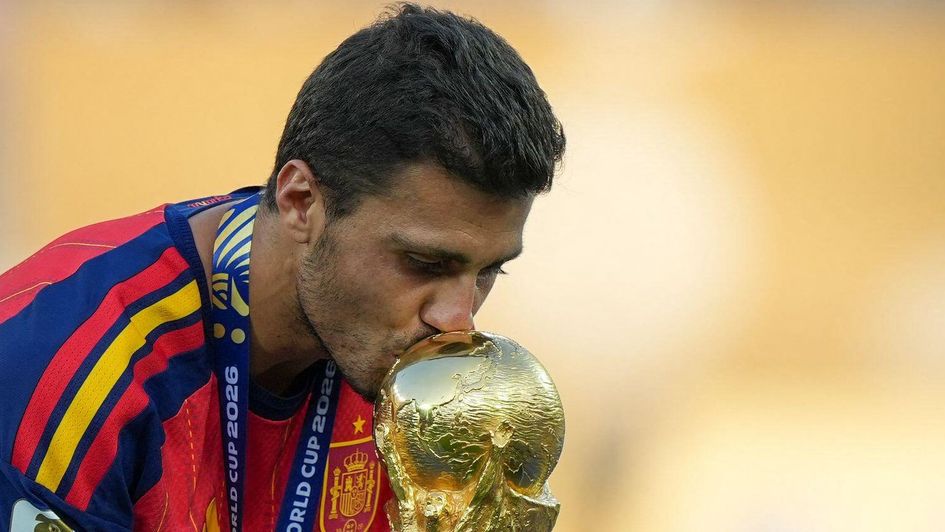
One hundred and four games involving 48 nations across 16 cities, 308 goals watched by 6.8 million attendees, and a glitter-bomb of US consumerist showmanship: another World Cup is sadly over, and as the comedown begins the pounding headache is just that little bit stronger than usual.
It was a sprawling mess of a tournament, a migraine of glitz and glamour and blinding Americana. That was to be expected, although the intensity of the USA’s commercialism still took us by surprise.
Remnants of hot dogs and popcorn still litter the concourse but if we try to look back upon the 2026 World Cup that was, what stands out is its garish American aspect, from the division of the game into ad-friendly quarters to the half-time show, from the booming kick-off countdowns to Donald Trump elbowing his way into the Spanish celebrations.
Oh right, and Mexico and Canada also hosted.
What survives from any World Cup is a general feeling that bubbles up from under the surface. This one might be dread: the cold end-of-days dread we now associate with America’s shallow and glutinous infotainment wasteland, scarcely shielding a much darker political backdrop.
Perhaps the World Cup could have survived its Americanisation - flourished, even, as tourists in its kitsch - was it not for the Folarin Balogun incident.
This is what will rise above Cape Verde’s 0-0 draw with eventual winners Spain, England’s Azteca heroics and risible collapse in Atlanta, or Lionel Messi’s last dance.
By inexplicably suspending Balogun’s red card FIFA flagrantly broke its own laws (as they did again in the final by extending half-time), a Rubicon-crossing moment that opens the door to FIFA further corroding sporting values in the interests of politics and smashes open the window to conspiracy theorists.
It was Trump’s World Cup, but more significantly it was Gianni Infantino’s. There is no better place for his vision to triumph than in the sickly sweet, vacuous plastics of America.
Those are the images, but what of the football? It was a broadly exciting tournament although one with oddly few stories to tell, the early exits of Brazil and Germany arguably offering more romance than anything that happened in the quarter-finals onwards.
Then again, the meaning of the World Cup in football terms tends not to emerge until much later, when it gets retrofitted as if the results of a knockout tournament aren’t prone to random acts.
Germany’s win in 2014 reflected the age of gegenpressing and the rise of the Jurgen Klopp school, yet if Gonzalo Higuain hadn’t fluffed a one-on-one then Argentina would have lifted the trophy.
In 2010 Spain’s win was a triumph for possession football, a sign it ruled the world, yet they relied on extra-time and wobbled against Paraguay and Germany earlier on.
Nevertheless, on both occasions the right nation - the best nation overall - did win out, and the same can be said for 2026 after Spain battered Argentina in the final and ended the tournament having conceded just a single goal.
It was very similar to how they did it 16 years ago: ultra-patient possession, the sacrifice of the individual for the team, and a near-perfect defensive record built on the caution of endless short passing.
If there is a narrative to be built from the carnage, then, it is that Spanish football is back, or rather, has proved to the world that it never really went away.
In the interim between their 2010 and 2026 triumphs we have had the emergence of the German school, the move across Europe towards more transition-heavy football, and then the recent rebounding in England to set-pieces.
Yet throughout that period Pep Guardiola has reigned supreme, setting the tone at Bayern Munich and then Manchester City, and even as his star has fallen over the last couple of years European football is strewn with his protégés, from Mikel Arteta to Xabi Alonso.
The Spanish style of suffocating possession, rebuilt by Pep out of the ashes of Cruyff’s Dutch Total Football, remains the foundation of the modern game.
That it has been essentially static for two decades - bookended by Spain’s World Cup wins - is above all a testament to Guardiola’s extraordinary and extraordinarily robust legacy.
More from Sporting Life
Safer gambling
We are committed in our support of safer gambling. Recommended bets are advised to over-18s and we strongly encourage readers to wager only what they can afford to lose.
If you are concerned about your gambling, please call the National Gambling Helpline / GamCare on 0808 8020 133.
Further support and information can be found at begambleaware.org and gamblingtherapy.org.