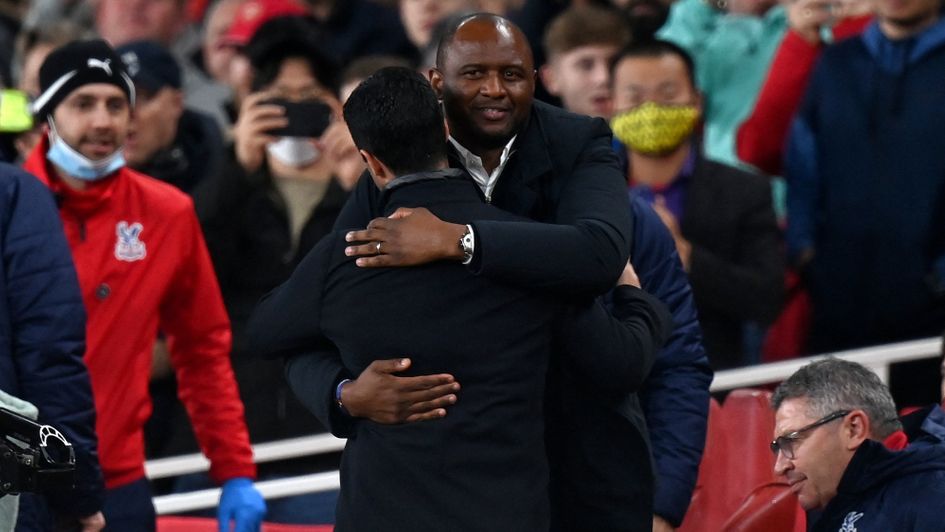
As the Premier League went into its final break of the season Arsenal seemed in an almost unassailable position in the top four race, four points clear and in a run of form that has moved beyond their usual peaks and troughs into something resembling genuine consistency.
The way the players celebrated their win at Aston Villa suggested they felt an important milestone had been reached.
But the gap is smaller than it looks and their game at Selhurst Park on Monday night is one of the biggest of the season.
Patrick Vieira’s side might be without a league win in five on home soil but their 0-0 draw with Manchester City was further evidence they are an extremely tough team to beat.
Arsenal’s position is a bit more precarious than it looks – and Palace will be confident of picking up at least a point.
Defence v Attack likely on Monday
The tactical pattern of the game is easy enough to predict.
Arsenal’s tendency to press aggressively after losing the ball, coupled with their newfound confidence in playing very high up the pitch – thanks to the metronomic possession now provided by dual eights Martin Odegaard and Granit Xhaka – will force Palace back, just as Man City did when they held 74% possession in that stalemate.
Vieira has implemented a much more expansive and confrontational system at Palace, but in big matches he consistently allows his teams to lose the territorial battle and revert to the Hodgsonian idea of waiting for the opposition to over-commit before hitting on the counter-attack through quick dribblers Wilfried Zaha and Michael Olise.
A game of attack versus defence, with the odd Palace counter, will be the main theme of the evening.
Pressing battle key
But there are plenty of interesting match-ups to consider.
Most important is how Arsenal cope with the pressing Palace apply in central midfield; only Leeds United and Everton have applied more pressures in the middle third of the pitch per game than Palace (70.8), and they have attempted the fourth most tackles per game across the division (19.6).
This bite in central midfield, led of course by Conor Gallagher, is of particular relevance to this match because of Arsenal’s narrowness.
Opta measure Arsenal’s ‘absolute width’ as the fourth lowest in the Premier League at 24.59 metres, which is remarkably narrow for a team that has so much of the ball (only Newcastle, Brentford, and Burnley have a lower score).
Alexandre Lacazette’s new false nine role, coupled with the growing influence of Odegaard and Arsenal’s wingers tending to cut inside, means they will be running at Palace’s strongest area defensively. It could lead to another 0-0.
Importance of Arsenal's verticality
Given this problem, Arsenal’s best chance of success is in the transitional moments just after winning the ball back high up the pitch.
Vieira instructs his team to pass out neatly from the back, even under pressure, regularly stringing short-passing moves together even as Man City hunted the ball down in the 0-0 in mid-March.
It worked, just about, on that occasion, but is even more vulnerable here – because whereas Pep Guardiola wants his team to recycle the ball to move into their attacking positions, Arteta is happy to play vertically.
Arsenal are fifth in the table for high turnovers (20) and first for high turnovers leading to goals (6).
Palace will have to be extremely careful in picking their moments to play through the Arsenal press, with particular attention given to what happens on Palace’s left.
Tyrick Mitchell, in form and buoyed by his England debut, is always handed possession in tight areas because his team-mates are confident of his success. But this happens to be where Arsenal are strongest in the attacking transitions, where Bukayo Saka links with Odegaard.
Isolated Partey will give Palace chances
As for Palace’s attacks, again the focus is in central midfield. Although the 4-3-3 is working very well for Mikel Arteta, there are some gaps appearing around Thomas Partey now that he is alone at the base.
This means Gallagher, linking with Jeffrey Schlupp, may be able to target this area of the pitch when Palace have the opportunity to launch a counter-attack.
This is essentially what happened in the reverse fixture, when Palace came within minutes of victory at the Emirates back in October, a 94th minute Lacazette goal snatching a 2-2 draw for Arsenal.
Both Crystal Palace goals came from pinching the ball in midfield and breaking quickly, the first Jordan Ayew on Partey and the second Gallagher on Albert Lokonga. Arsenal are sturdier now – yet the threat remains.
Then there is the more obvious and traditional Palace method of attack: counters filtered through Zaha.
He is likely to start on the left flank, where the vulnerable Cedric Soares continues to deputise for Takehiro Tomiyasu. That is the game’s biggest mismatch and arguably the defining individual battle.
Clearly there are enough reasons here to believe Crystal Palace can get at Arsenal and cause them problems, even if they are indeed forced into a deeper formation than usual as the visitors probe in the final third.
At the beginning of a very tough run of games for Arsenal, all that optimism we saw at Villa Park could dissipate as early as Monday night.