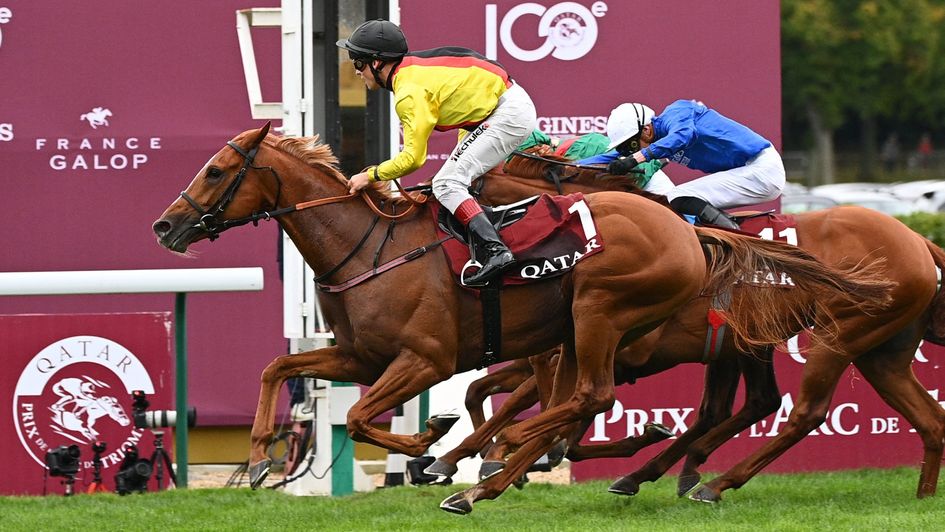
Ahead of Torquator Tasso's run on Saturday, Adam Houghton reveals how Arc winners have fared in the King George VI and Queen Elizabeth Stakes at Ascot.
It’s quite a rare thing for the King George field to include the previous year’s Arc winner. In fact, it’s only happened eight times in the last 50 years, and it didn’t crop up at all during that period until 1995 when Carnegie ran at Ascot for André Fabre.
Carnegie showed borderline top-class form when winning the 1994 Arc, holding on very gamely to beat Hernando by a short neck in a driving finish, his fifth win from seven starts as a three-year-old.
The following year Carnegie arrived at Ascot having won the Grand Prix de Saint-Cloud on his previous start, though that form was still some way below his best and it was a similar story in the King George.
Sent off the 11/4 second favourite, he ultimately proved a disappointment, never looking likely to play a part and making only a little late headway as he passed the post around three and a quarter lengths in sixth behind future Arc winner Lammtarra.
The next Arc winner to try and win the following year’s King George was Helissio, who produced an outstanding performance at Longchamp when beating Pilsudski by five lengths in 1996.
That effort earned him a Timeform rating of 136 and he shaped as if retaining all his ability when winning the Prix Ganay and the Grand Prix de Saint-Cloud on his first two starts as a four-year-old prior to lining up in the King George, which was billed in some quarters as the 'race of the decade' with illustrious names such as Pilsudski, Singspiel and Swain featuring among the opposition.
It was a sign of the esteem in which Helissio was held that he was still sent off the 11/10 favourite in such a strong renewal, but he couldn’t live up to his star billing in the race itself. He still appeared to be going well on the home turn but had nothing left when asked for his effort, running well below his Arc form as he finished third (beaten two and a quarter lengths) behind Swain and Pilsudski.
One horse who rarely failed to live up to his star billing was Montjeu, who racked up a sequence of impressive victories as a three-year-old in 1999, culminating with a thrilling success in the Arc to prove himself a colt out of the very top drawer.
It was business as usual for Montjeu as a four-year-old and, after a couple of routine wins in the Tattersalls Gold Cup and the Grand Prix de Saint-Cloud, he then produced arguably the most visually striking performance of his career to also land the King George.
Sent off the 3/1-on favourite, Montjeu was essentially a grade better than his opponents and he saw them off contemptuously in the straight after being held up in rear in the early stages. He was eased into the lead with less than two furlongs to run and didn’t need to be asked any sort of a question once he'd gone clear, ultimately winning by a length and three-quarters.
Incidentally, Montjeu’s victory made him the first horse since the great Italian champion Ribot – who won at Ascot in 1956 – to lift the Arc and then the King George.
The 2005 King George was run at Newbury whilst Ascot was closed for redevelopment, but everything else about the race remained the same as a whole host of high-class performers went to post for the premier middle-distance prize of the summer.
They included the previous year’s Arc winner Bago, though he had failed to match that form on his first three starts as a four-year-old, first when winning the Prix Ganay and then when hitting the frame in both the Tattersalls Gold Cup and the Grand Prix de Saint-Cloud.
His King George run was a bit more like it, but it was still only good enough for him to secure another placed finish, looking rather ungainly under pressure as he passed the post around a length and a half behind Azamour in third.
Bago went on to fill the same position when trying to defend his Arc title later that year. His conqueror that day was Hurricane Run, a son of Montjeu who stamped himself the best middle-distance colt in Europe with a taking display.
Hurricane Run returned in 2006 with a seven-length success in the Tattersalls Gold Cup and even a shock defeat on his next start in the Grand Prix de Saint-Cloud – when beaten a head by Pride at odds of 5/1-on – wasn't enough to deter punters when he ran in the King George.
In a strong edition featuring the Dubai World Cup winner Electrocutionist and the high-class Japanese raider Heart’s Cry, Hurricane Run justified odds-on favouritism this time with a comfortable victory, only winning by half a length but looking value for extra after meeting a bit of trouble in the straight.
It was a few more years before a previous winner of the Arc ran in the King George, namely Workforce who disappointed on his first run in the King George in 2010 but proved himself a top-class colt by winning the Derby and Arc either side of that effort.
Workforce had a second attempt at winning the King George in 2011 and, having finished a good second in the Coral-Eclipse on his previous start, he was sent off the 6/5 favourite to beat four rivals who included the multiple Group One winners Rewilding and St Nicholas Abbey.
In the event, however, the 2011 King George was very much a race to forget. It was marred first and foremost by Rewilding sustaining a fatal injury, while form-wise it was way off meeting expectations, nothing like the top-class renewal that was anticipated.
Workforce, in particular, didn’t perform to the level he was capable of, ultimately having to settle for the runner-up spot (beaten two and three-quarter lengths) behind Nathaniel. Workforce did have valid excuses, though, as he was reportedly struck into which possibly caused him to veer left in the final two furlongs.
Workforce again had a plausible excuse (hampered early and always behind) when down the field in the Arc later that year, a race the German-trained filly Danedream won in record time by five lengths, the biggest winning margin since Sakhee won by six lengths in 2001.
However, when Danedream lined up in the following year’s King George, she still started at 9/1, only fifth in the betting. Only five fillies had won the King George, and perhaps that fact, coupled with her being trained in Germany and having bargain-basement origins, convinced the British betting public that the Arc win had been something of a `flash in the pan’.
Danedream had also been beaten at odds-on in the Grand Prix de Saint-Cloud on her last outing before the King George, finishing behind Meandre, Shareta and Galikova, all of whom she had beaten comprehensively in the Arc.
Nevertheless, connections were quoted before the King George as saying that Danedream was back in top form and so it proved. After a thrilling battle with the defending champion Nathaniel, Danedream eventually got the verdict by a nose, the closest finish in the history of the race and the first time a German-trained horse had been successful.
Finally, the most recent Arc winner to run in the King George was Enable, who achieved a lofty Timeform rating of 134 in an all-conquering three-year-old campaign in 2017, notably becoming just the seventh horse – and the first of her sex – to win both the King George and the Arc in the same season.
Enable raced on as a four-year-old, though her reappearance was delayed due to injury, causing her to miss the King George. She returned to win all three of her starts in the autumn, including a second success in the Arc.
By the time Enable made her second appearance in the King George – as a five-year-old after winning the Coral-Eclipse three weeks earlier – her winning sequence stood at 10 races.
A bit of her three-year-old brilliance had been lost by this stage of her career, but she demonstrated other admirable qualities, such as heart and courage, in a sustained duel with Crystal Ocean to rival that between Grundy and Bustino back in 1975.
Enable was always holding on under a hands-and-heels ride late on and passed the post with a neck to spare over Crystal Ocean, with Waldgeist also beaten less than two lengths back in third.

Unlimited Replays
of all UK and Irish races with our Race Replays
Discover Sporting Life Plus Benefits

Can German raider become fifth to double up?
That makes a list of only four horses since 1956 who have won the Arc and then lifted the King George, namely Montjeu, Hurricane Run, Danedream and Enable.
So, what is the likelihood of Torquator Tasso adding his name to that list on Saturday?
There was certainly no fluke about Torquator Tasso's victory in last year's Arc as he became just the third German-trained winner of the race after Star Appeal (1975) and Danedream. Having been quite wide throughout, he was gradually able to build up to full stride in the straight and got on top close home to beat Tarnawa by three quarters of a length.
After disappointing on his return to action, Torquator Tasso quickly put that effort behind him with a dominant victory in a Group Two at Hamburg earlier this month, hitting the front over a furlong out and quickly drawing clear from there to land the spoils by three and a half lengths.
The way Torquator Tasso shaped there suggests he is at least as good as ever and he will now attempt to become the third German-trained winner of the King George in the last 12 years after Danedream and Novellist (2013).
The quick ground at Ascot is a slight concern given that he’s done all his racing so far on going described by Timeform as good or slower, but he certainly has the form to play a leading role.
For context, Torquator Tasso has only one horse ahead of him on Timeform’s weight-adjusted ratings, namely Mishriff, who almost certainly doesn’t stay a mile and a half as strongly as last year’s Arc hero.
More from Sporting Life
- Racecards
- Fast results
- Full results and free video replays
- Horse racing news
- Horse racing tips
- Horse racing features
- Download our free iOS and Android app
- Football and other sports tips
- Podcasts and video content
Safer gambling
We are committed in our support of safer gambling. Recommended bets are advised to over-18s and we strongly encourage readers to wager only what they can afford to lose.
If you are concerned about your gambling, please call the National Gambling Helpline / GamCare on 0808 8020 133.
Further support and information can be found at begambleaware.org and gamblingtherapy.org.