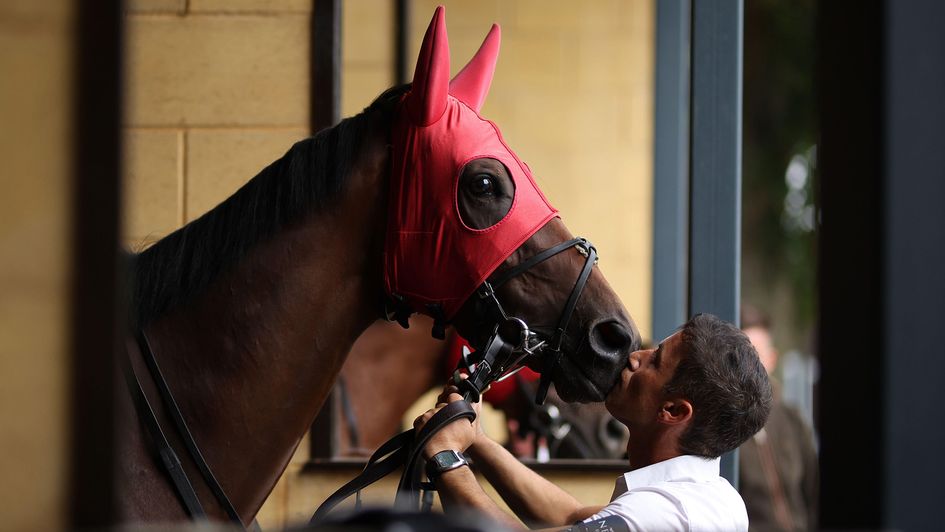
Vicki Gibbins talks to some leading trainers including Clive Cox and Aidan O'Brien to find out just how beneficial the red hoods worn by some horses in parade rings can prove to be.
Calming influence
The date is the January 23 2020 and racegoers at Fakenham are watching horse-racing history unfold in the Horseman’s Group Handicap Chase.
It’s unlikely that the casual racegoer at Fakenham would have noticed what they were witnessing, especially given the COVID pandemic would soon turn day-to-day life upside down, but it’s nice to think that a knowing punter was leaning over the rail and whistling through his teeth at the sight.
The somewhat aptly-named Vinnie The Hoddie, trained by Oliver Sherwood, was wearing the first red hood to be officially recorded by the British Horseracing Authority; the first ripple of a wave which was about to engulf the sport. In the five years since, the red hood has become a regular sight on British racecourses, finding its way into paddocks on the biggest days.
With padded ear coverings, the red hood is intended to keep a horse calm during the preliminaries of a race, can be worn on the way to the start but must be removed before racing. It falls into the category of ‘race-day privileges’ rather than an ‘official’ piece of equipment like cheekpieces, hoods or blinkers; declared to the BHA by 1pm on the day before racing but can be added on race-day with permission from the stewards. When first introduced, trainers were required to provide a member of staff to remove the red hood at the start, a task that was eventually transferred to the BHA starting team.
For Lambourn-based trainer Clive Cox, red hoods are utilised as required and their go-to status is a major positive.
“They are a calming influence on a horse,” explains Cox.
“We’ve got a very peaceful, quiet training establishment and our horses don’t go away to gallop so the racing atmosphere isn’t always practiced until you go racing.
"A case in point would be A Bit Of Spirit, who was very sober at home and did everything really nicely when we got to the races.
“Then suddenly, the yard became busier with racing beginning and he completely turned into a melted monster – sweating, colty, a completely different personality that we’d witnessed previously.
“Thankfully, I went straight to the stewards’ and said: ‘we need to saddle this horse in the stables, he's displaying a very different personality than we see at home, can we put a red hood on him’.
“It’s always part of our tack kit and once we did, it dampened the whole thing down and he won first time. Without that little bit of help, I daresay it would have been a lot tougher, but once you know, you can plan ahead.
“It's a management aid that is very helpful when used correctly and available at short notice – ours is a perfect case study."
Anything to declare?
Runners from George Scott’s Eve Lodge yard are frequently spotted sporting red hoods, with the Newmarket handler citing their use as helpful for keeping horses calm pre-race. Inclusion on a racecard or in the post-running comments would not affect Scott’s use of the aid.
“For the anxious horses, it’s certainly an aid to keep them relaxed pre-race” said Scott.
“I don’t think it enhances performance, it’s more of a precautionary aid. If they were to go into the form-book, it wouldn’t make any difference to the way I use them – perhaps if people were buying a horse from a yard that doesn’t use them, it would be an indication that a horse was hot, but with us, it’s something that people know we do rather than a reflection on the horse’s mindset."
Richard Hannon is of a similar mindset regarding use, often turning to the red hood for assistance with fillies.
“We don’t use them very often; sometimes they work, sometimes with the fillies, it helps to keep horses calm. As far as I’m concerned, they’re declarable and it wouldn’t make any difference at all to our use.”
'Earmuffs' effect not always a good thing
In contrast, Aidan O’Brien chooses not to use red hoods on his runners, preferring the horses to take in their surroundings.
“A red hood is like putting a pair of earmuffs on yourself,” explains O’Brien. “As a human being, I would rather be aware of my surroundings and feeling what’s going on around me, rather than having a pair of earphones on.
“Everyone’s approach is different – no one is right or wrong. We always try to have them in the right kind of place so they don’t need that kind of assistance.
“When a horse comes to the races and behaves badly, I would always believe it was my fault for not having them prepared properly both mentally and physically. But it doesn’t mean that’s right or wrong.”
What can be done for greater transparency?
The reasons for use, and non-use, are varied and informative. Yet the information for punters surrounding red hoods remains difficult to find - unless an avid reader of the post-race stewards' reports. It does not feature on a racecard, or in the in-running comments on any of the leading form-guide providers.
Why does it matter, you ask?
Racing needs to move towards transparency to thrive and it’s a drum that requires constant beating in an era when freedom of information is king.
Why are trainers reaching for red hoods, if not to optimise performance? And if performance is enhanced, should the punter be made aware?
Provision of information is a difficult tightrope to tread and there’s an argument as to where it ends. But the red hood is tangible, with the infrastructure already in place to make it recordable on a wider scale than the stewards' reports – whether marked on a racecard next to a horse’s name or noted in the in-running comments.
It represents an easy win for a sport looking to make transparency its watchword.
More from Sporting Life
- Free bets
- Racecards
- Fast results
- Full results and free video replays
- Horse racing news
- Horse racing tips
- Horse racing features
- Download our free iOS and Android app
- Football and other sports tips
- Podcasts and video content
Safer gambling
We are committed in our support of safer gambling. Recommended bets are advised to over-18s and we strongly encourage readers to wager only what they can afford to lose.
If you are concerned about your gambling, please call the National Gambling Helpline / GamCare on 0808 8020 133.
Further support and information can be found at begambleaware.org and gamblingtherapy.org.