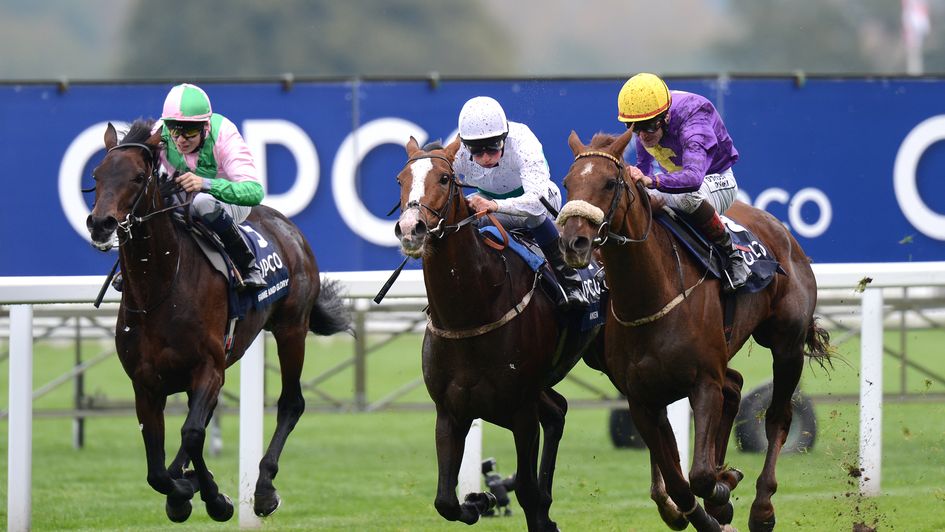
Following Ethical Diamond's win in the Breeders' Cup Turf, John Ingles looks at other horses who have taken unusual routes to the top.
Collier Hill: From bumpers to Hong Kong
From a Catterick bumper to the Hong Kong Vase. Those wins book-ended the remarkable career of Collier Hill for his North Yorkshire trainer Alan Swinbank. After that successful debut at Catterick aged four, Collier Hill’s attentions were switched to the Flat. His first win on the level came in a classified stakes at Ayr but he progressed well to win twice more that season and went close in a handicap at the Ebor meeting. Aged five, Collier Hill returned better than ever, developing into a useful handicapper and winning twice, notably the Old Newton Cup at Haydock. The following winter he was tried over hurdles, and while he made a promising start by winning at Kelso, three subsequent defeats, two when sent off odds on, meant that the hurdling experiment was shelved but the question as he turned six was how much improvement, if any, did he still have left on the Flat?
The answer was plenty. As well as winning a Listed rated stakes at Hamilton, Collier Hill made a successful debut in pattern company when sent to Sweden for the Stockholm Cup, his first win for the jockey who would become his regular partner, Dean McKeown. There was much more travelling for Collier Hill the following year when he proved better still, earning a Timeform rating of 120. He started off with three races in Dubai, winning a handicap and then outrunning odds of 40/1 to finish third on his Group 1 debut in the Dubai Sheema Classic. Back in Europe, he made all for a Group 2 win in the Gerling-Preis at Cologne and provided his trainer and jockey with their biggest wins to date when winning the Irish St Leger later in the year with Vinnie Roe, bidding to win the race for a fifth time, and Yeats, still to win the first of his four Gold Cups, among those he beat.
But it was his final season, as an eight-year-old in 2006, that was to be Collier Hill’s most lucrative campaign when he was better than ever (rated 123). He went one place better than the year before in the Sheema Classic when runner-up to Japan’s high-class horse Heart’s Cry, but it wasn’t until the autumn that he hit winning form. A hat-trick of wins abroad began with victory in the Stockholm Cup again before much more valuable successes in the Canadian International and the Hong Kong Vase, the fact he won both races by a nose testament to his excellent attitude. Plans for Collier Hill to race on again at nine were shelved due to arthritis so he ended his career on a high with record earnings at the time for a British-trained gelding.
Les Arcs: From hurdling to the July Cup
No less remarkable was the career of a contemporary of Collier Hill, Les Arcs, a gelding who took a most unlikely route to the top of the sprinting tree before winning the Golden Jubilee Stakes and July Cup in 2006. Coincidentally, like Collier Hill he began his career in training with John Gosden, but while Collier Hill never ran for Gosden, Les Arcs had three runs for him in Sheikh Mohammed’s colours at three, all over a mile and a quarter. While he won a maiden at Ripon, he was soon moved on, and Les Arcs, who had been a $140,000 purchase as a yearling, was picked up at the Newmarket Autumn Sales that year for 32,000 guineas by Richard Guest.
His new trainer had no reason to believe he had a sprinter on his hands at first, and Les Arcs was tried at a mile and a half and even over hurdles, though that proved a one-off after he was beaten nearly seventy lengths at Cartmel. He did win twice, though, in a classified stakes at Hamilton and a handicap at Wolverhampton, both at around a mile. As a five-year-old, the free-going Les Arcs began to show more ability and consistency, with headgear fitted for most of his starts. He won a couple of handicaps over seven furlongs at Musselburgh and Chester, with Timeform’s report on his Musselburgh win noting ‘so well does he travel that he’s worth a try at six furlongs’.
But it wasn’t until after another change of trainer at the end of 2005 that Les Arcs’ true sprinting potential began to be realised. Joining Tim Pitt soon after the trainer had received his licence, with the headgear now left off Les Arcs proceeded to win his next five starts, improving rapidly into a smart performer and even proving effective at five furlongs as well as six. He completed his five-timer in the Listed Cammidge Trophy, run that year at Redcar while Doncaster was being redeveloped. Defeats in his next three starts suggested that Les Arcs had now reached his ceiling, though he wasn’t beaten that far in a blanket finish to the King’s Stand Stakes when eleventh in a huge field behind the Australian winner Takeover Target.
Les Arcs was turned out again at Royal Ascot four days later in the Golden Jubilee Stakes, starting at 33/1 with Takeover Target favourite to complete a quick double. But that was without reckoning on further improvement from Les Arcs who, helped by a favourable draw, took his form to a new level with a neck win over another outsider, Balthazaar’s Gift, with Takeover Target back in third. Taking on many of the same rivals in the July Cup, Les Arcs, well drawn again, confirmed himself a high-class sprinter with a head win over the unlucky Iffraaj. Les Arcs made his final appearance that season when seventh in the Sprinters Stakes in Japan and proved hard to train thereafter, but that took nothing away from the progress and transformation he had made from his early days.
Weld's Passage: From Cheltenham to Champions Day
Dermot Weld has pulled off some notable training feats in his career, among them his victory in the 2010 Ascot Gold Cup with Rite of Passage, a gelding who had last been seen at the Cheltenham Festival. In fact, the Gold Cup was only the third Flat race for Rite of Passage who had raced mainly under National Hunt Rules until then although Flat-bred, being a son of Giant’s Causeway. He began his career as a four-year-old winning a bumper at the Galway Festival, a meeting where Weld has been leading trainer numerous times. An impressive win at Naas later in the season booked Rite of Passage a place in the Champion Bumper where he was all the rage beforehand, sent off the 5/2 favourite under the stable’s Flat jockey Pat Smullen. Rite of Passage ran well in third though bumped into ten-length winner Dunguib who recorded one of the highest ever Timeform bumper ratings.
After one more run in bumpers when fourth at the Curragh, Rite of Passage made a successful switch to Flat racing the following autumn. He landed the odds in workmanlike fashion on his first Flat start in a maiden at Ballinrobe but made a far bigger impression in following up in the Leopardstown November Handicap with a useful performance more in keeping with the level of ability he had shown in bumpers. He won by eight lengths, powering clear without Smullen having to go for his stick and who then eased him down in the final hundred yards. While that promised plenty for the continuation of his Flat career, more immediately there was the prospect of Rite of Passage making into a leading novice over hurdles. In just three starts over hurdles in the early months of 2010, Rite of Passage showed smart form back under amateur Robbie McNamara who had ridden him in his Irish bumpers. After smoothly landing the odds at Leopardstown and Punchestown, Rite of Passage started favourite at the Cheltenham Festival for the second year running, this time in the Baring Bingham Novices’ Hurdle, though once again he had to settle for third, succumbing to stronger stayers Peddlers Cross and Reve de Sivola.
The 2010 Gold Cup was a new era for the race, marked by the absence of Yeats who had won the last four renewals. Favourite was Ask, the previous season’s Yorkshire Cup, Coronation Cup and Prix Royal-Oak winner, he too making his reappearance, while Rite of Passage, with just those two wins the previous autumn the only Flat form to judge him on, was a 20/1-chance. A searching gallop made the Gold Cup a thorough test of stamina despite conditions being on the firm side and Rite of Passage prevailed in one of the best finishes of the meeting, wearing down Ballydoyle’s Age of Aquarius for a neck win. Rite of Passage proved difficult to train and raced only twice more, but in a tremendous training performance returned from a second lengthy absence to win the 2012 Long Distance Cup back at Ascot on his final start.
More from Sporting Life
- Free bets
- Racecards
- Fast results
- Full results and free video replays
- Horse racing news
- Horse racing tips
- Horse racing features
- Download our free iOS and Android app
- Football and other sports tips
- Podcasts and video content
Safer gambling
We are committed in our support of safer gambling. Recommended bets are advised to over-18s and we strongly encourage readers to wager only what they can afford to lose.
If you are concerned about your gambling, please call the National Gambling Helpline / GamCare on 0808 8020 133.
Further support and information can be found at begambleaware.org and gamblingtherapy.org.