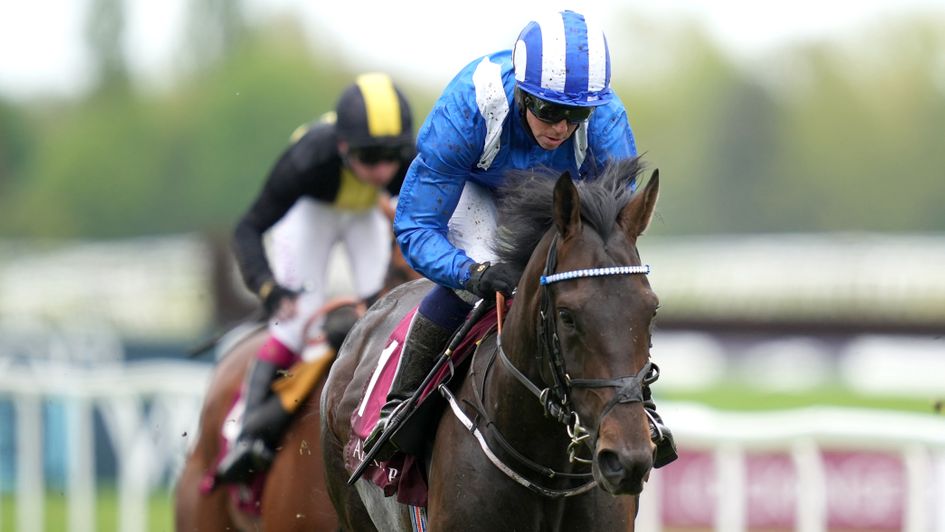
After the quirky Al Aasy got back among the winners at Newbury on Saturday, Adam Houghton looks at the best horses to have been awarded the Timeform squiggle down the years.
What is a Timeform 'squiggle'?
The definition of the Timeform squiggle was changed towards the end of the twentieth century and it is now commonly used to identify a horse who is “unreliable (for temperamental or other reasons)”. The symbol is used alongside – or sometimes in place of – a horse’s form rating and phrases such as “one to treat with caution”, “quirky” or “ungenuine” will also appear in their comment to underline why the squiggle has been awarded.
These descriptions are considerably more restrained than they used to be. Indeed, no punches were pulled in the early days of the Racehorses series, in which phrases such as the below were all used to describe recipients of the squiggle:
- resolute only in refusing to race: can run a bit but won't
- an arrant coward
- a thorough jade
- when it comes to a struggle, discretion always triumphs over the remaining parts of valour
- likely to refuse to start, or run wide, or do anything else he can think of to avoid racing
- a stubborn, lazy, wilful pig of a horse
- soon showed that he had no intention of racing if he could help it
- a plodder and a rogue
- eight hundredweight of cowardice
- a well-bred thief who will never win again
With many more opportunities through the expanded fixture list for horses at the bottom of the scale to win races, dogmatic statements such as “will never win again” are not made by Timeform nowadays. The number of squiggles has probably fallen a little for similar reasons, though far more are still awarded to horses at the lower end of the ratings scale.

Why was Al Aasy given a squiggle?
Top horses down the years have received squiggles when their performances merited them, as was the case when Al Aasy was turned over at short odds for the third start in a row at Newbury back in September 2021.
Al Aasy had been beaten narrowly by a couple of doughty battlers on the first two occasions, but a subsequent gelding operation suggests his connections took a more negative view of his finishing efforts. Either way, it’s hard to deny that he failed to battle at Newbury after cruising up to the leader, running below form as he wilted in the final furlong.
Al Aasy was every inch a very smart performer in his prime. He showed that on his first three starts in 2021, recording back-to-back Group 3 wins at Newbury before finishing second (beaten just a neck behind Pyledriver) on his first tilt at the top level in the Coronation Cup at Epsom. That Epsom defeat was a sign of things to come, though, as Al Aasy traded at the basement price of 1.01 in-running before being worried out of it close home.
With a Timeform rating of 119§ – down from 122§ at his peak – the six-year-old Al Aasy remains capable of winning more good races when everything falls right. He underlined that point when readily winning a Listed event back at Newbury on Saturday, though this comment from the Timeform report on the race rather summed up his future prospects:
"Al Aasy was a totally different proposition from his reappearance, in a more cooperative mood and consenting to be finessed into the race late on, showing he retains all his ability, what mood he'll be in next time anyone's guess..."
Who are the highest rated squiggle horses this century?*
*Based on peak Timeform rating
- Papal Bull 132§
- Gold Ship 127§
- Norse Dancer 127§
- Pakistan Star 126§
- US Ranger 124§
- Antonius Pius 123§
- Royal Rebel 123§
- Accidental Agent 122§
- Al Aasy 122§
- Frozen Fire 122§
- King of Comedy 122§
Papal Bull was a high-class performer on his day but became something of a law unto himself after his three-year-old days. As a four-year-old he won the Princess of Wales's Stakes and Geoffrey Freer Stakes but became a difficult ride, tending to run in snatches, often hanging and sometimes veering off a true line.
Papal Bull was kept in training at five to see if he could pick up a Group 1 and he nearly hit the jackpot when making Duke of Marmalade pull out all the stops in the King George VI and Queen Elizabeth Stakes at Ascot.
The pair finished nine lengths clear of the rest and Papal Bull produced a performance that would have won him a Group 1 had he repeated it. However, his three subsequent appearances served only to confirm that, while Papal Bull was a high-class horse when on his best behaviour, he was unpredictable and not one to trust.
Similar comments apply to Norse Dancer, who finished in the first four in 10 different Group 1 races and was beaten less than a length on five of those occasions.
A top-level success continued to prove elusive, however, and by the time of his retirement at the end of his six-year-old campaign, he still had only four wins from 35 starts to show for his efforts.
Just like Al Aasy and Papal Bull, Norse Dancer was on the receiving end of plenty of critical barbs during his career, many of them – to be blunt – justified.
Indeed, the fact he was unable to convert even one of his many Group 1 opportunities had more to do with his lack of application than the strength of his opponents. Sometimes slowly away, he often raced lazily and would carry his head awkwardly before finding little, looking thoroughly un-genuine at times.
Al Aasy may have been gelded, but Norse Dancer (sire of the high-class hurdler Yanworth) and Papal Bull (sire of the useful hurdler/chaser The Jam Man) are two examples of eccentric racehorses who have enjoyed successful careers at stud, both having produced plenty of winners over jumps.
Close shaves for Montjeu and George Washington
On the Flat, the notoriously temperamental Nasrullah went on to be champion sire on both sides of the Atlantic, though he was racing in the era of Best Horses, the forerunner of the Racehorses series, and was too early to get a Timeform rating. His sons Grey Sovereign and Red God both had a Timeform squiggle in their racing days, however, before enjoying very successful careers at stud.
Papal Bull's own sire Montjeu had his idiosyncrasies as a racehorse but went on to establish himself as one of the top sires in Europe, though a fair proportion of his offspring also displayed touches of temperament.
Montjeu was never in danger of getting a squiggle but the mulish George Washington, ill-fated winner of the 2006 2000 Guineas, only just escaped the ignominy after looking very reluctant, carrying his head awkwardly and hanging, when beaten at odds-on in the Celebration Mile at Goodwood.
10 years earlier, another classic winner, the St Leger winner Shantou, an unwilling racehorse at times, achieved the singular claim to fame of being the only winner of a British classic to carry the Timeform squiggle alongside his name going into the race (it was removed afterwards!).
Shantou later became a successful sire under the National Hunt banner, with the Cheltenham Festival winners Ballynagour, Briar Hill and The Storyteller featuring amongst his best progeny.
For the record, the highest-rated horses to have acquired a squiggle in Racehorses were Coronation Cup winner Zucchero and Prix du Jockey Club winner Auriban, both of whom raced in the 1950s and were rated 133§.
More from Sporting Life
Safer gambling
We are committed in our support of safer gambling. Recommended bets are advised to over-18s and we strongly encourage readers to wager only what they can afford to lose.
If you are concerned about your gambling, please call the National Gambling Helpline / GamCare on 0808 8020 133.
Further support and information can be found at begambleaware.org and gamblingtherapy.org