
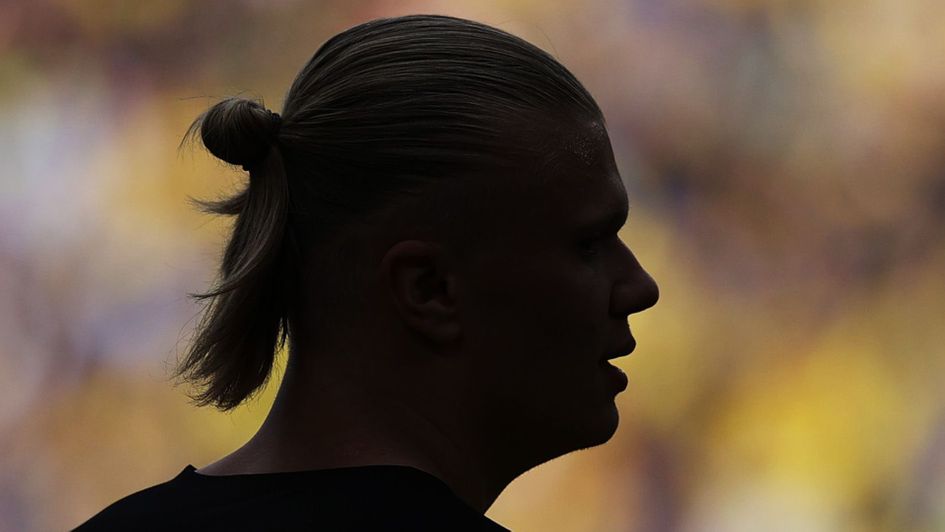
Sometimes the simplest and most obvious analysis is enough.
Erling Haaland is the best young striker in the world and Manchester City, one of the best teams in the world, needed a new striker.
They create lots of chances, he scores lots of goals. Sometimes two plus two equals four.
But in this era of deep-cut tactical analysis and statistical spreadsheets, when soaring points tallies make the margins between success and failure ever thinner, things are rarely so simple – especially with a maverick thinker like Pep Guardiola, whose transfer strategy over the last year should raise eyebrows.
Guardiola's transfer strategy
His last four attempted signings are Jack Grealish, Cristiano Ronaldo, Paul Pogba, and Erling Haaland. That represents a major shift away from system-nerd nifty playmakers towards individualist superstars; from packing the team with tiki-taka caricatures to embracing the celebrity culture that has corrupted many of the world’s super-clubs.
But Guardiola has not been lured onto the rocks. His changing priorities speak to an acknowledgement that his squad has become restrictively choreographed and a little too Guardiola-y.
City lack that disruptive element of chaos, that spark of idiosyncracy required to unlock an ultra-deep defence or to rupture and repair the established patterns of a thorny Champions League knockout tie.
It is in this context we should view the capture of Haaland. To ask whether he fits the Man City style is to miss the point. He has been signed precisely because he doesn’t fit.
Guardiola was widely praised for his striker-less system in 2021/22 but it was always an improvisation he would rather have avoided, hence the summer-long pursuit of Harry Kane.
The City manager knew they would be too midfield-heavy without a fulcrum and so it proved, dropping points across six matches against Tottenham Hotspur, Southampton, and Crystal Palace almost costing him the title.
In all six, City played the game in front of the opponent, making it easy for the defensive shell to remain stubbornly in place as Guardiola’s false nine dropped deep to dance around in the same congested area as the other creative players.
Haaland qualities give City options
In Erling Haaland, City have a hyper-intelligent runner; a penalty-box poacher whose movement will recalibrate how the team attacks.
With runs in behind the defence for when City win the ball back high up the pitch, with dummy runs and darts into space for when City work the ball to the byline for the cut-back, and with an aerial presence for when Kevin De Bruyne has possession on the right flank, Haaland’s qualities will give City the options they have needed.
To put it another way, what Guardiola has lacked isn’t someone to finish off moves.
It’s not like City’s forwards were blazing chances over the bar or playing perfect passes that found nobody at the back post, but rather someone who forces his playmakers to see new options.
The Pep 'myth' on playing style
City will adapt to Haaland as much as the other way around, creating a more vertical and flexible team capable of surprising opponents with greater variation.
It is a myth that Guardiola has one set way of playing. His Barcelona, Bayern Munich, and Man City teams have all shared principles but they were unique to their respective leagues and built around the personnel at the manager’s disposal.
Haaland will change how City play and Guardiola, always open to indulging the unique qualities of his forwards, will encourage this.
That’s the theory, at least, although in practice it might take some time before they gel, plus Haaland will still need to improve his own game to fit the wider tactical theory at the Etihad.
Haaland's numbers
Currently his numbers aren’t good enough, and they cannot solely be attributed to the difference in style between Manchester City and Borussia Dortmund.
According to FBRef, compared to all forwards in the ‘big five’ leagues over the last 365 days Haaland ranks in the 44th percentile for passes completed, the 27th percentile for pressures, the 43rd percentile for touches, and the 3rd percentile for tackles and interceptions.
He is well below average for both his defensive work and his contributions outside the penalty area, two things this high-pressing and possession-dominant City team demand of their forwards.
The good news is that Haaland has steadily improved over his three full seasons as a professional; his passes per 90 (up from 14.7 to 16.0), shot-creating actions per 90 (up from 2.12 to 2.59), assists (up from two to eight), and pressures per 90 (up from 11.9 to 12.8) are all on the rise.
The bad news is that they are rising only slightly, and are still considerably below the averages recorded by Sergio Aguero over his final four years at City.
Haaland is a very smart player, and with Guardiola’s elite coaching, he should improve considerably on these numbers over the next year. While the 21-year-old may never be quite at the usual City standard, this is not necessarily a problem.
If Guardiola wanted another City-style false nine, he would have bought one.
Haaland is a point of difference who will improve the team because he isn’t like the rest of them. And besides, there’s all those goals: 71 in 80 Bundesliga and Champions League matches for Dortmund, 20 in 21 for Norway.
The simplest conclusion is probably the right one.