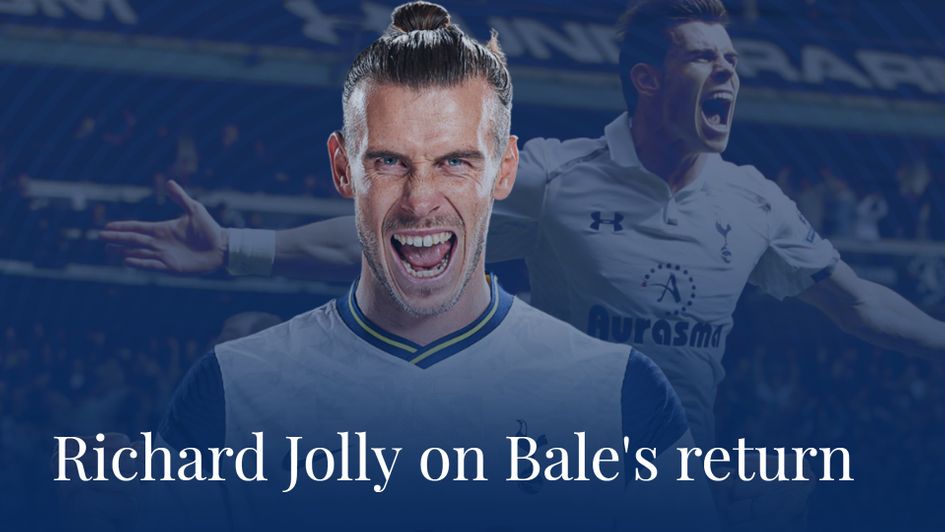
The biggest story of the transfer window so far has seen Gareth Bale return to Tottenham, and Richard Jolly says it's a logical fit for more than one reason..
When Gareth Bale joined Tottenham, he did not finish on the winning side in any of his first 24 Premier League games. Suffice to say Spurs will hope history does not repeat itself in his second spell. In the unlikely event it does, they are more likely to be in the bottom three than the top four.
But other figures offer reasons why Spurs brought him back to London. Their tally of 61 league goals last season was their lowest in five years. They had been trending downwards every season since 2016-17, when they scored 86.
No side managed by Jose Mourinho for even part of a campaign has got 70 since Chelsea were champions with 73 in 2014-15 and while the last two third- and fourth-placed sides recorded totals in the sixties, the average in the last decade for the clubs who finished there was 70.6 and 70.9 respectively.
Mourinho’s football has not always promised enough potency and while Tottenham scored five times at Southampton on Sunday, it highlighted the differences in the regular front three. Harry Kane scored one and assisted four. Heung-Min Son scored four times. Yet Lucas Moura has gone 22 league games without a goal. Replace the Brazilian with Bale, when he is fit again, and it bodes rather better.
Prolific as they are, Kane and Son actually recorded their lowest or joint lowest goals per 90 minutes last season in the last six and four seasons respectively last year, though they were still 0.63 and 0.40 respectively. Perhaps that merely reflected Spurs’ struggles and Son’s tally of 10 assists was nevertheless a personal best while Kane doubled last year’s two in one afternoon at St Mary’s, so there is evidence each can be both finisher and creator.
In Bale, they have a new ally whose goal return has also gone down, but whose peak was remarkable. Bale was at his statistical – and probably actual – best in 2015-16, with 19 goals and 10 assists in 21 league starts and two cameos. It amounted to an xG per 90 of 0.99 and an xA of 0.52; in short, he brought three goals every two games, either for himself or others. His combined goals and assists was 1.51 per 90 minutes; by way of comparison, the best in last season’s Premier League was Sergio Aguero at 1.18. The most in the last decade was Aguero’s 1.35 in 2013-14.
That was an outlier, higher even than his team-mate Cristiano Ronaldo’s 1.30. His numbers last year were an outlier in the other direction. He only scored twice in La Liga. His goals and assists per 90 minutes (both 0.17) were both the lowest in of his six campaigns in Spain’s top flight. So was his shots on target per 90 minutes (1.07). Yet he only had 12 league starts, under a manager who marginalised him so it is a question of whether a small sample size in a stop-start season offers a true reflection of the player Bale is now.
In one sense, Bale is different. His game has evolved. The season the Welshman had most shots was in Tottenham’s colours, an average of 5.0 per game in 2012-13. Perhaps that reflected the reality he was their major threat and was given licence to let fly. That number has decreased year on year from 2015-16, from 3.5 to 2.1.
In particular, Bale may no longer be the emerging talent who surged past Inter Milan to mean Maicon infamously required a taxi a decade ago. Then he was a serial solo runner, but his number of dribbles has dropped. Apart from that 2010-11 Champions League run (3.8), it was at its highest – once again – in 2015-16, at 2.8. Last season, that was down to 1.1. Perhaps it is an indication he does not quite have the physical power he once did.
In his younger days, Bale was at his best on the break. Mourinho has tended to have counter-attacking teams and Spurs scored eight goals on the counter-attack last season. That number may rise. Stylistically, he looks a logical fit for a manager who has never prioritised possession. The concern is that his passing may be less incisive: he averaged fewer key passes per game in the last two seasons than in any of the previous nine.
His three best seasons for assists were 2011-12, 2013-14 and 2015-16. Bale has become less of a creator, but Tottenham can remember his capacity to make something out of nothing. In 2012-13, he got nine goals from outside the penalty box. It remains a Premier League record and last season Spurs only got six long-range goals, one-third of Manchester City’s total and the first time they were in single figures since 2009-10.
He could bring another dimension, but he only scored five long-range goals for Real Madrid from 159 shots. Once again, it comes back to whether Bale is the player Tottenham remember, the one who arguably improved in his first three seasons in Spain or the one who has offered evidence of decline since, the one who played 3217 minutes in the Premier League in 2011-12 or the one who has not managed 2000 in La Liga since 2014-15. Because the numbers game for Bale does not just involve goals and assists but also minutes on the pitch.