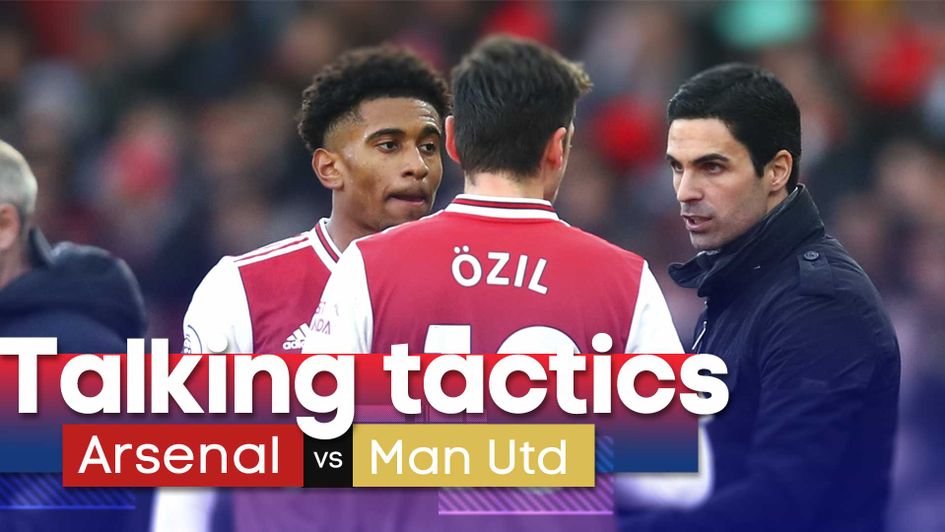
Alex Keble looks at what Mikel Arteta and Ole Gunnar Solskjaer will need to do tactically to win the big Arsenal v Man Utd clash at the Emirates.
It wasn’t until the 87th minute at Stamford Bridge that the mask slipped and we were reminded that, yes, this was still Arsenal. There was so much to love about Mikel Arteta’s second game in charge, so much to be optimistic about as players flew into challenges and zipped the ball around the pitch, but then right at the last things fell apart. That’s the Arsenal we know; panicked, disconnected, and error-prone.
It is testament to the work Arteta had done on the training ground over the previous six days that when Tammy Abraham practically walked through the middle of the pitch on the way to scoring Chelsea’s winner, Matteo Guendouzi threw his hands in the air, furious with the tactical and psychological errors his team-mates were making.
Arteta-ball, so heavily inspired by Pep Guardiola, demands courage, demands everyone step up and boldly compress space high up the pitch. The sight of David Luiz and Shokdran Mustafi frantically back-pedalling, rather than closing the gap to the midfield and thus getting tight to Abraham, betrayed their fragility. That Guendouzi knew it was an egregious error of judgement at least tells us Arsenal are listening to Arteta’s instructions. It’s just that some of these players are not suited to his tactics.
Rome was not built in a day. To play such bold attacking football this Arsenal team do not just need to be taught the intricacies of a new tactical system, they need to learn how to trust each other and themselves. This is an awkward time, then, to be facing a Manchester United side who have lost just one of their last nine matches and have just the tools – pace on the counter and self-belief against the Big Six – to capitalise on Arsenal’s ingrained timidity.
Arteta’s tactical blueprint
Against Chelsea in particular Arsenal’s shape was strikingly similar to Pep Guardiola’s, which is hardly surprising given Arteta’s entire coaching career has been spent under the Catalan’s tutelage. In a 4-2-3-1 shape that will almost certainly be used again for Man Utd, Arsenal looked to dominate possession by compressing bodies into central areas of the pitch – maximising short-passing options for high-tempo football.
Just like Man City when they use a 4-2-3-1, Arsenal had two holding midfielders but one (Guendouzi) was in a box-to-box role to the left of centre, counterbalancing Mesut Ozil drifting into the right half-spaces as Kevin de Bruyne does for City. With a high defensive line pinning Chelsea back, Arsenal then crowded central areas by inverting Ainsley Maitland-Niles into midfield (like Kyle Walker) and tasking Pierre-Emerick Aubameyang with making diagonal inside runs ahead of a deeper Alexandre Lacazette (much in the way Raheem Sterling overlaps Sergio Aguero).
The idea was to constantly shift the ball from one wing to the other, and to create quick one-twos in central attacking midfield, with a high press engaged to keep the energy levels up. More importantly, the positions of each individual were highly choreographed just as they are at City; from a bird's eye view, no two players are supposed to occupy the same space on the x or y axis, creating a multitude of triangles when in possession.
It will take a long time for Arteta’s ideas to become muscle memory and bring consistently creative football. In the meantime, we can expect bursts of cohesion followed by sudden collapses – starting with the Man Utd game on New Year’s Day.
Why Man Utd’s tactics are perfect to hurt Arsenal
The great flaw in Arteta’s approach, of course, is that it requires a high defensive line and constant positional diligence – two things this hesitant and ambling Arsenal team severely lacked under Unai Emery. That’s why this expansive shape should be ideally suited for Ole Gunnar Solskjaer’s counter-attacking football.
It is well documented that United struggle when tasked with breaking down a deep-lying defence but suddenly look fluid when the opposition holds the majority of possession. Solskjaer’s focus on raw speed in attack - plus his lack of tactical coaching - means that will always be the case while he remains in charge. Fortunately for United fans, Arsenal are exactly the kind of team who will be lured forward by United and vulnerable to the sucker punch.
That’s what happened in their 2-1 win at Man City, and with Arsenal now in a similar mould – only several years behind in terms of coaching and experience – there is a serious danger the Emirates will witness another defeat. As Arsenal leave an entire half of the pitch empty (but with centre-backs too scared to stay high) and play in a fanned-out shape (but without the discipline to understand how to counter-press), United’s front line should find space on the break.
The key player for United is Fred, whose ability to wriggle free of an onrushing press has been pivotal in triggering counter-attacks in recent weeks. Should he play well, Arsenal are in serious trouble – not least because their full-backs are so clearly weaker in their head-to-heads.
Bukayo Saka isn’t a left back, as his positional play at Chelsea proved, and yet Arteta has no choice but to put him up against Daniel James. Saka will probably get caught too high up the pitch on numerous occasions. On the other side, Maitland-Niles’ new inverted role will vacate the flank for Marcus Rashford to do damage with Anthony Martial as the striker drifts out to the left.
Arsenal will need to control midfield
Arteta will only prevent United from countering if his team truly control midfield. Lucas Torreira’s brilliant performance against Chelsea highlights the potential in his partnership with Guendouzi, and should Ozil again work hard this trio can put the squeeze on a United midfield missing Scott McTominay. Nemanja Matic is often too flat-footed these days, and that may allow Arsenal to swarm and dominate throughout.
But more likely, gaps will appear as legs tire, and with in-form Mason Greenwood to come off the bench – not to mention Paul Pogba – the final 20 minutes of the match could prove to be decisive. If another couple of days on the training field has given Arteta the chance to cement some of the core practices of his Guardiola-style football then Man Utd might be in trouble.
And yet it is hard to imagine this Arsenal team, so early in its revolution, keeping Rashford, Martial, and James quiet for a whole 90 minutes.